Ibrahim Al-bakri Nyei
I have chosen to delve into issues of technology and the relationship between governance and socioeconomic growth in this edition of the series because this has been my preoccupation over the last one week here in Dar es Salaam, Tanzania. From June 28 – July 1, world leaders, young scientist, and development experts from mostly Africa and Asia have been discussing the possibilities of leveraging technology to enhance socioeconomic growth in Africa. This is very important because the pace of development today in many aspects of life is determined by the progress made towards improvements on technological innovations. It could be the mobile phone, the iPod, a medication, a transport facility or any kind of innovation that addresses some of humanity’s challenges.
Industrialized nations are making gains from technology particularly in issues of health and education, and are at the same time improving other aspects of life - making communication and transportation easier, and even breaking trade barriers between countries. These nations are mostly succeeding because of huge investments in research and development, institution building and support to capacity building programs particularly in education, and incentives for innovations. Africa can learn many more things from the industrialized world. Asian countries are making some gains in that direction, albeit modest. Nevertheless, the reality is that most Asian nations can now support their local economies and enhance better livelihood for their peoples due to recent investments in technology and its utilization in agriculture, mining and trade. This is in particular reference to countries like South Korea, China, Singapore, Malaysia, and Indonesia.
African nations, too, can follow in the rank of some these countries in stimulating socio-economic growth for their people. The application of modern technology that increases Africa’s mining and agricultural output is key to this strategy. Mining and agriculture have been central in Africa’s export, and mostly ‘rentier’ economies. The absence of effective or modern technology or the underutilization of local technology has made it difficult for the African peoples to make substantial gains from agriculture and mining. Local people do agriculture and mining mostly in low-scales; even though they have access to huge tracks of rich land. Like most African farmers do subsistence farming, miners also do not go beyond artisan equipments that involve intensive labor and time, and in most cases with very little financial returns. It is this limitation of African landowners that developing Asian nations and their Western competitors are exploiting through the infusion of huge foreign direct investments in mostly poor African countries with lax regulations and weak state institutions. One of such is postwar Liberia, were over 16 billion FDI agreements have been signed over the last five years in mostly the mining and agricultural sectors. This has thrown local miners out of business and reduced the sources of livelihood for most subsistence farmers. If local technologies were developed or if there were sufficient or even modest levels of capitals that support commercial activities, families and communities would not have lost their livelihoods to multinational companies. As local farmers have made substantial efforts over the years with the technologies available to feed themselves, they could have done more cultivations and harvests to feed other communities and improve their living standards.
The absence of technology is also affecting productivity in many other sectors including health and education. In today’s world education have been digitized and students learn even faster with new technological applications introduced through the computer and related machines. Millions of African students are yet to understand the application of computer and its significance to their career developments. This is a critical challenge, particularly for this generation of Africans, born during this growing age of computer technology. If African leaders do not make significant moves towards ensuring that the young generation of Africans get better education and access to affordable technology, it is highly unlikely that they will meet the challenges of today’s and tomorrow’s market. As markets are more electronic, and money now also electronic, consumers in Africa (mostly in the rural areas) will find it difficult and even expensive to participate, if a process of solid education that facilitates Africa’s integration into the emerging techno-market is not given national implementation priorities. This will also continue to make Africa inefficient in reaping shared benefits from international cooperation and trade.
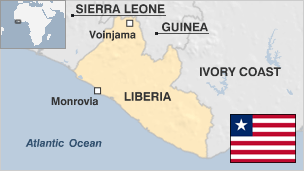
Africa’s move towards socio-economic growth and sustained poverty reduction will require several steps, and in this piece, I advance the following as key to developing technology for socio-economic growth. First, we need institutions of governance responsive and efficient in regulating standards, enforcing contracts and advancing social services. Then we need institutions of training and research that emphasize on science and technology for training young Africans, investigating issues and arriving at innovative solutions. Second, African nations need to invest in energy generation – electricity. A sustainable power-base for electricity is a major stimulant for local economic growth and technological advancement. Local businesses and multinational companies are likely to grow and create more jobs once there is adequate source of power. On the reverse, a limited or no source of electricity cripples or even kills businesses, particularly small businesses that cannot stand the cost of managing private sources of electricity. Third is the need for improvement in transportation networks within national borders and across regions of Africa. Improved transportation networks, particularly ones that provide for easy and fast movement of people and goods is an indispensable requirement for accelerating trade and growth. Good transport network has improved trade and free movements across Western Europe and North America. Regions in Africa need to cooperate on intra-regional transport infrastructure projects as a means of increasing on trade outputs. For example, if the countries in the Mano River Basin area– Liberia, Sierra Leone, Guinea and Ivory coast - can connect their national capitals and major commercial hubs through railways and roads, intra-regional trade will improve faster as local businesses will have access to alternative markets.
I conclude by saying that Africa’s greatest challenge in building strong economies and accelerating socio-economic development is the absence of technology and the knowledge base for its applications. I recognize that African nations do not have adequate capacities currently, but I also appreciate that the potentials are huge in tackling this challenge. National vision strategies must therefore consider the development of technology as an imperative in attaining poverty reduction goals. The need also to expand the utilization and improvements of local technologies and innovations cannot be overemphasized if we are to realize our national visions.
In the Cause of Democracy and Social Justice the Pen Shall Never Run Dry
Friday, July 5, 2013


Wednesday, June 26, 2013
Liberia and the International Military Intervention in Mali
Ibrahim Al-bakri Nyei
Since the destabilization of Northern Mali by Tuaregs and so-called Islamic movements in early 2012, there have been serious concerns over the stability of the entire West African region. Mali’s position in West Africa is geopolitically strategic as it plays a key role in Francophone West Africa and connects with North Africa. This means a full destabilization of Mali has the proclivity to destabilize a significant portion of Africa. This has particularly come at a time when there are troubles in Libya, Niger and Nigeria. The intensification of the perennial Tuaregs insurgency in Mali cannot be discussed without reference to the Arab Spring, and its further expansion could weigh heavily on poor West African countries, particularly those in the Mano River basin area that currently serves as a haven for mercenaries.
This is why it has become an imperative to join forces around West Africa to contain the advances of the dissidents and restore full civilian authorities. This intervention should mostly claim the attention of stable countries in the sub-region. International efforts at stabilizing Mali has been double-edged with the UN and ECOWAS striking from one end with a multidimensional peace mission under the African-led International Support Mission in Mali (AFISMA), which includes military operations and several other aspects of postwar peacebuilding. On the other hand is Mali’s colonial master, France, who seized the moment with a military intervention that overran the rebels in just few weeks. France’s military intervention in January 2013 made headways in inflicting heavy casualties on the terrorist movements thereby paving ways for sustained international efforts at combating the dissidents and enforcing peace.
Can an African-led military mission make such gains in just few months? This has not been possible in Somalia and even Darfur, where there is a full UN Mission. Africa’s failure to make military gains during peace operations can possibly be linked to the lack of capacity both in trained military and in resources for such operations. In addition, the inability of regional organizations and even countries bordering war-affected states to contain mercenary activities corrosively undermines their collective peace missions. This has been experienced in the Mano River basin area for years. Therefore, increased coordination in political and military strategies by the countries can possibly lead to success in Mali. In addition, joint efforts by African nations to support each other during times of instability strengthen the confidence of the African peoples in the African Union and in regional organizations. This also heightens sense of internal security and builds confidence in the local population in states contributing to peace missions.
Liberia, a war-torn country still under UN peace operations has joined the ranks of other stable countries to send a platoon of its newly reformed army to form part of AFISMA. In the case of Liberia, it is obvious that the country is making all efforts to portray an image of post-conflict success and internal stability to the outside world, but the issue of confidence in internal security is still illusive considering the fact that Liberia’s security is still in the hands of the United Nations Mission in Liberia and its security institutions rely heavily on foreign aid. It is against this background that opponents of the deployment have described Liberia’s military involvement in Mali as premature. The most common argument against the involvement of Liberia is the proposition that the country is still struggling with internal security challenges and threats from porous borders. Proponents of this arguments believe that it makes no sense for such a nation to get involved with a foreign military operation.
On the other side, is the moral imperative argument that Liberia ‘must pay back’ the gains of the fragile peace it has now, because it was built on the blood and sweat of other peacekeepers. This has been the most popular argument even from top government officials. This argument has significant limitations in justifying such a costly military intervention. In issues of intervention, particularly in the case of containing terrorists, several key issues ought to be considered before moving in, and these issues are beyond the politics of international image building. One key issues to consider is the issue of capacity to sustain the mission, particularly when foreign aid has taken a downward trend in the last few years. Military operations need homegrown support to be sustained overtime. Second is the issue of internal assurance against retaliatory attacks, which are common in nations that are involved in counterterrorism warfare. Terrorists are stateless and anarchists fighting countless number of ‘enemies’ everywhere. Those involved in warfare against terrorists must have internal mechanisms that ensure adequate security particularly at border posts. The case of the July 2010 attack in Uganda by Al-Shabbab militants from Somalia is one such retaliatory attacks during which about 70 Ugandans sadly loss their lives. Al-Shabbab claimed then that the attack was a continuation of the fight against Uganda whose army is part of the AU mission in Somalia (AMESOM). The terrorist fighting in Mali are no different from Al-Shabbab. While there are greater hopes for the better, Liberia must not take its internal security and border issues lightly at this time.
Considering the current state of security affairs in Liberia, it is obvious that the country is not prepared at all for such a herculean task, which is largely concerned with image-building and ‘paying back’ rather than substantive considerations of the potential ramifications. In the April 2012 report of the UN Secretary General on the state of affairs in Liberia to the Security Council, the report described the current peace in Liberia as fragile and ‘vulnerable to disruption’. The report further stated that security agencies in Liberia (including the Armed Forces of Liberia) are incapable of containing instability without the support of UNMIL. The report further stated that the army is indiscipline, ‘does not have appropriate training or equipment’ even for border operations, and that attrition in the army stands at an alarming 10%. Many other analytical reports and newspaper articles have confirmed high attrition rate and lack of logistics for a functional army. The critical question now is how can such an army take up a major combat role in an international engagement? A short-term training for few in the same army just for a peace mission is more of a tinkering approach than an engagement of the larger process of post war army (re)formation and strengthening.
International affairs and security pundits had thought that stable countries in West Africa and elsewhere in Africa with considerable military might would have handled the military component of such a mission to contain the terrorists in Mali, while others like Liberia would make modest contributions in other dimensions of the mission. The current strength and capacity of the Liberian army, as discussed above is inadequate for such a mission. Besides, this army is still in training and expected to be operational only in 2014. This unpreparedness is technically and logically justified by the inclusion of the deployed AFL platoon into a Nigerian battalion.
Finally, this edition of the series fully supports the popular international intervention to return peace to Mali, and applauds the move towards greater solidarity and cooperation in African international and security affairs. At this time, Liberian authorities need to devise more strategies to ensure involvement in the non-military aspects of the intervention, which will be the peacekeeping stage. This could involve the deployment of civilian police as well as observers. Individual Liberian experts must also take the courage of seeking non-military or security related jobs in the AFISMA mission, for example, civic affairs and social services. All of these could add up to a modest and affordable contribution by both the state and its citizens.
In the Cause of Democracy and Social Justice the Pen Shall Never Run Dry
Since the destabilization of Northern Mali by Tuaregs and so-called Islamic movements in early 2012, there have been serious concerns over the stability of the entire West African region. Mali’s position in West Africa is geopolitically strategic as it plays a key role in Francophone West Africa and connects with North Africa. This means a full destabilization of Mali has the proclivity to destabilize a significant portion of Africa. This has particularly come at a time when there are troubles in Libya, Niger and Nigeria. The intensification of the perennial Tuaregs insurgency in Mali cannot be discussed without reference to the Arab Spring, and its further expansion could weigh heavily on poor West African countries, particularly those in the Mano River basin area that currently serves as a haven for mercenaries.
This is why it has become an imperative to join forces around West Africa to contain the advances of the dissidents and restore full civilian authorities. This intervention should mostly claim the attention of stable countries in the sub-region. International efforts at stabilizing Mali has been double-edged with the UN and ECOWAS striking from one end with a multidimensional peace mission under the African-led International Support Mission in Mali (AFISMA), which includes military operations and several other aspects of postwar peacebuilding. On the other hand is Mali’s colonial master, France, who seized the moment with a military intervention that overran the rebels in just few weeks. France’s military intervention in January 2013 made headways in inflicting heavy casualties on the terrorist movements thereby paving ways for sustained international efforts at combating the dissidents and enforcing peace.
Can an African-led military mission make such gains in just few months? This has not been possible in Somalia and even Darfur, where there is a full UN Mission. Africa’s failure to make military gains during peace operations can possibly be linked to the lack of capacity both in trained military and in resources for such operations. In addition, the inability of regional organizations and even countries bordering war-affected states to contain mercenary activities corrosively undermines their collective peace missions. This has been experienced in the Mano River basin area for years. Therefore, increased coordination in political and military strategies by the countries can possibly lead to success in Mali. In addition, joint efforts by African nations to support each other during times of instability strengthen the confidence of the African peoples in the African Union and in regional organizations. This also heightens sense of internal security and builds confidence in the local population in states contributing to peace missions.
Liberia, a war-torn country still under UN peace operations has joined the ranks of other stable countries to send a platoon of its newly reformed army to form part of AFISMA. In the case of Liberia, it is obvious that the country is making all efforts to portray an image of post-conflict success and internal stability to the outside world, but the issue of confidence in internal security is still illusive considering the fact that Liberia’s security is still in the hands of the United Nations Mission in Liberia and its security institutions rely heavily on foreign aid. It is against this background that opponents of the deployment have described Liberia’s military involvement in Mali as premature. The most common argument against the involvement of Liberia is the proposition that the country is still struggling with internal security challenges and threats from porous borders. Proponents of this arguments believe that it makes no sense for such a nation to get involved with a foreign military operation.
On the other side, is the moral imperative argument that Liberia ‘must pay back’ the gains of the fragile peace it has now, because it was built on the blood and sweat of other peacekeepers. This has been the most popular argument even from top government officials. This argument has significant limitations in justifying such a costly military intervention. In issues of intervention, particularly in the case of containing terrorists, several key issues ought to be considered before moving in, and these issues are beyond the politics of international image building. One key issues to consider is the issue of capacity to sustain the mission, particularly when foreign aid has taken a downward trend in the last few years. Military operations need homegrown support to be sustained overtime. Second is the issue of internal assurance against retaliatory attacks, which are common in nations that are involved in counterterrorism warfare. Terrorists are stateless and anarchists fighting countless number of ‘enemies’ everywhere. Those involved in warfare against terrorists must have internal mechanisms that ensure adequate security particularly at border posts. The case of the July 2010 attack in Uganda by Al-Shabbab militants from Somalia is one such retaliatory attacks during which about 70 Ugandans sadly loss their lives. Al-Shabbab claimed then that the attack was a continuation of the fight against Uganda whose army is part of the AU mission in Somalia (AMESOM). The terrorist fighting in Mali are no different from Al-Shabbab. While there are greater hopes for the better, Liberia must not take its internal security and border issues lightly at this time.
Considering the current state of security affairs in Liberia, it is obvious that the country is not prepared at all for such a herculean task, which is largely concerned with image-building and ‘paying back’ rather than substantive considerations of the potential ramifications. In the April 2012 report of the UN Secretary General on the state of affairs in Liberia to the Security Council, the report described the current peace in Liberia as fragile and ‘vulnerable to disruption’. The report further stated that security agencies in Liberia (including the Armed Forces of Liberia) are incapable of containing instability without the support of UNMIL. The report further stated that the army is indiscipline, ‘does not have appropriate training or equipment’ even for border operations, and that attrition in the army stands at an alarming 10%. Many other analytical reports and newspaper articles have confirmed high attrition rate and lack of logistics for a functional army. The critical question now is how can such an army take up a major combat role in an international engagement? A short-term training for few in the same army just for a peace mission is more of a tinkering approach than an engagement of the larger process of post war army (re)formation and strengthening.
International affairs and security pundits had thought that stable countries in West Africa and elsewhere in Africa with considerable military might would have handled the military component of such a mission to contain the terrorists in Mali, while others like Liberia would make modest contributions in other dimensions of the mission. The current strength and capacity of the Liberian army, as discussed above is inadequate for such a mission. Besides, this army is still in training and expected to be operational only in 2014. This unpreparedness is technically and logically justified by the inclusion of the deployed AFL platoon into a Nigerian battalion.
Finally, this edition of the series fully supports the popular international intervention to return peace to Mali, and applauds the move towards greater solidarity and cooperation in African international and security affairs. At this time, Liberian authorities need to devise more strategies to ensure involvement in the non-military aspects of the intervention, which will be the peacekeeping stage. This could involve the deployment of civilian police as well as observers. Individual Liberian experts must also take the courage of seeking non-military or security related jobs in the AFISMA mission, for example, civic affairs and social services. All of these could add up to a modest and affordable contribution by both the state and its citizens.
In the Cause of Democracy and Social Justice the Pen Shall Never Run Dry
Wednesday, June 19, 2013
Is Liberia’s education system in a mess? Then clean it up!
Ibrahim Al-bakri Nyei
Liberia’s education system has come under the spotlight as substandard and poorly equipped as compared to education systems elsewhere in Africa. This underrating has been confirmed by the performance of Liberian students in international exams, particularly the local West African Examination Council exams over the last few years. Interestingly, key government officials have joined the chorus condemning the same education system that they have been given power and authority to fix. This is an irony. In 2011, the Planning & Economic Affairs Minister cried out that most of the university students and even graduates are undertrained to the extent that they are incapable of writing a standard letter of application. This pronouncement was made at a national conference on the education sector. Just this year, the President of Liberia has complained twice that the education system is in a ‘mess’. What the Liberian people hope to see is not the weeping and condemnation from the officials, but actions on their part as employees or representatives of the people to fix the system and make it affordable, accessible and of quality to the population.
The cries are enough, and actions are required to provide better education to the children of Liberia. The actions required in the opinion of this patriot is not the change of individuals from the Ministry of Education as many Liberians would suggest, but rather a remaking of the system and the capacitating of institutions to make the system work. The solutions therefore are above dismissals and appointments that tend largely to massage problems in the public sector rather than sustainably addressing them.
The key issue undermining standards in Liberia is the absence of efficient regulatory systems; and where they exist, then it’s the lack of compliance and enforcement mechanisms. If there should be any sector with rigid enforcement of rules and standards in every given society, it should be the education sector with its attendant status of nobility. No nation should compromise enforcing standards on basic services that are critical to the livelihoods of the people and the survival of the state itself. Education and health care are key priorities to sustain the development and growth of a nation. A poor education system eventually produces poor quality in every other sector – public service, private sector and even the religious sector that supposedly provides the moral compass. If in Liberia, the system suffers such a laxity, ultimately the outcomes and products will be of no greater quality than the process that produces it – substandard, inefficient, and sloppy.
At present one can easily understand that the Ministry of Education is overburdened and have no capacity for the huge tasks at its feet. The incapacity of the Ministry, coupled with corruption at all levels in the school systems, and the lack of support to enhance quality, collectively form the mess in the system. With just few qualified teachers in the classrooms and a huge number of unqualified with very little experience and credentials, and limited wages, the outcome will be low output from the end of the teachers. Also with limited resources including tuition financing, textbooks and laboratory equipments students will obviously not perform as expected. This is therefore a compound problem that needs to be solved with the government, school authorities and teachers and parents in a single network to clean the mess. Yet, it is the responsibility of the government to take the lead by providing decisive policy directions that decentralizes the governance of the education sector.
A robust reform is thus required in the education sector. This needs to be radical, and will involve first, devolving implementation authorities to the counties and leaving the Ministry of Education with only policy and regulatory functions. At the last education conference in 2011, a policy on decentralization in the education sector was promulgated, and this policy provided for the creation of an education board in each county. It is high time that the policy is implemented and the boards are established and institutionalized to function as relevant and credible local authorities on education sector governance. This is needed to reduce the loads on the Ministry since it has proven to have limited or no capacity to enforce standards and compliance at the local levels. Giving the education boards full support in logistics and other needed resources will facilitate the process of cleaning the mess in each county given the proximity of the authority (the board) in said county. Decentralizing local decision-making, implementation authorities and resources will enable local education boards to implement national education policies and to have sufficient controls over such things as teachers’ licensing, schools supervision and monitoring, school feeding and subsidies to schools.
The current system cannot provide for effective governance of the education sector and equally cannot provide for better education to the children of Liberia. With a core of political appointees seated at the Ministry and agents in the counties as education officers reporting to Monrovia, it is difficult to have hands-on solution to the problems creating the mess. Thus, the difficulty in cleaning the on-going mess is that the decision makers are far from the mess itself, so it hard for them to really smell the stench. Yes, they do hear and know that it exists. What to do next is to stop weeping that there is mess, and move on to clean the mess.
In the Cause of Democracy and Social Justice the Pen Shall Never Run Dry
Liberia’s education system has come under the spotlight as substandard and poorly equipped as compared to education systems elsewhere in Africa. This underrating has been confirmed by the performance of Liberian students in international exams, particularly the local West African Examination Council exams over the last few years. Interestingly, key government officials have joined the chorus condemning the same education system that they have been given power and authority to fix. This is an irony. In 2011, the Planning & Economic Affairs Minister cried out that most of the university students and even graduates are undertrained to the extent that they are incapable of writing a standard letter of application. This pronouncement was made at a national conference on the education sector. Just this year, the President of Liberia has complained twice that the education system is in a ‘mess’. What the Liberian people hope to see is not the weeping and condemnation from the officials, but actions on their part as employees or representatives of the people to fix the system and make it affordable, accessible and of quality to the population.
The cries are enough, and actions are required to provide better education to the children of Liberia. The actions required in the opinion of this patriot is not the change of individuals from the Ministry of Education as many Liberians would suggest, but rather a remaking of the system and the capacitating of institutions to make the system work. The solutions therefore are above dismissals and appointments that tend largely to massage problems in the public sector rather than sustainably addressing them.
The key issue undermining standards in Liberia is the absence of efficient regulatory systems; and where they exist, then it’s the lack of compliance and enforcement mechanisms. If there should be any sector with rigid enforcement of rules and standards in every given society, it should be the education sector with its attendant status of nobility. No nation should compromise enforcing standards on basic services that are critical to the livelihoods of the people and the survival of the state itself. Education and health care are key priorities to sustain the development and growth of a nation. A poor education system eventually produces poor quality in every other sector – public service, private sector and even the religious sector that supposedly provides the moral compass. If in Liberia, the system suffers such a laxity, ultimately the outcomes and products will be of no greater quality than the process that produces it – substandard, inefficient, and sloppy.
At present one can easily understand that the Ministry of Education is overburdened and have no capacity for the huge tasks at its feet. The incapacity of the Ministry, coupled with corruption at all levels in the school systems, and the lack of support to enhance quality, collectively form the mess in the system. With just few qualified teachers in the classrooms and a huge number of unqualified with very little experience and credentials, and limited wages, the outcome will be low output from the end of the teachers. Also with limited resources including tuition financing, textbooks and laboratory equipments students will obviously not perform as expected. This is therefore a compound problem that needs to be solved with the government, school authorities and teachers and parents in a single network to clean the mess. Yet, it is the responsibility of the government to take the lead by providing decisive policy directions that decentralizes the governance of the education sector.
A robust reform is thus required in the education sector. This needs to be radical, and will involve first, devolving implementation authorities to the counties and leaving the Ministry of Education with only policy and regulatory functions. At the last education conference in 2011, a policy on decentralization in the education sector was promulgated, and this policy provided for the creation of an education board in each county. It is high time that the policy is implemented and the boards are established and institutionalized to function as relevant and credible local authorities on education sector governance. This is needed to reduce the loads on the Ministry since it has proven to have limited or no capacity to enforce standards and compliance at the local levels. Giving the education boards full support in logistics and other needed resources will facilitate the process of cleaning the mess in each county given the proximity of the authority (the board) in said county. Decentralizing local decision-making, implementation authorities and resources will enable local education boards to implement national education policies and to have sufficient controls over such things as teachers’ licensing, schools supervision and monitoring, school feeding and subsidies to schools.
The current system cannot provide for effective governance of the education sector and equally cannot provide for better education to the children of Liberia. With a core of political appointees seated at the Ministry and agents in the counties as education officers reporting to Monrovia, it is difficult to have hands-on solution to the problems creating the mess. Thus, the difficulty in cleaning the on-going mess is that the decision makers are far from the mess itself, so it hard for them to really smell the stench. Yes, they do hear and know that it exists. What to do next is to stop weeping that there is mess, and move on to clean the mess.
In the Cause of Democracy and Social Justice the Pen Shall Never Run Dry
Monday, February 25, 2013
A Review of Nvasekie Konneh’s “The Land of My Father’s Birth”
Ibrahim Al-bakri Nyei
Nvasekie Konneh’s The Land of My Father’s Birth is a narrative of the tragedies and agonies of the Liberian civil war. The book narrates particularly the ordeals of the Mandingo ethnic group during the civil war and the attempts by the Mandingoes to resist what was becoming a genocide in the early 1990s. In his book, Nvasekie Konneh brought to us a true story of his own experiences during the war. This story, while centered on the encounters of a young man growing up in Liberia, reveals the ordeal of a nation infested with tribal hatred and its resulting tragedies; a nation confused with historical occurrences that had left it in a desolate situation with a people not knowing themselves, their origin and traditions. Thus, they fight amongst themselves for land, citizenship, class and status.
While thematically the book delves into politics, religion, ethnicity, and multicultural issues, I particularly capture the following as themes worth noting and revealing. First, it is the theme of ethnicity, race and citizenship. The book discusses how one ethnicity and race has lots to do with the perceptions of others on his citizenship. While the Mandingoes live in the territories of today Liberia, Guinea and Sierra Leone long before the arrival of the Americo-Liberian settlers in the 1800s, according to Nvasekie’s recollection of history, the Mandingoes still suffer tribal prejudices in Liberia, and this has come to affect them in economic and political activities in Liberia. They have potentials to advance in trade and commerce, but they are being weakened by encroachments on their properties, particularly in places like Nimba County where rival tribes benefitting from the spoils of the civil war have claimed ownership over strategic properties of economic values historically owned by Mandingo people. Based on the question of their ethnic identity, Mandingoes are being targeted by state security officers, mostly Immigration officers, and this action by state agents have portrayed Mandingoes as foreigners (Guineans) in the eyes of other tribes including rival ethnic groups, thus denying them the right to advance themselves politically, for example denials to vote during national elections. Like the Mandingoes’ quest for equal rights as citizens of Liberia, Nvasekie touched on the Black question in America, particularly during the times of slavery and segregation when blacks where denied most privileges in the US and treated as underclass citizens. Today black Americans are proud of their advances in all spheres of American life, from the academics to the economy and politics, all of which have been starred by the emergence of Barack Obama as the first black president of America.
The second theme that runs through Nvasekie’s book is that of perseverance and persistency of a young man determined to realize his life dreams. Nvasekie was born in Nimba County, Northern Liberia, a county divided among several ethnic groups with his ethnic group suffering prejudices that put his Liberian citizenship into questions by neighbors and rivals alike. He was born to a Mandingo father, who himself was a son of a Mandingo man and a Mano Woman. He did not cause it. He was born a Liberian by law, and a Mandingo by natural imposition. He was made to flee the land of his and his father’s birth when civil war broke out during which his ethnic group was targeted for discriminate killings. During the civil war, as a young man with no employable skills, he fled and lived as a refugee in Guineas and Ivory Coast, returned home and then travelled to the United States of America after winning the American Diversity Visa Lottery. In America, Nvasekie explained how he restarted life taking menial jobs against his wish just to make a living. Out of desperation to make a living and remit some income to his family back in Liberia, he would fall for anything legitimate that pays. Destiny put him in military service, something he never thought he would have ever done. He became a member of the US Navy and served for almost a decade traveling to over 15 countries on sea, and then left the navy to become a civilian again to pursue his life dream of becoming a writer and poet. The Land of My Father’s Birth has come as a product of a dream well nursed in a man for years, and has been manifested through courage, hard work, and determination in the midst of harsh situations – identity crisis, civil war, poverty, involuntary emigration.
While in the US Navy, Nvasekie applied for American citizenship, a status that would enable him access to so many privileges. His American citizenship was conferred at a ceremony graced and celebrated by Americans. The irony in getting his American citizenship was that while the Americans, both black and white, celebrated him as a citizen of their country, his fellow black Africans, all born in the same land (Liberia) continuously denounce him, chase him out, and grudgingly accept him today. On this irony, Nvasekie wrote:
“…as Mandingo, I am constantly reminded by my fellow Liberians that I am a foreigner, even though my father and mother were born there before I was even born. In America, it took a mere procedure for me to be a citizen and I am entitled to all the rights of American citizens, but in my native country, my birth record is not even enough for me to be considered a full fledge citizen. I have to constantly fight to prove my citizenship”(Pp. 206 – 207).
A third theme one can learn from Nvasekie’s memoir is the challenges of governance and development in Africa, and the consequences of the lack of effective leadership on the continent. One can tell from the story how colonialism separated African peoples of the same ethnicity and divided them among separate states, a division only shown by artificial boundaries. For example, the Mandingo nation that existed under kings in the Mano River Basin area is now divided amongst the states of Guinea, Liberia, Sierra Leone and Ivory Coast. So are the Manos, Krahns and Gios divided among Liberia, Guinea and Ivory Coast in different ways. Even in the aftermath of these colonial oddities, African leaders have not been able to provide good governance and better development to ameliorate the sufferings of their people, unite them and make them proud of Africa. As a result of poor governance in Africa, poverty and civil wars have been recurrent in most countries, particularly south of the Sahara. Nvasekie wrote that it is because of poor leadership and the lack of better incentives for the advancement of life, that the individual African citizen is challenging all odds and even taking risks to escape wars, poverty and political upheavals in Africa. In addressing the mass exodus of Africans, he recommends democracy and good governance as the best options that can provide the environments needed for the African citizen to achieve his life dreams:
“Some come to seek fortune, something they have found very difficult, if not totally illusive, to achieve. So until we have good governments that will create the environment for people to pursue their dream of success in Africa, these waves of Africans wanting to seek greener pastures abroad will continue to increase. So with all the talk of relieving Africa’s debts by the West, the other things that need to be done is to advocate for democracy, good governance, and eradication of corruption. That will require leadership that is guided morally”. (Pp. 182)
Finally, the fourth theme of the memoir is the acceptance and celebration of tribal and religious diversities. As a product of multicultural heritage, the author calls for the embrace of our cultural diversity instead of making it a source of conflicts as we have seen in recent years. As someone with family ties both Mandingo and Mano ethnic groups, and he is a Muslim, the story of his father’s birth to a Mandingo father and Mano mother speaks a lot about inter-marriages between the Mandingoes and Manos and the Gios in Nimba County. So many other children of Mandingo, Mano or Gio descents are products of such arrangements. One would think that a society of such interconnectivity among its different peoples would be peaceful and progressives building on the mutual relationships they form. In Nimba, the case has been different, and it turned brutish in the 1990s. It will take all Nimbains, particularly children of intermarriages, like Nvasekie, to bring their own peoples together. On a trip to his birthplace, Nvasekie wrote that his origin as a product of two rival ethnic groups could be used as a rallying point to resolve some of the conflicts that have undermined Mandingoes, Mano and Gio unity in Nimba County.
“Given my multi-ethnic heritage, I had in mind that my visit to Nimba County, particularly in Saclepea and Tengbenye, and my interaction with the Mano side of my family could in one way or the other help bring about a greater understanding among our people leading to the resolution of the land problem”. (Pp. 220)
Nvasiekie was right to believe that way. His grandmother’s people did not disappoint him. They received him warmly and they were proud of him. The lesson here is that people need to build on ethnic and religious diversities as building blocks for peace and development rather than as precipices of conflicts. In another instance of his numerous life encounters, Nvasekie explained how Americans are making use of, or ignoring religious and other cleavages and uniting around their common nationality to progress. The story of using a single chapel for all religious services – Islamic, Christian or Jewish – on a US Naval ship as told in this book is revealing of this lesson.
In Nvasekie’s memoir, there are many lessons to be learned from the themes identified above. First, as a young person with a life dream, you will learn that no matter what the situation in life is, and no matter the career path destiny places you on, you can achieve what you are passionate about. Escaping the terror of the civil war and the hatred against his ethnic group, and joining the US Navy did not stop Nvasekie from becoming a writer. Second, as a nation we can learn from the narration in this book that ethnic, religious and racial prejudices and hatred destroy a whole country, and until people can accept each other for the sake of their common humanity, societies will continue to be in violent crisis based on inevitable differences like ethnicity and race. Finally, leaders of a nation-state will have to follow good governance practices and moral standards to avoid upheavals and curb poverty among their people.
Readers of The Land of My Father’s Birth must put themselves in the circumstance that motivated the writing of this book, and in addition to understanding the literature and the tragedies narrated, readers must work to avert such situations in life - war, poverty, political crisis, and bad governance. With the lessons from this memoir we can be messengers of peace and development, and we must also be challenged to tell the truth of our own experiences in the world as Nvasekie has taken the time, courage and pain to do so. One can simply describe the book as a memoir of a single person, but tells the story of tribes haunted by legacies of colonialism and entrenched prejudice built from envy and ignorance.
Nvasekie Konneh’s The Land of My Father’s Birth is a narrative of the tragedies and agonies of the Liberian civil war. The book narrates particularly the ordeals of the Mandingo ethnic group during the civil war and the attempts by the Mandingoes to resist what was becoming a genocide in the early 1990s. In his book, Nvasekie Konneh brought to us a true story of his own experiences during the war. This story, while centered on the encounters of a young man growing up in Liberia, reveals the ordeal of a nation infested with tribal hatred and its resulting tragedies; a nation confused with historical occurrences that had left it in a desolate situation with a people not knowing themselves, their origin and traditions. Thus, they fight amongst themselves for land, citizenship, class and status.
While thematically the book delves into politics, religion, ethnicity, and multicultural issues, I particularly capture the following as themes worth noting and revealing. First, it is the theme of ethnicity, race and citizenship. The book discusses how one ethnicity and race has lots to do with the perceptions of others on his citizenship. While the Mandingoes live in the territories of today Liberia, Guinea and Sierra Leone long before the arrival of the Americo-Liberian settlers in the 1800s, according to Nvasekie’s recollection of history, the Mandingoes still suffer tribal prejudices in Liberia, and this has come to affect them in economic and political activities in Liberia. They have potentials to advance in trade and commerce, but they are being weakened by encroachments on their properties, particularly in places like Nimba County where rival tribes benefitting from the spoils of the civil war have claimed ownership over strategic properties of economic values historically owned by Mandingo people. Based on the question of their ethnic identity, Mandingoes are being targeted by state security officers, mostly Immigration officers, and this action by state agents have portrayed Mandingoes as foreigners (Guineans) in the eyes of other tribes including rival ethnic groups, thus denying them the right to advance themselves politically, for example denials to vote during national elections. Like the Mandingoes’ quest for equal rights as citizens of Liberia, Nvasekie touched on the Black question in America, particularly during the times of slavery and segregation when blacks where denied most privileges in the US and treated as underclass citizens. Today black Americans are proud of their advances in all spheres of American life, from the academics to the economy and politics, all of which have been starred by the emergence of Barack Obama as the first black president of America.
The second theme that runs through Nvasekie’s book is that of perseverance and persistency of a young man determined to realize his life dreams. Nvasekie was born in Nimba County, Northern Liberia, a county divided among several ethnic groups with his ethnic group suffering prejudices that put his Liberian citizenship into questions by neighbors and rivals alike. He was born to a Mandingo father, who himself was a son of a Mandingo man and a Mano Woman. He did not cause it. He was born a Liberian by law, and a Mandingo by natural imposition. He was made to flee the land of his and his father’s birth when civil war broke out during which his ethnic group was targeted for discriminate killings. During the civil war, as a young man with no employable skills, he fled and lived as a refugee in Guineas and Ivory Coast, returned home and then travelled to the United States of America after winning the American Diversity Visa Lottery. In America, Nvasekie explained how he restarted life taking menial jobs against his wish just to make a living. Out of desperation to make a living and remit some income to his family back in Liberia, he would fall for anything legitimate that pays. Destiny put him in military service, something he never thought he would have ever done. He became a member of the US Navy and served for almost a decade traveling to over 15 countries on sea, and then left the navy to become a civilian again to pursue his life dream of becoming a writer and poet. The Land of My Father’s Birth has come as a product of a dream well nursed in a man for years, and has been manifested through courage, hard work, and determination in the midst of harsh situations – identity crisis, civil war, poverty, involuntary emigration.
While in the US Navy, Nvasekie applied for American citizenship, a status that would enable him access to so many privileges. His American citizenship was conferred at a ceremony graced and celebrated by Americans. The irony in getting his American citizenship was that while the Americans, both black and white, celebrated him as a citizen of their country, his fellow black Africans, all born in the same land (Liberia) continuously denounce him, chase him out, and grudgingly accept him today. On this irony, Nvasekie wrote:
“…as Mandingo, I am constantly reminded by my fellow Liberians that I am a foreigner, even though my father and mother were born there before I was even born. In America, it took a mere procedure for me to be a citizen and I am entitled to all the rights of American citizens, but in my native country, my birth record is not even enough for me to be considered a full fledge citizen. I have to constantly fight to prove my citizenship”(Pp. 206 – 207).
A third theme one can learn from Nvasekie’s memoir is the challenges of governance and development in Africa, and the consequences of the lack of effective leadership on the continent. One can tell from the story how colonialism separated African peoples of the same ethnicity and divided them among separate states, a division only shown by artificial boundaries. For example, the Mandingo nation that existed under kings in the Mano River Basin area is now divided amongst the states of Guinea, Liberia, Sierra Leone and Ivory Coast. So are the Manos, Krahns and Gios divided among Liberia, Guinea and Ivory Coast in different ways. Even in the aftermath of these colonial oddities, African leaders have not been able to provide good governance and better development to ameliorate the sufferings of their people, unite them and make them proud of Africa. As a result of poor governance in Africa, poverty and civil wars have been recurrent in most countries, particularly south of the Sahara. Nvasekie wrote that it is because of poor leadership and the lack of better incentives for the advancement of life, that the individual African citizen is challenging all odds and even taking risks to escape wars, poverty and political upheavals in Africa. In addressing the mass exodus of Africans, he recommends democracy and good governance as the best options that can provide the environments needed for the African citizen to achieve his life dreams:
“Some come to seek fortune, something they have found very difficult, if not totally illusive, to achieve. So until we have good governments that will create the environment for people to pursue their dream of success in Africa, these waves of Africans wanting to seek greener pastures abroad will continue to increase. So with all the talk of relieving Africa’s debts by the West, the other things that need to be done is to advocate for democracy, good governance, and eradication of corruption. That will require leadership that is guided morally”. (Pp. 182)
Finally, the fourth theme of the memoir is the acceptance and celebration of tribal and religious diversities. As a product of multicultural heritage, the author calls for the embrace of our cultural diversity instead of making it a source of conflicts as we have seen in recent years. As someone with family ties both Mandingo and Mano ethnic groups, and he is a Muslim, the story of his father’s birth to a Mandingo father and Mano mother speaks a lot about inter-marriages between the Mandingoes and Manos and the Gios in Nimba County. So many other children of Mandingo, Mano or Gio descents are products of such arrangements. One would think that a society of such interconnectivity among its different peoples would be peaceful and progressives building on the mutual relationships they form. In Nimba, the case has been different, and it turned brutish in the 1990s. It will take all Nimbains, particularly children of intermarriages, like Nvasekie, to bring their own peoples together. On a trip to his birthplace, Nvasekie wrote that his origin as a product of two rival ethnic groups could be used as a rallying point to resolve some of the conflicts that have undermined Mandingoes, Mano and Gio unity in Nimba County.
“Given my multi-ethnic heritage, I had in mind that my visit to Nimba County, particularly in Saclepea and Tengbenye, and my interaction with the Mano side of my family could in one way or the other help bring about a greater understanding among our people leading to the resolution of the land problem”. (Pp. 220)
Nvasiekie was right to believe that way. His grandmother’s people did not disappoint him. They received him warmly and they were proud of him. The lesson here is that people need to build on ethnic and religious diversities as building blocks for peace and development rather than as precipices of conflicts. In another instance of his numerous life encounters, Nvasekie explained how Americans are making use of, or ignoring religious and other cleavages and uniting around their common nationality to progress. The story of using a single chapel for all religious services – Islamic, Christian or Jewish – on a US Naval ship as told in this book is revealing of this lesson.
In Nvasekie’s memoir, there are many lessons to be learned from the themes identified above. First, as a young person with a life dream, you will learn that no matter what the situation in life is, and no matter the career path destiny places you on, you can achieve what you are passionate about. Escaping the terror of the civil war and the hatred against his ethnic group, and joining the US Navy did not stop Nvasekie from becoming a writer. Second, as a nation we can learn from the narration in this book that ethnic, religious and racial prejudices and hatred destroy a whole country, and until people can accept each other for the sake of their common humanity, societies will continue to be in violent crisis based on inevitable differences like ethnicity and race. Finally, leaders of a nation-state will have to follow good governance practices and moral standards to avoid upheavals and curb poverty among their people.
Readers of The Land of My Father’s Birth must put themselves in the circumstance that motivated the writing of this book, and in addition to understanding the literature and the tragedies narrated, readers must work to avert such situations in life - war, poverty, political crisis, and bad governance. With the lessons from this memoir we can be messengers of peace and development, and we must also be challenged to tell the truth of our own experiences in the world as Nvasekie has taken the time, courage and pain to do so. One can simply describe the book as a memoir of a single person, but tells the story of tribes haunted by legacies of colonialism and entrenched prejudice built from envy and ignorance.
Friday, February 22, 2013
Towards Constitutional Reform in Liberia
Ibrahim Al-bakri Nyei
Introduction
Liberia’s emergence from collapse to a fragile state status has been a marked achievement of the collective efforts of progressive forces in the country – the civil society, political actors, and the Government of Liberia. The local civil society has taken lead to advocate and monitor efforts at peacebuilding and democratic governance. While the present administration continues to engage international partners on the need for increase aid in security and reconstruction, local state-driven efforts towards good governance and democratization cannot be overemphasized in the process of sustaining the peace and stability in the aftermath of international presence and aid to Liberia. In the process of statebuilding, constitution making is a key issue that sets the foundation for democratic governance and the rule of law. If political uprisings and violent conflicts in Liberia were caused by poor governance and unaddressed popular grievances then constitutional interventions were needed immediately after the cessation of hostilities in 2003. Ten years after the the civil war and eight years after the reestablishment of constitutional order, a process of constitutional reform has been initiated by the current regime towards which a Constitution Review Committee has been appointed to lead a process of reviewing the 1986 Constitution, and drafting propositions for amendment. This article is an analysis of constitutional reform in Liberia and a contribution to the popular debate on the way forward. This article argues that a new Constitution that sets and sustains a foundation for democratic governance and provides for a balanced distribution of power is the solution to the governance and developmental challenges of the Liberian state.
Constitutional History of Liberia
The first constitution of Liberia dates back to 1847. This constitution essentially had several characteristics relevant to addressing the governance and security challenges of that era. It can be said that the constitution was highly protective against the wave of colonialism and imperialism in Africa, and was at the same time imposing a pattern of settler-colonialism on the local indigenous population. It also included from its originality a bill of rights that guaranteed the fundamental rights of the citizens of Liberia. In 1980, the Constitution was suspended after a military coup that toppled the over 100 years of Americo-Liberian rule. Before then, the 1847 Constitution had gone through several amendments addressing emerging issues that had required constitutional interventions.
After the suspension of the 1847 Constitution, the military ruled by decree and in 1984 a commission was set up to draft a new constitution for Liberia. The Constitution Commission’s strategy of public dialogue on key issues opened up the space for the Liberian people to make choices on the form and nature of governance they prefer. The greatest aspiration of the people was to have a broad based participatory governance that gives more power to the people and reduce imperial presidency. These aspirations were captured in the provisions drafted by the Commission. Unfortunately, most of those provisions - particularly those that sought to reduce the powers of the president - were eliminated or revised by another body setup by the Head of State called the Constitutional Advisory Assembly. In the end, the Liberian people went to a referendum to adopt a Constitution presented by the Assembly against no other alternative (See Sawyer 2005). A real opportunity of providing for a responsive and participatory democratic governance in Liberia was to avail itself in the transition years following the coup, and this could have been done through the establishment of viable constitutional order. However, this opportunity was missed. This was because the head of the military junta, had a personal interest in becoming President, thus he had to ensure that any new constitutional arrangement would protect him and his associates. It is therefore obvious that what Liberia has today is a Constitution with vague provisions and one that overly concentrates power in the hands of the President, including provisions that grants blanket Amnesty to members of the military junta that led the 1980 coup.
The failure or inability of the government emerging from the 1985 elections to establish constitutional order and the inherent limitations of the 1986 Constitution in providing for self-governance and democratic participation at all levels promoted and entrenched the culture of imperial presidency even after the fall of the True Whig Party hegemony. What followed was a catastrophic civil war during which the Constitution was suspended on several occasions to provide for a governing order that accommodates all actors in the conflict – transitional and factionalized arrangements. This was a means of ceasing or managing the wars, rather than solving the problems and resolving the conflicts afflicting Liberia.
Since the end of the conflict, there has been no substantial effort at addressing the constitutional crises facing Liberia. The referendum of 2011 was a minimalist and selfish effort of the sitting regime. It ignored the key issues that needed to be addressed to solve the governance challenges facing Liberia through a constitutional interventions. The referendum was focused on protecting the interests of officials to hold positions under certain circumstances not guaranteed under the 1986 Constitution. For example, the sitting president was deemed unfit for rerun under the requirement for residency; therefore, a fast tracked change in the residency requirement that favors the president and several members of the political elite was needed before the October 2011 elections. The intentions of the political leaders that railroaded the 2011 referendum was not too different from that of the PRC members during the drafting of the 1986 Constitution. Those intentions can obviously be analyzed as manipulating the constitution as a means of perpetuating themselves in power, and protecting themselves and wielding more powers in the presidency through the constitution. Other issues on the 2011 referendum were the election of members of the Legislature on simple majority, an increase in the retirement age for justices of the Supreme Court, and an adjustment in the time for presidential and general elections. These issues were logically inconsequential to the social and political crises facing the people of Liberia, thus they were denied by the people. What followed were series of machinations and a smothering of the 1986 Constitution revealing the kind of strongman/woman politics that have plagued Liberia and many other African countries for years.
Constitutional Reform: A leakage of the Accra Peace Agreement
The comprehensive peace agreement was another lost opportunity on constitutional reform in Liberia. Most nations that experience such civil and political breakdowns address constitutional issues before the return to civilian democratic rule and the restoration of viable constitutional order. In most cases, like Kenya and Zimbabwe, transitional arrangements lead the constitution reform process; the population votes on a new constitution and then elections for a new government are held. The new government is formed based on the approved constitution and governs through it principles and provisions.
Liberia’s political actors and the international community deliberately ignored, or fell short of considering constitutional reform as a critical element of transitional processes that facilitate state reconstruction. Several other interests topped the table at the peace conference. Warring factions were concerned with securing seats in a power-sharing deal, and a general amnesty among others. Political parties and civil society took on accountability issues, ceasefire, disarmament, elections and the restoration of order. The international community’s primary concern was a halt to violence and the return of peace, stability and humanitarian services. No party pushed constitutional reform as a key concern during the peace conference that made way for the transitional period of 2003 – 2005. Like other previous arrangements, the constitution was suspended to allow for a factionalized transitional government inclusive of warring factions, political parties and the civil society movement. The lesson Liberian political actors have not yet learned is that if a constitution is continuously suspended, then that constitution is the problem, and until it is remade or reformed, there will be crises. The 1986 Constitution of Liberia has proven to be the problem, and in addition to its weaknesses of providing for a broad based participatory governance, its provisions institutionalize predatory governance and power abuse. Provisions that promote good governance and democratic practices are even undermined by other provisions that support imbalance distribution of power and over-centralization.
Need to reform constitution
The 1986 Constitution is not a completely flawed or outdated constitution. It includes several provisions that are relevant and wanting in every democratic environment. Chapter Two and Three are outstanding sections of the 1986 constitution that every democratic society craves. Its fundamental weaknesses lie in the fact that it does not lay a foundation for state building and also did not provide for effective distribution of power that ensures checks and balances between the people and their elected leaders and/or representatives. This is why it has become problematic over the years. It also does not provide for strong institution building. It is institutions that enforce rules and once institutions are flawed in themselves, it becomes difficult to ensure proper interpretation and enforcement of rules. The need therefore to set rules and build institutions for their enforcement through a constitutional process has become imperative to state reconstruction in Liberia.
Key issues have emerged in post conflict Liberia and they can only be addressed through a constitutional reform process. For example, political and social discourses in Liberia have focused over the last few years on but not limited to the following (1) citizenship – who is a Liberian and who is not? Should a person with Liberian citizenship be allowed to carry citizenship of another or more countries? (2) Government Decentralization – there is a convincing case that Liberia needs a decentralized governance system to break the chain of imperial presidency and centrally-controlled national body-polity to provide for an effective participation of the people in local self governance and social economic development; (3) Property rights – land ownership, tenure security and distribution is a critical issue in post conflict Liberia and the Constitution will have to be clear on property rights, for example who owns the land, the trees on the land, and the resources beneath the land. This issue as addressed in the 1986 Constitution is perceived to be frequently abused by the state when expropriating land from the people.
The current political and social dynamics in Liberia have given compelling reasons for a thorough look at the current constitutional arrangement. The current constitution of Liberia does not sufficiently answer the looming political and social questions emerging in the new Liberia. In addition to these limitations, it is the key guarantor of the predatory and imperial nature of the Liberian presidency. Thus it has caused massive abuse of powers in all branches of government. Constitutional cases have emerged under the current administration, and the opinions of the Supreme Court have been greeted with rancor albeit grudgingly accepted. One particular Supreme Court opinion passed in 2007 allowing for the President of Liberia to appoint mayors of cities did not only undermine the popular aspiration of the people towards democratic local self-governance, but reinforced the imperial powers of the presidency on the local people.
Debates on Constitutional Reform
Sustainable constitutional reform needs to take place in consideration of the popular opinions of the Liberia people on range of issues and problems facing the individual citizen, the local communities and the state. A national debate therefore on the issues needs to gain traction and be framed in context to inform constitutional reforms. Over the years, there have been popular positions on reforming the Constitutions of 1986. While most of the debates have been limited to selected provisions, new arguments have emerged on the totality of the constitution. One school of thought believes that the entire Constitution needs to be remade. For this group of people, a referendum on selected provisions cannot address the range of constitutional problems facing the country, and that other issues on which the 1986 Constitution is silent need to be addressed clearly in a new constitution. Thus they propose that a new constitution be written and submitted for popular debate and referendum. On the other hand, a second group believes that the constitution must be held in its present originality and be submitted for a referendum on provisions considered inconsistent, outdated or impractical to the reality of today or provisions that do not move in cadence with emerging social and development issues. These two debates have merits and demerits in other ways, but the common consensus is that no matter what position is taken, there is a need to review the 1986 Constitution and set it on course with contemporary realities. This needs however, to be done in a way that it addresses the problems facing the people of Liberia and facilitates the realization of their collective national aspirations.
The Way forward
The way forward is to identify the key problems undermining democratic governance, socio-economic development and peace in Liberia, and open them up for public debates through which the views and aspirations of the Liberian people can be elicited. It is important to note from the start that the challenges of democratic governance and massive poverty and inequality in Liberia are underpinned by imbalance distribution of power, inefficient use of resources, corruption, weak protection of property rights, power abuse, and the lack of accountability and transparency in the management of public affairs. Other issues like citizenship, government decentralization, property rights, national identity and national symbols have risen to the public agenda sparkling controversial debates since the end of the civil war. These issues, in addition to ones mentioned above, cannot be addressed in the absence of a national endeavor to change the contents of the current Constitution and make it effective in the functioning of the state. Amendment of provisions will be a tinkering approach short of solving the problems facing the Liberian state and the people. A comprehensive process of reforming the Constitution is therefore needed to address these issues in their generic, and all other specific issues can follow through enabling legislations. This means a new Constitution, that includes essential principles and provisions of the current Constitution is needed for Liberia.
The opportunity Liberians have in this constitution remaking process is that there have been popular consensus from the citizenry and competing political actors that there is a need to review the current Constitution and find a way of solving the country’s problems through a functional constitutional arrangement. In addition to this, a strong will and support from political leaders will accelerate the process of constitutional reform. By the current Constitution, the current President of Liberia cannot run for a third term of office. The fact that this process has begun during her last tenure is an opportunity to have a new constitution free of manipulations and a flawed process that concentrates power at the presidency and give amnesty to individuals who violate humanitarian and human rights laws. Liberians therefore have an opportunity of leading themselves into a sound constitution making process upon which the pillars of local self-governance and democracy can be sustained.
In the Cause of Democracy and Social Justice the Pen Shall Never Run Dry
Introduction
Liberia’s emergence from collapse to a fragile state status has been a marked achievement of the collective efforts of progressive forces in the country – the civil society, political actors, and the Government of Liberia. The local civil society has taken lead to advocate and monitor efforts at peacebuilding and democratic governance. While the present administration continues to engage international partners on the need for increase aid in security and reconstruction, local state-driven efforts towards good governance and democratization cannot be overemphasized in the process of sustaining the peace and stability in the aftermath of international presence and aid to Liberia. In the process of statebuilding, constitution making is a key issue that sets the foundation for democratic governance and the rule of law. If political uprisings and violent conflicts in Liberia were caused by poor governance and unaddressed popular grievances then constitutional interventions were needed immediately after the cessation of hostilities in 2003. Ten years after the the civil war and eight years after the reestablishment of constitutional order, a process of constitutional reform has been initiated by the current regime towards which a Constitution Review Committee has been appointed to lead a process of reviewing the 1986 Constitution, and drafting propositions for amendment. This article is an analysis of constitutional reform in Liberia and a contribution to the popular debate on the way forward. This article argues that a new Constitution that sets and sustains a foundation for democratic governance and provides for a balanced distribution of power is the solution to the governance and developmental challenges of the Liberian state.
Constitutional History of Liberia
The first constitution of Liberia dates back to 1847. This constitution essentially had several characteristics relevant to addressing the governance and security challenges of that era. It can be said that the constitution was highly protective against the wave of colonialism and imperialism in Africa, and was at the same time imposing a pattern of settler-colonialism on the local indigenous population. It also included from its originality a bill of rights that guaranteed the fundamental rights of the citizens of Liberia. In 1980, the Constitution was suspended after a military coup that toppled the over 100 years of Americo-Liberian rule. Before then, the 1847 Constitution had gone through several amendments addressing emerging issues that had required constitutional interventions.
After the suspension of the 1847 Constitution, the military ruled by decree and in 1984 a commission was set up to draft a new constitution for Liberia. The Constitution Commission’s strategy of public dialogue on key issues opened up the space for the Liberian people to make choices on the form and nature of governance they prefer. The greatest aspiration of the people was to have a broad based participatory governance that gives more power to the people and reduce imperial presidency. These aspirations were captured in the provisions drafted by the Commission. Unfortunately, most of those provisions - particularly those that sought to reduce the powers of the president - were eliminated or revised by another body setup by the Head of State called the Constitutional Advisory Assembly. In the end, the Liberian people went to a referendum to adopt a Constitution presented by the Assembly against no other alternative (See Sawyer 2005). A real opportunity of providing for a responsive and participatory democratic governance in Liberia was to avail itself in the transition years following the coup, and this could have been done through the establishment of viable constitutional order. However, this opportunity was missed. This was because the head of the military junta, had a personal interest in becoming President, thus he had to ensure that any new constitutional arrangement would protect him and his associates. It is therefore obvious that what Liberia has today is a Constitution with vague provisions and one that overly concentrates power in the hands of the President, including provisions that grants blanket Amnesty to members of the military junta that led the 1980 coup.
The failure or inability of the government emerging from the 1985 elections to establish constitutional order and the inherent limitations of the 1986 Constitution in providing for self-governance and democratic participation at all levels promoted and entrenched the culture of imperial presidency even after the fall of the True Whig Party hegemony. What followed was a catastrophic civil war during which the Constitution was suspended on several occasions to provide for a governing order that accommodates all actors in the conflict – transitional and factionalized arrangements. This was a means of ceasing or managing the wars, rather than solving the problems and resolving the conflicts afflicting Liberia.
Since the end of the conflict, there has been no substantial effort at addressing the constitutional crises facing Liberia. The referendum of 2011 was a minimalist and selfish effort of the sitting regime. It ignored the key issues that needed to be addressed to solve the governance challenges facing Liberia through a constitutional interventions. The referendum was focused on protecting the interests of officials to hold positions under certain circumstances not guaranteed under the 1986 Constitution. For example, the sitting president was deemed unfit for rerun under the requirement for residency; therefore, a fast tracked change in the residency requirement that favors the president and several members of the political elite was needed before the October 2011 elections. The intentions of the political leaders that railroaded the 2011 referendum was not too different from that of the PRC members during the drafting of the 1986 Constitution. Those intentions can obviously be analyzed as manipulating the constitution as a means of perpetuating themselves in power, and protecting themselves and wielding more powers in the presidency through the constitution. Other issues on the 2011 referendum were the election of members of the Legislature on simple majority, an increase in the retirement age for justices of the Supreme Court, and an adjustment in the time for presidential and general elections. These issues were logically inconsequential to the social and political crises facing the people of Liberia, thus they were denied by the people. What followed were series of machinations and a smothering of the 1986 Constitution revealing the kind of strongman/woman politics that have plagued Liberia and many other African countries for years.
Constitutional Reform: A leakage of the Accra Peace Agreement
The comprehensive peace agreement was another lost opportunity on constitutional reform in Liberia. Most nations that experience such civil and political breakdowns address constitutional issues before the return to civilian democratic rule and the restoration of viable constitutional order. In most cases, like Kenya and Zimbabwe, transitional arrangements lead the constitution reform process; the population votes on a new constitution and then elections for a new government are held. The new government is formed based on the approved constitution and governs through it principles and provisions.
Liberia’s political actors and the international community deliberately ignored, or fell short of considering constitutional reform as a critical element of transitional processes that facilitate state reconstruction. Several other interests topped the table at the peace conference. Warring factions were concerned with securing seats in a power-sharing deal, and a general amnesty among others. Political parties and civil society took on accountability issues, ceasefire, disarmament, elections and the restoration of order. The international community’s primary concern was a halt to violence and the return of peace, stability and humanitarian services. No party pushed constitutional reform as a key concern during the peace conference that made way for the transitional period of 2003 – 2005. Like other previous arrangements, the constitution was suspended to allow for a factionalized transitional government inclusive of warring factions, political parties and the civil society movement. The lesson Liberian political actors have not yet learned is that if a constitution is continuously suspended, then that constitution is the problem, and until it is remade or reformed, there will be crises. The 1986 Constitution of Liberia has proven to be the problem, and in addition to its weaknesses of providing for a broad based participatory governance, its provisions institutionalize predatory governance and power abuse. Provisions that promote good governance and democratic practices are even undermined by other provisions that support imbalance distribution of power and over-centralization.
Need to reform constitution
The 1986 Constitution is not a completely flawed or outdated constitution. It includes several provisions that are relevant and wanting in every democratic environment. Chapter Two and Three are outstanding sections of the 1986 constitution that every democratic society craves. Its fundamental weaknesses lie in the fact that it does not lay a foundation for state building and also did not provide for effective distribution of power that ensures checks and balances between the people and their elected leaders and/or representatives. This is why it has become problematic over the years. It also does not provide for strong institution building. It is institutions that enforce rules and once institutions are flawed in themselves, it becomes difficult to ensure proper interpretation and enforcement of rules. The need therefore to set rules and build institutions for their enforcement through a constitutional process has become imperative to state reconstruction in Liberia.
Key issues have emerged in post conflict Liberia and they can only be addressed through a constitutional reform process. For example, political and social discourses in Liberia have focused over the last few years on but not limited to the following (1) citizenship – who is a Liberian and who is not? Should a person with Liberian citizenship be allowed to carry citizenship of another or more countries? (2) Government Decentralization – there is a convincing case that Liberia needs a decentralized governance system to break the chain of imperial presidency and centrally-controlled national body-polity to provide for an effective participation of the people in local self governance and social economic development; (3) Property rights – land ownership, tenure security and distribution is a critical issue in post conflict Liberia and the Constitution will have to be clear on property rights, for example who owns the land, the trees on the land, and the resources beneath the land. This issue as addressed in the 1986 Constitution is perceived to be frequently abused by the state when expropriating land from the people.
The current political and social dynamics in Liberia have given compelling reasons for a thorough look at the current constitutional arrangement. The current constitution of Liberia does not sufficiently answer the looming political and social questions emerging in the new Liberia. In addition to these limitations, it is the key guarantor of the predatory and imperial nature of the Liberian presidency. Thus it has caused massive abuse of powers in all branches of government. Constitutional cases have emerged under the current administration, and the opinions of the Supreme Court have been greeted with rancor albeit grudgingly accepted. One particular Supreme Court opinion passed in 2007 allowing for the President of Liberia to appoint mayors of cities did not only undermine the popular aspiration of the people towards democratic local self-governance, but reinforced the imperial powers of the presidency on the local people.
Debates on Constitutional Reform
Sustainable constitutional reform needs to take place in consideration of the popular opinions of the Liberia people on range of issues and problems facing the individual citizen, the local communities and the state. A national debate therefore on the issues needs to gain traction and be framed in context to inform constitutional reforms. Over the years, there have been popular positions on reforming the Constitutions of 1986. While most of the debates have been limited to selected provisions, new arguments have emerged on the totality of the constitution. One school of thought believes that the entire Constitution needs to be remade. For this group of people, a referendum on selected provisions cannot address the range of constitutional problems facing the country, and that other issues on which the 1986 Constitution is silent need to be addressed clearly in a new constitution. Thus they propose that a new constitution be written and submitted for popular debate and referendum. On the other hand, a second group believes that the constitution must be held in its present originality and be submitted for a referendum on provisions considered inconsistent, outdated or impractical to the reality of today or provisions that do not move in cadence with emerging social and development issues. These two debates have merits and demerits in other ways, but the common consensus is that no matter what position is taken, there is a need to review the 1986 Constitution and set it on course with contemporary realities. This needs however, to be done in a way that it addresses the problems facing the people of Liberia and facilitates the realization of their collective national aspirations.
The Way forward
The way forward is to identify the key problems undermining democratic governance, socio-economic development and peace in Liberia, and open them up for public debates through which the views and aspirations of the Liberian people can be elicited. It is important to note from the start that the challenges of democratic governance and massive poverty and inequality in Liberia are underpinned by imbalance distribution of power, inefficient use of resources, corruption, weak protection of property rights, power abuse, and the lack of accountability and transparency in the management of public affairs. Other issues like citizenship, government decentralization, property rights, national identity and national symbols have risen to the public agenda sparkling controversial debates since the end of the civil war. These issues, in addition to ones mentioned above, cannot be addressed in the absence of a national endeavor to change the contents of the current Constitution and make it effective in the functioning of the state. Amendment of provisions will be a tinkering approach short of solving the problems facing the Liberian state and the people. A comprehensive process of reforming the Constitution is therefore needed to address these issues in their generic, and all other specific issues can follow through enabling legislations. This means a new Constitution, that includes essential principles and provisions of the current Constitution is needed for Liberia.
The opportunity Liberians have in this constitution remaking process is that there have been popular consensus from the citizenry and competing political actors that there is a need to review the current Constitution and find a way of solving the country’s problems through a functional constitutional arrangement. In addition to this, a strong will and support from political leaders will accelerate the process of constitutional reform. By the current Constitution, the current President of Liberia cannot run for a third term of office. The fact that this process has begun during her last tenure is an opportunity to have a new constitution free of manipulations and a flawed process that concentrates power at the presidency and give amnesty to individuals who violate humanitarian and human rights laws. Liberians therefore have an opportunity of leading themselves into a sound constitution making process upon which the pillars of local self-governance and democracy can be sustained.
In the Cause of Democracy and Social Justice the Pen Shall Never Run Dry
Monday, August 27, 2012
How Costly is the Controversial Act to Fund Political Parties?
Ibrahim Al-bakri Nyei
The recent bill passed by the House of Representative, dubbed as ‘An Act to Sustain Democracy’ does not serve the general interest of the masses of the Liberian state, but adds to the burdens of state reconstruction. With this law, our leaders have further proven their self-serving characters. It can be recalled that over the last few years, most of the popular legislations passed have been to service the ambitions, and financial gains of political leaders. While the Liberian people awaited a well-organized process of Constitutional reform as a fundamental requirement of post-war statebuilding, the Liberian leaders, railroaded a constitutional referendum intended to serve their electoral interests. Key questions of citizenship, local governance autonomy and land ownership, among other pressing issues were completely left out. In addition to these selfish legislations was the outcome of the constituency threshold process that ended up in a resolution not reflecting the 2008 Census, but supporting the wishes of those who felt threatened that they were to lose legislative seats.
A law to fund political parties is not the solution to sustaining democracy in Liberia. We are all aware that political parties in Liberia have not gone beyond ‘clubs of friends’ organized for elections, and groups lacking stated agenda and ideology or vision for the country. These organizations are not rooted in the population, thus they cannot not be qualified for support by the state. If this law goes through, it will be a legitimized theft of public money. This is why we encourage progressive forces not to allow this to happen to the Liberian people. How much do politicians want to take from the Liberian people using this law? While many activists and commentators have eloquently voiced out their opposition to this law, I join them this time with a simulation using the results of the first round of the 2011 elections to bring to light expected amount to be diverted from genuine and pressing national issues to funding political parties under the guise of ‘sustaining democracy’. According to the proposed “Act to Sustain Democracy”, parties are expected to get funding as follow: Any party that wins 5% to 9% of the presidential votes will get USD $250, 000; 10% to 19% - $360,000; 20% to 29%-$450,000; 30% to 39% - $675,000.00; 40% to 49% -$825,000; 50% to 100%-$1,125,000.00.
Using the results of the 2011 elections, only four parties are qualified for this funding. They are, the ruling Unity Party that won 43%, Congress for Democratic Change, 32%, National Union for Democratic Progress, 11.6% and the Liberty Party, 5.5% of the total votes. Based on the provision of the law quoted above, over the period of six years Unity Party will get a total of USD 4, 950, 000 for obtaining 43% of the votes. This will be against the aspirations of the remaining 57% of the voters that voted against this party. In the same way, CDC will get a of USD 4, 050, 000 against the wish of the 68% of the people that voted against this party; NUDP and LP will walk away with USD 2, 160, 000 and USD 1, 500, 000 respectively over the six years. In total, the Liberian people will be deprived of USD $12, 660, 000 just for the presidential elections if we were to consider this election for simulation purposes to predict the weight this legislation will have on the national treasury.
It does not stop to the presidential elections. The lawmakers work harder to ensure that their seats are given bonuses in addition to the huge salaries and benefits they get monthly. Parties, alliances and coalitions and independent candidates that win seats in either House will get 15, 000 per annum for a seat in the Senate and 12, 500 per annum for a seat in the House. Since every single seat is won by a party or an independent candidate, this means that every year $ 912, 500 will be given out to the 73 seats in the House and 450, 000 to the 30 seats in the Senate.
Another simulation is also possible here. I looked at the leading parties in both Houses from the 2011 election. Fifteen seats were contested for in the Senate and 73 in the House. In the Senate election the Unity Party won 4 seats qualifying it for USD 60, 000 annually, and 24 seats in the House of Representatives which qualifies the party for $300, 000 annually. This means that the party will collect 360, 000 annually for its seats in both houses. Taken for a period of six years the party will get $2, 160, 000 from the national treasury for its legislative success in 2011. The other leading parties are to get the following for their legislative seats over the six years: CDC (2 Sen.; 11 Rep.) - $1,005, 000; NUDP (1 Sen.; 6 Rep.) – $540, 000; LP (7 Rep.) – $525, 000. The National Patriotic Party that got nothing from the presidential election will get $585, 000 over the 6-year period for the 4 Senate seats and 3 House seats it won in 2011. And individuals in both houses that are called ‘Independent Candidates’ are also qualified to get $ 12, 500 as representatives and $15, 000 as senators. Seven persons won seats as Independents in the House and one in the Senate. The total amount for these individuals per year is USD $102, 500; and over a period of six years, this will be $650, 000. For these individuals one can easily tell that this money will be a bonus to their salary since they are independent and report to no organization or group of people.
The figures above are clear enough to tell how much Liberians will be losing to politicians and their parties. If this legislation goes through it will be against not only the wishes of the majority of the citizenry, but also in violation of their rights since many people will be paying taxes to support organizations they do not support. It is evident that no party has been able to convince 51% (a majority) of Liberians in any recent general election. On the side of pressing national issue, this law will put basic services like education, water, electricity and security in competition with political parties during budget debates, and no one would be surprise if political parties are given priority over these issues. What we think the parties need to do in sustaining democracy is to first sustain democracy in their internal structures by opening them up for broad-based participation, and becoming accountable to their members. Once the parties move from the stage of being centered around individuals and get established among their members, the members will take ownership of the parties and their visions thereby making each party to get a reliable source of funding in its membership.
The parties in Liberia also have to prove themselves beyond being ‘clubs of friends’ that are only visible during elections. Ruling parties that feed on state funds are the only ones visible after elections, and the sources of support for ruling parties need to be checked and monitored as a way of ensuring a level playing field. This was proven by the elaborate presence of the ruling Unity Party after the 2005 elections. Even though this organization was nominally poor in the years before the 2005 elections, it was able to assemble dozens of pickups, massive bill-boards once it was in power. Nothing has convinced some of us that those things were not funded by state resources, or that the party’s influence at the helm of power was not peddled in getting them.
This law will add a new phenomenon to politicking in Liberia. Political parties are usually formed around an objective and ideology, which they pursue through seeking state power, the ultimate prize. But this law will add a new prize – money - in the competition for state power in Liberia. This is likely to polarize the process and will be an incentive to making the competition for state power even fiercer, because parties that will see themselves losing will do anything possible to get qualified for state funding, and they might resort to fraud, and if possible violence to attain this aim. In addition, this law will give some parties undue edge over others, and will further limit the field to the manipulations of few actors who will be funded by the state at the disadvantage of other actors. These are all reasons why this bill must be defeated in the Senate. Progressive activists will have to continue the mobilization against these kinds of legitimized thievery and no one should buy into the deception that the fact that other countries are funding political parties, Liberia should do the same. We must resist this legislations to the latter. It is even heartbreaking that individuals who grew out of the struggle for social justice and economic empowerment have now abandoned the long time objective of the popular struggle. Their actions in recent years like the one supporting this legislation, and even allowing the report of the Truth and Reconciliation Commission to be ignored by the political establishment, are supportive of the allegations in some quarters that the long struggle for economic empowerment and social justice in Liberia has long been betrayed, reechoing the need for a broad based mobilization and re-consciencitization of the people with the hope that the future will be better.
Finally, it is worth noting here that sustaining democracy in Liberia requires mass education of the citizenry. This means sustained support to education and basic services. In this regard, supporting civil society organizations to carry out civic education projects around the country will serve further better than putting money in the accounts of unaccountable organizations. We must continue to monitor this legislation till it is defeated in the Senate or vetoed by the President. And we look up to political parties (including ones that we have associated ourselves with before) to build internal democracies that will appeal to members better that will make them get supports that are even remarkable and greater than money – loyalty, emotional, and passionate support which can be built from conviction established through a well –articulated ideology.
-In the Cause of Democracy and Social Justice the Pen Shall Never Run Dry-
The recent bill passed by the House of Representative, dubbed as ‘An Act to Sustain Democracy’ does not serve the general interest of the masses of the Liberian state, but adds to the burdens of state reconstruction. With this law, our leaders have further proven their self-serving characters. It can be recalled that over the last few years, most of the popular legislations passed have been to service the ambitions, and financial gains of political leaders. While the Liberian people awaited a well-organized process of Constitutional reform as a fundamental requirement of post-war statebuilding, the Liberian leaders, railroaded a constitutional referendum intended to serve their electoral interests. Key questions of citizenship, local governance autonomy and land ownership, among other pressing issues were completely left out. In addition to these selfish legislations was the outcome of the constituency threshold process that ended up in a resolution not reflecting the 2008 Census, but supporting the wishes of those who felt threatened that they were to lose legislative seats.
A law to fund political parties is not the solution to sustaining democracy in Liberia. We are all aware that political parties in Liberia have not gone beyond ‘clubs of friends’ organized for elections, and groups lacking stated agenda and ideology or vision for the country. These organizations are not rooted in the population, thus they cannot not be qualified for support by the state. If this law goes through, it will be a legitimized theft of public money. This is why we encourage progressive forces not to allow this to happen to the Liberian people. How much do politicians want to take from the Liberian people using this law? While many activists and commentators have eloquently voiced out their opposition to this law, I join them this time with a simulation using the results of the first round of the 2011 elections to bring to light expected amount to be diverted from genuine and pressing national issues to funding political parties under the guise of ‘sustaining democracy’. According to the proposed “Act to Sustain Democracy”, parties are expected to get funding as follow: Any party that wins 5% to 9% of the presidential votes will get USD $250, 000; 10% to 19% - $360,000; 20% to 29%-$450,000; 30% to 39% - $675,000.00; 40% to 49% -$825,000; 50% to 100%-$1,125,000.00.
Using the results of the 2011 elections, only four parties are qualified for this funding. They are, the ruling Unity Party that won 43%, Congress for Democratic Change, 32%, National Union for Democratic Progress, 11.6% and the Liberty Party, 5.5% of the total votes. Based on the provision of the law quoted above, over the period of six years Unity Party will get a total of USD 4, 950, 000 for obtaining 43% of the votes. This will be against the aspirations of the remaining 57% of the voters that voted against this party. In the same way, CDC will get a of USD 4, 050, 000 against the wish of the 68% of the people that voted against this party; NUDP and LP will walk away with USD 2, 160, 000 and USD 1, 500, 000 respectively over the six years. In total, the Liberian people will be deprived of USD $12, 660, 000 just for the presidential elections if we were to consider this election for simulation purposes to predict the weight this legislation will have on the national treasury.
It does not stop to the presidential elections. The lawmakers work harder to ensure that their seats are given bonuses in addition to the huge salaries and benefits they get monthly. Parties, alliances and coalitions and independent candidates that win seats in either House will get 15, 000 per annum for a seat in the Senate and 12, 500 per annum for a seat in the House. Since every single seat is won by a party or an independent candidate, this means that every year $ 912, 500 will be given out to the 73 seats in the House and 450, 000 to the 30 seats in the Senate.
Another simulation is also possible here. I looked at the leading parties in both Houses from the 2011 election. Fifteen seats were contested for in the Senate and 73 in the House. In the Senate election the Unity Party won 4 seats qualifying it for USD 60, 000 annually, and 24 seats in the House of Representatives which qualifies the party for $300, 000 annually. This means that the party will collect 360, 000 annually for its seats in both houses. Taken for a period of six years the party will get $2, 160, 000 from the national treasury for its legislative success in 2011. The other leading parties are to get the following for their legislative seats over the six years: CDC (2 Sen.; 11 Rep.) - $1,005, 000; NUDP (1 Sen.; 6 Rep.) – $540, 000; LP (7 Rep.) – $525, 000. The National Patriotic Party that got nothing from the presidential election will get $585, 000 over the 6-year period for the 4 Senate seats and 3 House seats it won in 2011. And individuals in both houses that are called ‘Independent Candidates’ are also qualified to get $ 12, 500 as representatives and $15, 000 as senators. Seven persons won seats as Independents in the House and one in the Senate. The total amount for these individuals per year is USD $102, 500; and over a period of six years, this will be $650, 000. For these individuals one can easily tell that this money will be a bonus to their salary since they are independent and report to no organization or group of people.
The figures above are clear enough to tell how much Liberians will be losing to politicians and their parties. If this legislation goes through it will be against not only the wishes of the majority of the citizenry, but also in violation of their rights since many people will be paying taxes to support organizations they do not support. It is evident that no party has been able to convince 51% (a majority) of Liberians in any recent general election. On the side of pressing national issue, this law will put basic services like education, water, electricity and security in competition with political parties during budget debates, and no one would be surprise if political parties are given priority over these issues. What we think the parties need to do in sustaining democracy is to first sustain democracy in their internal structures by opening them up for broad-based participation, and becoming accountable to their members. Once the parties move from the stage of being centered around individuals and get established among their members, the members will take ownership of the parties and their visions thereby making each party to get a reliable source of funding in its membership.
The parties in Liberia also have to prove themselves beyond being ‘clubs of friends’ that are only visible during elections. Ruling parties that feed on state funds are the only ones visible after elections, and the sources of support for ruling parties need to be checked and monitored as a way of ensuring a level playing field. This was proven by the elaborate presence of the ruling Unity Party after the 2005 elections. Even though this organization was nominally poor in the years before the 2005 elections, it was able to assemble dozens of pickups, massive bill-boards once it was in power. Nothing has convinced some of us that those things were not funded by state resources, or that the party’s influence at the helm of power was not peddled in getting them.
This law will add a new phenomenon to politicking in Liberia. Political parties are usually formed around an objective and ideology, which they pursue through seeking state power, the ultimate prize. But this law will add a new prize – money - in the competition for state power in Liberia. This is likely to polarize the process and will be an incentive to making the competition for state power even fiercer, because parties that will see themselves losing will do anything possible to get qualified for state funding, and they might resort to fraud, and if possible violence to attain this aim. In addition, this law will give some parties undue edge over others, and will further limit the field to the manipulations of few actors who will be funded by the state at the disadvantage of other actors. These are all reasons why this bill must be defeated in the Senate. Progressive activists will have to continue the mobilization against these kinds of legitimized thievery and no one should buy into the deception that the fact that other countries are funding political parties, Liberia should do the same. We must resist this legislations to the latter. It is even heartbreaking that individuals who grew out of the struggle for social justice and economic empowerment have now abandoned the long time objective of the popular struggle. Their actions in recent years like the one supporting this legislation, and even allowing the report of the Truth and Reconciliation Commission to be ignored by the political establishment, are supportive of the allegations in some quarters that the long struggle for economic empowerment and social justice in Liberia has long been betrayed, reechoing the need for a broad based mobilization and re-consciencitization of the people with the hope that the future will be better.
Finally, it is worth noting here that sustaining democracy in Liberia requires mass education of the citizenry. This means sustained support to education and basic services. In this regard, supporting civil society organizations to carry out civic education projects around the country will serve further better than putting money in the accounts of unaccountable organizations. We must continue to monitor this legislation till it is defeated in the Senate or vetoed by the President. And we look up to political parties (including ones that we have associated ourselves with before) to build internal democracies that will appeal to members better that will make them get supports that are even remarkable and greater than money – loyalty, emotional, and passionate support which can be built from conviction established through a well –articulated ideology.
-In the Cause of Democracy and Social Justice the Pen Shall Never Run Dry-
Monday, April 30, 2012
Taylor’s Verdict: From the Accounts of an Eye Witness in the Hague
Ibrahim Al-bakri Nyei
In 2003 I was a senior high school student in Monrovia – then a tense and violent city under siege by two rebel movements - one from the Northwest and the other from the Southeast. In the city and in areas controlled by Taylor’s Government forces, there was of course no difference from those controlled by the rebels. It was terrifying, and on many occasions, we ran from school fearing attacks and stray bullets. During this time, I had joined many other young people and we have all been introduced to resistant street politics in the city. Mobilizing against the increasing militarization and the conscription of children (students) into government militias for what Taylor called to ‘defend the country’. At several times, we had to be indoor the whole day hiding from militia commanders chasing young men and sending them to ‘defend the country’. Then at some points we will assemble for demonstrations against the system. In no time, the local civil pressure and international pressure where increasing against the state of affairs. The rebels were swiftly advancing on the city. The state of emergency declared in 2002 was in force and the infamous decree of ‘No public gathering’, aimed at disbursing and deterring civic demonstrations was strictly enforced.
June 4, 2003: No one knew exactly who broke the news, but Monrovia ran helter-skelter, and we all ran from school. I didn’t know what was going on, but of course I had to run and take cover before inquiring. So I reached home, and tried to connect with other youth and student activists…this was impossible as everyone was busy first with personal safety. After several phone calls, I got to know that the President of Liberia, Mr. Charles Taylor, who had gone to open a peace conference on Liberia in Accra had been indicted by the Special Court for Sierra Leone for war crimes committed in that country. Again situation intensified, and there were growing fear in the city. Later on the same day the then joint chief of staff made his infamous statement saying ‘If anyone tries anything there will be military vibration’. That statement was intended to increase fear in the population and to deter anyone planning to get into the street or perceived coup plotters. Taylor returned to Monrovia the same day, and the rebels entered the city two days after-putting us through three months of intensive city fighting attended by shelling of residential areas, mass killing and looting. As the rebels approached the center of government, Taylor realized that they were just five kilometers away from him, so he resigned as president and went into exile.
Back then, as a high school student, joining others in resistance and at the same time fearing reprisals, little did I know that I will be in the courtroom landing down a verdict on this man who dominated our lives for over 14 years. The man we feared. The grandstanding man, Dakpanah Dr. Charles Ghankay Taylor.
After his arrest in 2006, I was still in Monrovia, this time in university and leading a campus-based political movement. Two days after his transfer we organized a symposium discussing the arrest and the implications for the Mano River basin area of Liberia, Guinea and Sierra Leone, the region he nearly established himself as an emperor.
It has been six years of judicial processes involving court hearings, legal briefings, and testimonies from witnesses of both the prosecution and defense teams. So as I got the news of the verdict, I was now in Maastricht, just few miles away from the seat of the Special Court for Sierra Leone. I then contacted a friend of mine (a Bosnian) who works for the International Criminal Tribunal for the former Yugoslavia to arrange me a pass to attend the verdict. She was so excited to make this arrangement. She knew what it meant to be at such hearing, as she had also gone through a period of violence as a citizen of the of the former Yugoslavia.
So I made my way to The Hague early on the morning of April 26, reached the court hosted in the court building of the Special Tribunal for Lebanon. As I took my seat and began to steer at the chambers of the court separated from the audience by a glass shielding, I paid more attention to looking at Mr. Taylor than the head judge reading the Verdict. Mr. Taylor on that day was not the Dapkanah that we used to hear on radio or see on television. He was not the Ghankay whom during his testimonies was courageous, strong and very eloquent. As a human, I felt sorry for him to admit. I saw him struggling with his eyes; he was unstable and very jittery. I am not sure if anyone can be normal on a day set to determine his fate, particularly when the whole world is watching. Elegantly dressed in navy blue suit, Mr. Taylor would at times try to write, but one could see that he was not really writing. As the judge read the verdict, he attempted taking notes, and quickly leaving it to listen again, and looking all around himself. That was Mr. Taylor on the day of the verdict.
So it went on slowly with the head judge eloquently reading out the verdict. He narrated from both prosecution and defense arguments and brought down opinions of his trial chamber. Since I have followed this case from 2003 there were three main arguments the prosecution had had against Mr. Taylor for which the 11 counts of war crimes, rape, murder and so forth were leveled against him. The prosecution had argued that he was personally and criminally responsible for the atrocities committed against the people of Sierra Leone; he was part of a joint criminal enterprise that unleashed terror on the people of Sierra Leone and looted their resources; and he was in charge of the command and control of the Revolutionary United Front (RUF) that committed the atrocities in Sierra Leone. It was on the basis of these that the 11 counts were drawn.
Reading the verdict Judge Richard Lussick went one by one citing issues and arguments. On all the three arguments above he said the trial chamber found that the prosecution failed to prove that the accused is personally responsible and that he operated in a joint criminal enterprise, and also that he was in charge of the command structure of the RUF. However, on the main issue for which he was found guilty, ‘aiding and abetting’, the trial chamber found that Mr. Taylor provided arms and ammunitions, moral and financial supports to the RUF and the Armed Forces Revolutionary (AFRC) Council between 1997 and 2001. And that he provided military personnel to RUF/AFRC joint operations on Freetown which was called ‘operation no living thing’. These issues were clearly read out by the judge. And what we could see happening in both the chamber and among the audience was the growing euphoria of nervousness, as everyone tried taking some notes and listening keenly. The verdict was now coming to land. It has been two hours of reading and what the whole world was waiting to hear was ‘guilty or acquitted’.
13:08 GMT April 26: Judge Lussick asked Mr. Taylor to stand up. Mr. Taylor stood up and the judge began to read out that he is criminally responsible for aiding and abetting the crimes committed by the RUF in Sierra Leone and was therefore guilty of all of the 11 counts leveled by the prosecution. According to the judge his support to the RUF through logistics, encouragement, advice, etc. all influenced the atrocities committed by the RUF. It was over! The rest were all after-event commentaries in the building and the street around the court building heavily guarded by security men.
But what was the most problematic issue? The world did not see this as they saw the entire ceremony from 11 GMT till after 13GMT. It was the position boldly stated by the alternate judge: Justice El Hadji Malick Sow. I remember seeing him and hearing him say ‘I have something to say’ and immediately after that the entire curtain separating the audience from the Chamber came down and the microphones were all switched off, the other three judges left him sitting and walked out. This action I believe was unfair to the world, and it can form any genuine basis for questioning the credibility of the court. No matter what, as a judge in the process, his opinion should have come out and the world deserved to hear him. However, the legal defense team of Mr. Taylor brought out a statement which they said was the transcript of what Justice Sow said. In the statement, Justice Sow said: “I disagree with the findings and conclusions of the other judges…the guilt of the accused from the evidence provided in this trial is not proved beyond a reasonable doubt by the prosecution.” From the statement one can see that Justice Sow believes that the principles of justice were not followed in finding Mr. Taylor guilty, and that the prosecution could not prove their case against him. So if it were Justice Sow alone, Mr. Taylor should walk free. Justice Sow said he didn’t have the opportunity to make this position clear during the deliberations before the verdict, so the only place he had was the courtroom, but he was cut off.
So the after-event commentaries went on with press conferences and side discussions. Taylor’s lawyer and defense team came out and met the Taylor’s family. I and two other Liberian observers stood by in national solidarity and we chatted on several other issues. But the family showed strength and they were calm and organized even taking photos and responding to journalists.
The prosecution held a news conference and declared victory for the people of Sierra Leone. The UN Special Representative for sexual violence applauded the ruling, so did representatives of several human rights organizations at the occasion. A man with one hand amputated, who represented the Sierra Leone victims, was also present and responding to journalists. As I listened to him there was one thing that he said and I took serious note of: ‘’So much money has been spent just to try this one man, what about our lives as victims’’? He applauded the ruling though. But his position is a serious issue. Victims deserve to get better reparations to be able to cope with life challenges in their difficult situations.
Barrister Courtenay Griffiths, QC, the head of Taylor’s defense team, took the stand to address a news conference in the building. It seems many people like to listen to this eloquent lawyer. So we were all keen listening. He started with the dissenting opinion of Justice Sow and how humiliating it was to be left alone. As usual, Griffiths continued his anti-colonial argument that the court is an instrument of neo-colonialism and that the outcome of the Taylor case was a product of political machinations rather than legal. He believes that atrocities were committed in Sierra Leone, but his case is that his client was not involved to the extent argued by the prosecution, and therefore not criminally responsible. Griffiths cited cases of world leaders interfering in the affairs of other countries, and also ongoing atrocities committed elsewhere around the world. From the numerous commentaries and the statements of the defense team, one can presume that the verdict will be appealed after the sentencing is announced on May 30.
So a long process spanning so many years seemingly came to an end on April 26, 2012. I think in some way if at all we take it as it is then Mr. Taylor was given justice since he had long years and many opportunities to exonerate himself from the allegations unlike the victims of the RUF who were accused the same day and executed or amputated on the spot with no opportunities to prove their innocence for the crimes they committed. Most of those crimes were just either their ethnicities, political affiliation, material possession or something they probably had no control over.
Again, while I see the verdict of Mr. Taylor as a process of justice consummating itself, I joined the numerous African activists condemning the selective process of the international justice system. From all indications, this process with two eyes: - one eye in the global north and one in the global south - has proven to be extremely biased. The eye of international justice in the global north is closed and not seeing the atrocities committed against people in Iraq, Afghanistan, and Palestine. But the eye in the global south shines even more than the sun over it. It would seem that only African victims deserve justice, but not victims in Palestine, Afghanistan, and Iraq; but of course it is not the case. The case is that some perpetrators are above the system and can dictate its course so they are immune.
This is evidenced by the fact that the International Criminal Court is quick to pay attention to African conflicts – even conflicts that last just few months – but ignores conflicts that have gone for decades. Examples include Ivory Coast, Libya, and the recent statement by the court to look into Mali. This system is unfair not just to African leaders who are being dragged to court, but also to victims in different places like Afghanistan and Iraq.
This is where I join other African activists to advocate an African justice system to try Africans accused of war crimes in Africa and also to host prisoners in Africa if convicted.
Back in Liberia, the reactions were different, some hailed Taylor’s verdict while others were extremely sad about the news. In Sierra Leone, the verdict came down on the eve of the anniversary of their independence celebration. There were massive celebrations after the verdict as we learned. What many people around the world who have not followed the case in details do not know is the fact that Taylor had only been tried for war crimes in Sierra Leone and not Liberia, so the questions continue to go around: What about the victims of the Liberian war; when will they get justice? This verdict of Mr. Taylor would probably renew the call long made for justice in Liberia.
In the Cause of Democracy and Social Justice the Pen Shall Never Run Dry
In 2003 I was a senior high school student in Monrovia – then a tense and violent city under siege by two rebel movements - one from the Northwest and the other from the Southeast. In the city and in areas controlled by Taylor’s Government forces, there was of course no difference from those controlled by the rebels. It was terrifying, and on many occasions, we ran from school fearing attacks and stray bullets. During this time, I had joined many other young people and we have all been introduced to resistant street politics in the city. Mobilizing against the increasing militarization and the conscription of children (students) into government militias for what Taylor called to ‘defend the country’. At several times, we had to be indoor the whole day hiding from militia commanders chasing young men and sending them to ‘defend the country’. Then at some points we will assemble for demonstrations against the system. In no time, the local civil pressure and international pressure where increasing against the state of affairs. The rebels were swiftly advancing on the city. The state of emergency declared in 2002 was in force and the infamous decree of ‘No public gathering’, aimed at disbursing and deterring civic demonstrations was strictly enforced.
June 4, 2003: No one knew exactly who broke the news, but Monrovia ran helter-skelter, and we all ran from school. I didn’t know what was going on, but of course I had to run and take cover before inquiring. So I reached home, and tried to connect with other youth and student activists…this was impossible as everyone was busy first with personal safety. After several phone calls, I got to know that the President of Liberia, Mr. Charles Taylor, who had gone to open a peace conference on Liberia in Accra had been indicted by the Special Court for Sierra Leone for war crimes committed in that country. Again situation intensified, and there were growing fear in the city. Later on the same day the then joint chief of staff made his infamous statement saying ‘If anyone tries anything there will be military vibration’. That statement was intended to increase fear in the population and to deter anyone planning to get into the street or perceived coup plotters. Taylor returned to Monrovia the same day, and the rebels entered the city two days after-putting us through three months of intensive city fighting attended by shelling of residential areas, mass killing and looting. As the rebels approached the center of government, Taylor realized that they were just five kilometers away from him, so he resigned as president and went into exile.
Back then, as a high school student, joining others in resistance and at the same time fearing reprisals, little did I know that I will be in the courtroom landing down a verdict on this man who dominated our lives for over 14 years. The man we feared. The grandstanding man, Dakpanah Dr. Charles Ghankay Taylor.
After his arrest in 2006, I was still in Monrovia, this time in university and leading a campus-based political movement. Two days after his transfer we organized a symposium discussing the arrest and the implications for the Mano River basin area of Liberia, Guinea and Sierra Leone, the region he nearly established himself as an emperor.
It has been six years of judicial processes involving court hearings, legal briefings, and testimonies from witnesses of both the prosecution and defense teams. So as I got the news of the verdict, I was now in Maastricht, just few miles away from the seat of the Special Court for Sierra Leone. I then contacted a friend of mine (a Bosnian) who works for the International Criminal Tribunal for the former Yugoslavia to arrange me a pass to attend the verdict. She was so excited to make this arrangement. She knew what it meant to be at such hearing, as she had also gone through a period of violence as a citizen of the of the former Yugoslavia.
So I made my way to The Hague early on the morning of April 26, reached the court hosted in the court building of the Special Tribunal for Lebanon. As I took my seat and began to steer at the chambers of the court separated from the audience by a glass shielding, I paid more attention to looking at Mr. Taylor than the head judge reading the Verdict. Mr. Taylor on that day was not the Dapkanah that we used to hear on radio or see on television. He was not the Ghankay whom during his testimonies was courageous, strong and very eloquent. As a human, I felt sorry for him to admit. I saw him struggling with his eyes; he was unstable and very jittery. I am not sure if anyone can be normal on a day set to determine his fate, particularly when the whole world is watching. Elegantly dressed in navy blue suit, Mr. Taylor would at times try to write, but one could see that he was not really writing. As the judge read the verdict, he attempted taking notes, and quickly leaving it to listen again, and looking all around himself. That was Mr. Taylor on the day of the verdict.
So it went on slowly with the head judge eloquently reading out the verdict. He narrated from both prosecution and defense arguments and brought down opinions of his trial chamber. Since I have followed this case from 2003 there were three main arguments the prosecution had had against Mr. Taylor for which the 11 counts of war crimes, rape, murder and so forth were leveled against him. The prosecution had argued that he was personally and criminally responsible for the atrocities committed against the people of Sierra Leone; he was part of a joint criminal enterprise that unleashed terror on the people of Sierra Leone and looted their resources; and he was in charge of the command and control of the Revolutionary United Front (RUF) that committed the atrocities in Sierra Leone. It was on the basis of these that the 11 counts were drawn.
Reading the verdict Judge Richard Lussick went one by one citing issues and arguments. On all the three arguments above he said the trial chamber found that the prosecution failed to prove that the accused is personally responsible and that he operated in a joint criminal enterprise, and also that he was in charge of the command structure of the RUF. However, on the main issue for which he was found guilty, ‘aiding and abetting’, the trial chamber found that Mr. Taylor provided arms and ammunitions, moral and financial supports to the RUF and the Armed Forces Revolutionary (AFRC) Council between 1997 and 2001. And that he provided military personnel to RUF/AFRC joint operations on Freetown which was called ‘operation no living thing’. These issues were clearly read out by the judge. And what we could see happening in both the chamber and among the audience was the growing euphoria of nervousness, as everyone tried taking some notes and listening keenly. The verdict was now coming to land. It has been two hours of reading and what the whole world was waiting to hear was ‘guilty or acquitted’.
13:08 GMT April 26: Judge Lussick asked Mr. Taylor to stand up. Mr. Taylor stood up and the judge began to read out that he is criminally responsible for aiding and abetting the crimes committed by the RUF in Sierra Leone and was therefore guilty of all of the 11 counts leveled by the prosecution. According to the judge his support to the RUF through logistics, encouragement, advice, etc. all influenced the atrocities committed by the RUF. It was over! The rest were all after-event commentaries in the building and the street around the court building heavily guarded by security men.
But what was the most problematic issue? The world did not see this as they saw the entire ceremony from 11 GMT till after 13GMT. It was the position boldly stated by the alternate judge: Justice El Hadji Malick Sow. I remember seeing him and hearing him say ‘I have something to say’ and immediately after that the entire curtain separating the audience from the Chamber came down and the microphones were all switched off, the other three judges left him sitting and walked out. This action I believe was unfair to the world, and it can form any genuine basis for questioning the credibility of the court. No matter what, as a judge in the process, his opinion should have come out and the world deserved to hear him. However, the legal defense team of Mr. Taylor brought out a statement which they said was the transcript of what Justice Sow said. In the statement, Justice Sow said: “I disagree with the findings and conclusions of the other judges…the guilt of the accused from the evidence provided in this trial is not proved beyond a reasonable doubt by the prosecution.” From the statement one can see that Justice Sow believes that the principles of justice were not followed in finding Mr. Taylor guilty, and that the prosecution could not prove their case against him. So if it were Justice Sow alone, Mr. Taylor should walk free. Justice Sow said he didn’t have the opportunity to make this position clear during the deliberations before the verdict, so the only place he had was the courtroom, but he was cut off.
So the after-event commentaries went on with press conferences and side discussions. Taylor’s lawyer and defense team came out and met the Taylor’s family. I and two other Liberian observers stood by in national solidarity and we chatted on several other issues. But the family showed strength and they were calm and organized even taking photos and responding to journalists.
The prosecution held a news conference and declared victory for the people of Sierra Leone. The UN Special Representative for sexual violence applauded the ruling, so did representatives of several human rights organizations at the occasion. A man with one hand amputated, who represented the Sierra Leone victims, was also present and responding to journalists. As I listened to him there was one thing that he said and I took serious note of: ‘’So much money has been spent just to try this one man, what about our lives as victims’’? He applauded the ruling though. But his position is a serious issue. Victims deserve to get better reparations to be able to cope with life challenges in their difficult situations.
Barrister Courtenay Griffiths, QC, the head of Taylor’s defense team, took the stand to address a news conference in the building. It seems many people like to listen to this eloquent lawyer. So we were all keen listening. He started with the dissenting opinion of Justice Sow and how humiliating it was to be left alone. As usual, Griffiths continued his anti-colonial argument that the court is an instrument of neo-colonialism and that the outcome of the Taylor case was a product of political machinations rather than legal. He believes that atrocities were committed in Sierra Leone, but his case is that his client was not involved to the extent argued by the prosecution, and therefore not criminally responsible. Griffiths cited cases of world leaders interfering in the affairs of other countries, and also ongoing atrocities committed elsewhere around the world. From the numerous commentaries and the statements of the defense team, one can presume that the verdict will be appealed after the sentencing is announced on May 30.
So a long process spanning so many years seemingly came to an end on April 26, 2012. I think in some way if at all we take it as it is then Mr. Taylor was given justice since he had long years and many opportunities to exonerate himself from the allegations unlike the victims of the RUF who were accused the same day and executed or amputated on the spot with no opportunities to prove their innocence for the crimes they committed. Most of those crimes were just either their ethnicities, political affiliation, material possession or something they probably had no control over.
Again, while I see the verdict of Mr. Taylor as a process of justice consummating itself, I joined the numerous African activists condemning the selective process of the international justice system. From all indications, this process with two eyes: - one eye in the global north and one in the global south - has proven to be extremely biased. The eye of international justice in the global north is closed and not seeing the atrocities committed against people in Iraq, Afghanistan, and Palestine. But the eye in the global south shines even more than the sun over it. It would seem that only African victims deserve justice, but not victims in Palestine, Afghanistan, and Iraq; but of course it is not the case. The case is that some perpetrators are above the system and can dictate its course so they are immune.
This is evidenced by the fact that the International Criminal Court is quick to pay attention to African conflicts – even conflicts that last just few months – but ignores conflicts that have gone for decades. Examples include Ivory Coast, Libya, and the recent statement by the court to look into Mali. This system is unfair not just to African leaders who are being dragged to court, but also to victims in different places like Afghanistan and Iraq.
This is where I join other African activists to advocate an African justice system to try Africans accused of war crimes in Africa and also to host prisoners in Africa if convicted.
Back in Liberia, the reactions were different, some hailed Taylor’s verdict while others were extremely sad about the news. In Sierra Leone, the verdict came down on the eve of the anniversary of their independence celebration. There were massive celebrations after the verdict as we learned. What many people around the world who have not followed the case in details do not know is the fact that Taylor had only been tried for war crimes in Sierra Leone and not Liberia, so the questions continue to go around: What about the victims of the Liberian war; when will they get justice? This verdict of Mr. Taylor would probably renew the call long made for justice in Liberia.
In the Cause of Democracy and Social Justice the Pen Shall Never Run Dry
Statement to Delegates at the National Islamic Youth Conference of Liberia – April 27, 2012
In the Name of Allah, the most merciful, the most beneficent
PEACE BE UNTO YOU!
I bring you warm greetings in the name of our creator, Allah, the Almighty. As I am physically absent today, I join you in hopes of successful deliberations at this conference. This conference has come at a time that it is most needed, and events of such nature will always be needed if we are to advance the status of Islam and Muslims in Liberia.
For so many years, we have worked building institutions to support Islamic activities and to improve the living status of Muslims in Liberia. Unfortunately, it seems almost every day, that we are just beginning and that Islam is just entering Liberia. Islam has a long history and it precedes every other universally known religion in the territories today called Liberia. But the evidence of its existence is discouraging, and for some reasons we Muslims have reduced ourselves to the status of a minority group, when in fact we are not. Even with a good number of resources and capacity at our individual levels, we have not made significant impacts on the social wellbeing of our fellow Muslims and the country at large. What then are the issues and challenges? This is not a new question. It has been asked years after years, and solutions have been recommended over time at conferences and meetings. The problems have been the lack of progressive leadership in the Islamic community, selfishness, sectarianism, and the growing power of tribal cleavages at the highest level of Islamic leadership in Liberia. These are issues that have plagued the frontline leadership of the Islamic community – The National Muslim Council of Liberia – and have therefore come down to affect other local organizations including Muslim youth and student organizations.
All previous Islamic youth conferences have dealt with issues of development, education and empowerment and national issues affecting Muslims, and the contribution of Muslims to the country’s development. Interestingly, leadership deficit have retarded progress on those issues. This is manifested in most of our organizations where the personal pursuits of individuals have overshadowed the workings of institutions formed for the advancement of Muslims. A clear case is in our own National Muslim Students Association of Liberia (NAMSAL) where the insatiable greed and selfish pursuit of the first president, ruined the credibility of the institution, something which even after five years, the organization have not fully recovered from. The failures of members of organizations also to remain engaged with institutions and support activities have always undermined genuine efforts. The underlining issue first therefore, is to build strong Islamic institutions with credible and progressive leaderships supported by committed members.
This conference today, the fourth of its kind since the end of the civil war, has succeeded in doing mass mobilization in Liberia and across the diaspora. Thus, the prospects for success and mass support for post-conference activities are high. It is our hope that you will fully deliberate and follow issues emerging from the conference. Fortunately, the first resolution that came from the conference organized by NAMSAL in 2006 concerning the introduction of Islamic education in the curriculum of public schools has been accepted and implemented by the government of Liberia. This effort was supported by numerous calls from conferences organized by the Coalition of Islamic Youth Organizations in 2006 at the Monrovia City Hall, and a subsequent one organized by the Organization of Liberian Muslim Youth (OLMY) in 2008. Many other issues were touched at both the CIYO (2006) and OLMY (2008) conferences, including the need for progressive leadership, the need for the provision of social services like more schools and clinics by Muslim organizations, and the need for the Government of Liberia to recognize the Eid-ul Fitr as a national holiday. NAMSAL, OLMY and several other organizations that formed the CIYO of 2006 worked over the years to improve social cohesion and co-existence amongst Muslims and non-Muslims in the country. With the same organizations and many more coming again years after under the same banner of CIYO (even if it was a coincident), then the need to look into history and review progress is critical at this conference. This is needed to build on the progresses, outline and deliberate on the pitfalls, and set a new agenda for the future.
I see this conference as a move forward by Muslim youths at a time Liberia is going through a process of long term national planning with a call for the involvement of all people in all sectors. It is my hope that this conference will derive ways that will forge unity and coherence of purpose amongst Islamic organizations in Liberia; and also derive a framework that will demand from Islamic organizations development projects aimed at advancing the economic and educational advancement of Muslim youths and women. It is also my hope that this conference will join the perennial advocacy of NAMSAL for a transformation of the National Muslim Council into a functional institution with social service delivery as part of its mandates of propagating Islam in Liberia.
Finally, I look forward, like many of you delegates, to sound resolutions and an institutional framework charged with following up those resolutions that will emanate from your deliberations.
The National Muslim Students Association of Liberia as always will remain supportive of these efforts and will continue to participate in the post-conference activities.
May Allah Bless Us All
Ibrahim Al-bakri Nyei
President/NAMSAL
PEACE BE UNTO YOU!
I bring you warm greetings in the name of our creator, Allah, the Almighty. As I am physically absent today, I join you in hopes of successful deliberations at this conference. This conference has come at a time that it is most needed, and events of such nature will always be needed if we are to advance the status of Islam and Muslims in Liberia.
For so many years, we have worked building institutions to support Islamic activities and to improve the living status of Muslims in Liberia. Unfortunately, it seems almost every day, that we are just beginning and that Islam is just entering Liberia. Islam has a long history and it precedes every other universally known religion in the territories today called Liberia. But the evidence of its existence is discouraging, and for some reasons we Muslims have reduced ourselves to the status of a minority group, when in fact we are not. Even with a good number of resources and capacity at our individual levels, we have not made significant impacts on the social wellbeing of our fellow Muslims and the country at large. What then are the issues and challenges? This is not a new question. It has been asked years after years, and solutions have been recommended over time at conferences and meetings. The problems have been the lack of progressive leadership in the Islamic community, selfishness, sectarianism, and the growing power of tribal cleavages at the highest level of Islamic leadership in Liberia. These are issues that have plagued the frontline leadership of the Islamic community – The National Muslim Council of Liberia – and have therefore come down to affect other local organizations including Muslim youth and student organizations.
All previous Islamic youth conferences have dealt with issues of development, education and empowerment and national issues affecting Muslims, and the contribution of Muslims to the country’s development. Interestingly, leadership deficit have retarded progress on those issues. This is manifested in most of our organizations where the personal pursuits of individuals have overshadowed the workings of institutions formed for the advancement of Muslims. A clear case is in our own National Muslim Students Association of Liberia (NAMSAL) where the insatiable greed and selfish pursuit of the first president, ruined the credibility of the institution, something which even after five years, the organization have not fully recovered from. The failures of members of organizations also to remain engaged with institutions and support activities have always undermined genuine efforts. The underlining issue first therefore, is to build strong Islamic institutions with credible and progressive leaderships supported by committed members.
This conference today, the fourth of its kind since the end of the civil war, has succeeded in doing mass mobilization in Liberia and across the diaspora. Thus, the prospects for success and mass support for post-conference activities are high. It is our hope that you will fully deliberate and follow issues emerging from the conference. Fortunately, the first resolution that came from the conference organized by NAMSAL in 2006 concerning the introduction of Islamic education in the curriculum of public schools has been accepted and implemented by the government of Liberia. This effort was supported by numerous calls from conferences organized by the Coalition of Islamic Youth Organizations in 2006 at the Monrovia City Hall, and a subsequent one organized by the Organization of Liberian Muslim Youth (OLMY) in 2008. Many other issues were touched at both the CIYO (2006) and OLMY (2008) conferences, including the need for progressive leadership, the need for the provision of social services like more schools and clinics by Muslim organizations, and the need for the Government of Liberia to recognize the Eid-ul Fitr as a national holiday. NAMSAL, OLMY and several other organizations that formed the CIYO of 2006 worked over the years to improve social cohesion and co-existence amongst Muslims and non-Muslims in the country. With the same organizations and many more coming again years after under the same banner of CIYO (even if it was a coincident), then the need to look into history and review progress is critical at this conference. This is needed to build on the progresses, outline and deliberate on the pitfalls, and set a new agenda for the future.
I see this conference as a move forward by Muslim youths at a time Liberia is going through a process of long term national planning with a call for the involvement of all people in all sectors. It is my hope that this conference will derive ways that will forge unity and coherence of purpose amongst Islamic organizations in Liberia; and also derive a framework that will demand from Islamic organizations development projects aimed at advancing the economic and educational advancement of Muslim youths and women. It is also my hope that this conference will join the perennial advocacy of NAMSAL for a transformation of the National Muslim Council into a functional institution with social service delivery as part of its mandates of propagating Islam in Liberia.
Finally, I look forward, like many of you delegates, to sound resolutions and an institutional framework charged with following up those resolutions that will emanate from your deliberations.
The National Muslim Students Association of Liberia as always will remain supportive of these efforts and will continue to participate in the post-conference activities.
May Allah Bless Us All
Ibrahim Al-bakri Nyei
President/NAMSAL
Wednesday, April 4, 2012
ECOWAS and the Political Crisis in Mali

The ongoing political crisis in Mali presents a dilemma for ECOWAS as it strives to restore calm and bring back the ousted regime. ECOWAS is caught between minimizing civilian casualty, maintaining stability and on the other hand restoring the ousted regime of Amadu Toumani Toure. Any success attain any side will be the organization’s first most successful attempt at restoring civilian democratic rule and stability as previous efforts in Guinea (2008) and Niger (2010) failed. At the same time the crisis poses a challenge to the legitimacy of ECOWAS as a sub-regional governing body, and this will be seen if the military juntas survive the pressure and hold on to power. This was the legitimacy crisis that faced ECOWAS when it failed in isolating the juntas in Guinea and Niger.
Days before the coup in Mali ECOWAS had a fact-finding mission in Mali during which they called on parties in the crisis – the Government of Mali under ousted President Toure and the National Movement for the Liberation of Azawad (NMLA) – to observe a ceasefire and allow humanitarian missions to reach civilian areas. ECOWAS also declared support for the Government of Mali and asked member states to support the regime with necessary logistics in fighting to regain its territories. This call was made two days before the coup on March 21. Unfortunately, member states could not support the regime with logistics, and this was evidenced by the rapid advances made by the rebels, and the frustration of soldiers who led the mutiny that resulted in a coup. At the moment the NMLA has overrun government forces and has claimed Northern Mali ‘liberated’. The question now is will ECOWAS continue to mobilize its 2000 standby soldiers to support Mali or will it continue to impose sanctions on the current junta leadership?
What ECOWAS has to realize at the moment is that the coup has changed the situation in Mali dramatically, and the self-claimed victory of the NMLA in the North has deepened the fragility of the situation. The need therefore to design a strategy that will stabilize the situation and minimize further civilian casualties and destruction is imperative. Threats of sanctions and isolation will not succeed in this case, but will increasingly make Mali ungovernable thereby giving rise to insurgent activities in other areas including the capital Bamako.
ECOWAS’ current action against the junta is supported by its Protocol on Democracy and Good Governance, in which the leaders of the subregion commits themselves to recognizing only governments that are formed through constitutional means, and not through force of arms. Article 1 (b) states: ‘Every accession to power must be made through free, fair and transparent elections’; and (c) Zero tolerance for power obtained or maintained by unconstitutional means. By this Protocol ECOWAS members therefore, cannot recognize the current junta leadership as a legitimate governing authority. But what happens to the people of Mali in this case. In anyway, returning Toure to power cannot easily resolve the political crisis. The government of Toure has been delegitimized and demoralized in the face of the Malian people. At the same time the military cannot be trusted as history has shown. ECOWAS at this point will want to be careful not to worsen the situation. Sanctions on the country will be felt more terribly by the ordinary people of Mali than the ruling military. The need therefore to find a trade-off between enforcing the protocol and the survival of the Malian people is critical at this point.
ECOWAS invocation of its protocol on Governance and Democracy in case of military coups have not also succeeded in fully isolating and compelling juntas to turn over power to civilian rule. Recent cases in Guinea and Niger were clear examples. Even with threats of isolation and sanctions from the sub-regional body, and the African Union, West African leaders worked and allied with both juntas. In the last political crisis in Ivory Coast, efforts by ECOWAS to use military force against defiant Laurent Gbagbo was frustrated by Ghana, seen then as an allied of the Gbagbo regime. The refusal of Ghana to participate in the campaign was a major blow to the organization because Ghana is a major power in the sub-region, and its territories were earmarked as a base for the military operation.
Nonetheless, the situation in Mali is seeing some coherence amongst ECOWAS members, but also pundits believe that the efforts are only aimed at bringing back a deposed ‘friend’ to power despite the precarious situation and the loss of legitimacy. Malian civilians have proven this by their support for the junta leadership. Opposition politicians have also not called for the return of Toure but continue to demand a turn over power to a civilian transitional arrangement. We believe that Toure’s return to power will degenerate the situation into further chaos, since we cannot out rule the possibilities of persecutions, and purges in the military and the political class.
Increased isolation of the juntas while they still hold onto power will also increase the tendency to strongman and dictatorial rule as characteristic of military leaderships. It is important to be reminded of the case of Guinea when outside pressures led the civilians to demonstrations against the military during which over 150 civilians were killed. What can be seen as opportunity for progress at this early stage are the moves for recognition by the military and its submission to the demand for the restoration of the Constitution. The announcement by the junta leader on April 1 2012 that the Constitution has been restored is a sign of progress which ECOWAS can build on. A second opportunity is the planned national transitional dialogue with civil society and political parties which the junta leadership is organizing. ECOWAS can participate and give guidance to this transition process.
ECOWAS’ initial plan to boost the military capacity by deploying 2000 troops from the ECOWAS Standby Force needs to be revised considering the dramatic change in leadership and the occupation of the North by the Tuaregs (NMLA). The force can now be deployed with a new objective of separating the two sides in the war. This force will also enforce the ceasefire and maintain stability. Any attempt to engage the Tuaregs militarily will possibly lead to years of war and destruction that will at the end, return to a referendum like the case of South Sudan.
The dialogue initially called for by ECOWAS between the Government of Mali and the NMLA can begin now and without delay. In this case ECOWAS will want to constitute a working committee to engage the Tuaregs, and also such committee can lead negotiations between the Tuaregs and the juntas to establish and enforce a ceasefire until a civilian government is elected after the proposed transition period. The civilian government with ECOWAS and United Nations support can now lay the foundations for discussing the future of Mali with focus on the demand of the Tuaregs. This will include deciding whether the Tuaregs will vote for an independent Azawad or will run an autonomous authority in the Republic of Mali.
Additional dialogues by sub-regional actors are also needed to examine the Tuaregs insurrection on the stability of West Africa, considering the increasing militarization and proliferation of small arms in the sub-region. Here we take note of the increasing instability in Nigeria by militants of Boko Haram, intermittent unrests in the Cassamance region of Senegal, and the alleged mobilization of rebels along the Liberian-Ivorian border.
Lastly, it is important for ECOWAS to strengthen its institutions and begin to promote programs aimed at increasing political and economic integration of the West African sub-region. The need to rationalize policy positions on international issues and a common security strategy for the region cannot be overemphasized. Efforts at rationalizing a common West African position on international issues have been frustrated by countries still under imperial control and led by puppet governments. ECOWAS must therefore include in its protocols sanctions against governments that undermine declared positions of the organization. Unless the members of the organization recognize it as a sub-regional governing authority, ECOWAS will continue to struggle for legitimacy.
-In the Cause of Democracy and Social Justice the Pen Shall Never Run Dry
Wednesday, March 7, 2012
Liberia’s emergence as a petro-state: Who licks the oil?
The recent news of the discovery of oil and hydrocarbons off the coast of Liberia has been welcoming, and many analysts are already critical of not just how the newfound wealth in oil will lead to economic growth, but also how it will be managed to avoid the curse of being a rich nation. This is the curse that most developing countries have suffered despite the resource endowment. In some cases the curse have not just been limited to poverty, but had also extended to large scale armed violence as a result of neglect of people in the resources abundant areas.
Natural resources have turned to curse rather than blessing in third world countries–mostly in sub-Saharan Africa due to the weaknesses of African regimes in doing due diligence and enforcing compliance laws. The roots of these weaknesses are in the greed and corrupt character of politicians and their corporate partners who have presided over those nations. Resources have been exploited in most instances to the disadvantages of local populations. The disadvantage talked about here refers to the condition in which local people see politicians and corporation owners getting extremely wealthy from resources extracted from their (local people) territories while they the local people lack basic amenities of life such as schools, hospitals, and public infrastructures and utilities like roads, clean water and electricity.
The other major part of the disadvantage is where, in addition to the social neglect of local communities, resource exploitations inflict environmental harms through pollution, environmental degradation and contamination of water sources, and the long term effect of unsustainable use in which future generations are deprived of the same resources. Cases of such are replete in Africa and other third world countries. In Liberia for example the excesses of mining companies like the former Liberia Mining Company in Bomi Hills is conspicuous with the underdevelopment and poverty of the county. The unsustainable mining practices have left the county to be nick-named ‘Bomi Hole’. A second and most recent example is the poverty of the people of Margibi County that have hosted the world’s largest rubber plantation for decades. Local communities around the Firestone Plantation in Margibi have accused the company of environmental pollutions and the dumping of chemical pollutants in water sources used by the people.
In other countries, disadvantaged people have risen up against the state and corporations. This is currently the case in the oil-rich region of Nigeria’s Niger Delta where militant groups, supported by local people have staged several insurgencies demanding dividends from their resources. The case of the newly independent state of South Sudan is also important to mention here. South Sudan has a huge deposit of oil and served as a source of most of Sudan’s oil wealth over the years. The neglect of the southerners by the state, concentrated in the North, led the southerners to decades of civil conflict and eventually succeeding from the North. Today, the southerners have full ownership of their oil wealth which accounts for 90% of the budget of the South Sudan.
With these cases cited, it is important for Liberia to begin to design strategies in answering the key questions surrounding natural resources exploitation and management: Who benefits and who loses? In the recent case of oil discovery, the specific question is: Who licks the oil and who washes the dishes? In the abstracts of social contract and political economy theories, resources of a state are to be used to the benefit of all its citizens and managed by a responsible government amenable to the people.
Can the current state in Liberia survive the pressure of managing a petro-state? Of course we know that most petro-states lack technology, and capital and skill to find and extract the products, least to speak of a technically-deficient postwar country. Foreign firms from industrialized countries therefore take over to do the business. It is under the concessions with foreign firms that things mostly go wrong; this is where Liberia needs to be careful as it tries to go into oil deals with international corporations. The mistakes made in other resource areas like the granting of land, forestry and mineral concessions are worthy to learn from. Critical to the development and management of Liberia’s oil resources is first the strengthening of the oil regulatory agency and transparency in implementing the petroleum law and other public contract laws. The next thing will be developing a local labor market for the emerging oil industry. This will require technical education for young Liberians. While it remains the obligation of the government of Liberia to provide education as a public or good or at least the conditions for quality education for every citizen, it is strongly recommended that young Liberians pursue careers in this industry so as to meet the labor market demand in the next few years. Without training and education and the development of local labor market for this industry much of the gains from this sector will be repatriated to other countries by foreign workers and corporation owners.
As most nations in sub-Saharan Africa including petro-states like Nigeria are moving towards manufacturing and planning to replace reliance on resource exportation to industrialization, Liberia needs to develop trade policies towards the same end. How can Liberia’s oil industry produce more jobs than the level required for extraction and how can the dividends from the oil trade increase economic growth? This will require more technical planning and strategic policy that will require oil companies to do some local productions home at least at some intermediate levels in the long term. Development from Ghana, a new petro-state, indicates that the economy has experienced double-digit growth since the first barrels of oil were poured in 2010. This, development we believe was the result of careful planning and effective management which Liberia will want to benefit from.
With reference to welfare gains, it is good to reemphasize here that oil business arrangements take seriously into consideration the need of local populations equally as it considers the revenue generation requirement of the government of Liberia. Environmental issues and social development for local communities should not be underestimated. The failure to consider local development concerns and to do long term plans that will maximize gains from the oil industry may keep Liberia in the state of a primary exporting country which will see growth without development, unemployment and the perennial tragedies of the resource curse as seen in other sectors.
The challenge now for progressive activists is to seek the expertise in monitoring the sector for transparency and accountability, and to advance the cause of local communities. At the heart of the advocacy should be the welfare argument: that the resources be used to the benefit of all citizens of the state, and that there should be no loser. If progressive forces neglect to champion this cause, politicians and corporate owners will lick the oil, while the ordinary Liberians remain in the kitchen to wash the dishes.
In the Cause of Democracy and Social Justice the Pen Shall Never Run Dry
Natural resources have turned to curse rather than blessing in third world countries–mostly in sub-Saharan Africa due to the weaknesses of African regimes in doing due diligence and enforcing compliance laws. The roots of these weaknesses are in the greed and corrupt character of politicians and their corporate partners who have presided over those nations. Resources have been exploited in most instances to the disadvantages of local populations. The disadvantage talked about here refers to the condition in which local people see politicians and corporation owners getting extremely wealthy from resources extracted from their (local people) territories while they the local people lack basic amenities of life such as schools, hospitals, and public infrastructures and utilities like roads, clean water and electricity.
The other major part of the disadvantage is where, in addition to the social neglect of local communities, resource exploitations inflict environmental harms through pollution, environmental degradation and contamination of water sources, and the long term effect of unsustainable use in which future generations are deprived of the same resources. Cases of such are replete in Africa and other third world countries. In Liberia for example the excesses of mining companies like the former Liberia Mining Company in Bomi Hills is conspicuous with the underdevelopment and poverty of the county. The unsustainable mining practices have left the county to be nick-named ‘Bomi Hole’. A second and most recent example is the poverty of the people of Margibi County that have hosted the world’s largest rubber plantation for decades. Local communities around the Firestone Plantation in Margibi have accused the company of environmental pollutions and the dumping of chemical pollutants in water sources used by the people.
In other countries, disadvantaged people have risen up against the state and corporations. This is currently the case in the oil-rich region of Nigeria’s Niger Delta where militant groups, supported by local people have staged several insurgencies demanding dividends from their resources. The case of the newly independent state of South Sudan is also important to mention here. South Sudan has a huge deposit of oil and served as a source of most of Sudan’s oil wealth over the years. The neglect of the southerners by the state, concentrated in the North, led the southerners to decades of civil conflict and eventually succeeding from the North. Today, the southerners have full ownership of their oil wealth which accounts for 90% of the budget of the South Sudan.
With these cases cited, it is important for Liberia to begin to design strategies in answering the key questions surrounding natural resources exploitation and management: Who benefits and who loses? In the recent case of oil discovery, the specific question is: Who licks the oil and who washes the dishes? In the abstracts of social contract and political economy theories, resources of a state are to be used to the benefit of all its citizens and managed by a responsible government amenable to the people.
Can the current state in Liberia survive the pressure of managing a petro-state? Of course we know that most petro-states lack technology, and capital and skill to find and extract the products, least to speak of a technically-deficient postwar country. Foreign firms from industrialized countries therefore take over to do the business. It is under the concessions with foreign firms that things mostly go wrong; this is where Liberia needs to be careful as it tries to go into oil deals with international corporations. The mistakes made in other resource areas like the granting of land, forestry and mineral concessions are worthy to learn from. Critical to the development and management of Liberia’s oil resources is first the strengthening of the oil regulatory agency and transparency in implementing the petroleum law and other public contract laws. The next thing will be developing a local labor market for the emerging oil industry. This will require technical education for young Liberians. While it remains the obligation of the government of Liberia to provide education as a public or good or at least the conditions for quality education for every citizen, it is strongly recommended that young Liberians pursue careers in this industry so as to meet the labor market demand in the next few years. Without training and education and the development of local labor market for this industry much of the gains from this sector will be repatriated to other countries by foreign workers and corporation owners.
As most nations in sub-Saharan Africa including petro-states like Nigeria are moving towards manufacturing and planning to replace reliance on resource exportation to industrialization, Liberia needs to develop trade policies towards the same end. How can Liberia’s oil industry produce more jobs than the level required for extraction and how can the dividends from the oil trade increase economic growth? This will require more technical planning and strategic policy that will require oil companies to do some local productions home at least at some intermediate levels in the long term. Development from Ghana, a new petro-state, indicates that the economy has experienced double-digit growth since the first barrels of oil were poured in 2010. This, development we believe was the result of careful planning and effective management which Liberia will want to benefit from.
With reference to welfare gains, it is good to reemphasize here that oil business arrangements take seriously into consideration the need of local populations equally as it considers the revenue generation requirement of the government of Liberia. Environmental issues and social development for local communities should not be underestimated. The failure to consider local development concerns and to do long term plans that will maximize gains from the oil industry may keep Liberia in the state of a primary exporting country which will see growth without development, unemployment and the perennial tragedies of the resource curse as seen in other sectors.
The challenge now for progressive activists is to seek the expertise in monitoring the sector for transparency and accountability, and to advance the cause of local communities. At the heart of the advocacy should be the welfare argument: that the resources be used to the benefit of all citizens of the state, and that there should be no loser. If progressive forces neglect to champion this cause, politicians and corporate owners will lick the oil, while the ordinary Liberians remain in the kitchen to wash the dishes.
In the Cause of Democracy and Social Justice the Pen Shall Never Run Dry
Subscribe to:
Posts (Atom)


