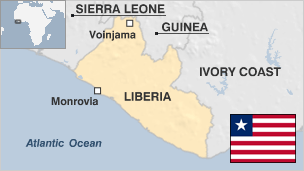
The recent news of the discovery of oil and hydrocarbons off the coast of Liberia has been welcoming, and many analysts are already critical of not just how the newfound wealth in oil will lead to economic growth, but also how it will be managed to avoid the curse of being a rich nation. This is the curse that most developing countries have suffered despite the resource endowment. In some cases the curse have not just been limited to poverty, but had also extended to large scale armed violence as a result of neglect of people in the resources abundant areas.
Natural resources have turned to curse rather than blessing in third world countries–mostly in sub-Saharan Africa due to the weaknesses of African regimes in doing due diligence and enforcing compliance laws. The roots of these weaknesses are in the greed and corrupt character of politicians and their corporate partners who have presided over those nations. Resources have been exploited in most instances to the disadvantages of local populations. The disadvantage talked about here refers to the condition in which local people see politicians and corporation owners getting extremely wealthy from resources extracted from their (local people) territories while they the local people lack basic amenities of life such as schools, hospitals, and public infrastructures and utilities like roads, clean water and electricity.
The other major part of the disadvantage is where, in addition to the social neglect of local communities, resource exploitations inflict environmental harms through pollution, environmental degradation and contamination of water sources, and the long term effect of unsustainable use in which future generations are deprived of the same resources. Cases of such are replete in Africa and other third world countries. In Liberia for example the excesses of mining companies like the former Liberia Mining Company in Bomi Hills is conspicuous with the underdevelopment and poverty of the county. The unsustainable mining practices have left the county to be nick-named ‘Bomi Hole’. A second and most recent example is the poverty of the people of Margibi County that have hosted the world’s largest rubber plantation for decades. Local communities around the Firestone Plantation in Margibi have accused the company of environmental pollutions and the dumping of chemical pollutants in water sources used by the people.
In other countries, disadvantaged people have risen up against the state and corporations. This is currently the case in the oil-rich region of Nigeria’s Niger Delta where militant groups, supported by local people have staged several insurgencies demanding dividends from their resources. The case of the newly independent state of South Sudan is also important to mention here. South Sudan has a huge deposit of oil and served as a source of most of Sudan’s oil wealth over the years. The neglect of the southerners by the state, concentrated in the North, led the southerners to decades of civil conflict and eventually succeeding from the North. Today, the southerners have full ownership of their oil wealth which accounts for 90% of the budget of the South Sudan.
With these cases cited, it is important for Liberia to begin to design strategies in answering the key questions surrounding natural resources exploitation and management: Who benefits and who loses? In the recent case of oil discovery, the specific question is: Who licks the oil and who washes the dishes? In the abstracts of social contract and political economy theories, resources of a state are to be used to the benefit of all its citizens and managed by a responsible government amenable to the people.
Can the current state in Liberia survive the pressure of managing a petro-state? Of course we know that most petro-states lack technology, and capital and skill to find and extract the products, least to speak of a technically-deficient postwar country. Foreign firms from industrialized countries therefore take over to do the business. It is under the concessions with foreign firms that things mostly go wrong; this is where Liberia needs to be careful as it tries to go into oil deals with international corporations. The mistakes made in other resource areas like the granting of land, forestry and mineral concessions are worthy to learn from. Critical to the development and management of Liberia’s oil resources is first the strengthening of the oil regulatory agency and transparency in implementing the petroleum law and other public contract laws. The next thing will be developing a local labor market for the emerging oil industry. This will require technical education for young Liberians. While it remains the obligation of the government of Liberia to provide education as a public or good or at least the conditions for quality education for every citizen, it is strongly recommended that young Liberians pursue careers in this industry so as to meet the labor market demand in the next few years. Without training and education and the development of local labor market for this industry much of the gains from this sector will be repatriated to other countries by foreign workers and corporation owners.
As most nations in sub-Saharan Africa including petro-states like Nigeria are moving towards manufacturing and planning to replace reliance on resource exportation to industrialization, Liberia needs to develop trade policies towards the same end. How can Liberia’s oil industry produce more jobs than the level required for extraction and how can the dividends from the oil trade increase economic growth? This will require more technical planning and strategic policy that will require oil companies to do some local productions home at least at some intermediate levels in the long term. Development from Ghana, a new petro-state, indicates that the economy has experienced double-digit growth since the first barrels of oil were poured in 2010. This, development we believe was the result of careful planning and effective management which Liberia will want to benefit from.
With reference to welfare gains, it is good to reemphasize here that oil business arrangements take seriously into consideration the need of local populations equally as it considers the revenue generation requirement of the government of Liberia. Environmental issues and social development for local communities should not be underestimated. The failure to consider local development concerns and to do long term plans that will maximize gains from the oil industry may keep Liberia in the state of a primary exporting country which will see growth without development, unemployment and the perennial tragedies of the resource curse as seen in other sectors.
The challenge now for progressive activists is to seek the expertise in monitoring the sector for transparency and accountability, and to advance the cause of local communities. At the heart of the advocacy should be the welfare argument: that the resources be used to the benefit of all citizens of the state, and that there should be no loser. If progressive forces neglect to champion this cause, politicians and corporate owners will lick the oil, while the ordinary Liberians remain in the kitchen to wash the dishes.
In the Cause of Democracy and Social Justice the Pen Shall Never Run Dry
Wednesday, March 7, 2012


Sunday, February 26, 2012
Liberia Vision 2030: Towards a Middle-Income Economy
Liberia’s 18-year development plan dubbed Vision 2030 or Liberia Rising 2030 has become the issue of public discourses with skepticisms that it is no different from former development agendas promulgated by past administration but did not go beyond the shelves of the various government ministries. Even though, the cynics have reasons based on experience to be critical, the patterns of development of this vision makes it starkly different from others: It originated from amongst the people, and its promulgation is people driven as well. So there are signs of fulfillments provided the resources are fully mobilized and the leadership committed to the plan. The challenge is mostly on progressive activists in Liberia to mobilize forces that will seek the legislation of the vision, support resource mobilization and monitoring of vision-specific projects.
A key theme of the vision is developing Liberia to the status of a middle-income. This particular theme has emerged at a very controversial time in economic development and the balance of global power politics. Whether this government and its successors can muster the necessary strength needed to match up in this era and lead Liberia to a middle income economy are the questions progressive activists are pondering over. At the moment, the powerful nations in the West are facing deepening financial crises, the campaign for a market economy across the world by western nations has recently proven to benefit capitalist forces only against the majority of the world citizens as demonstrated in the themes of the occupy movements in Europe and the United States. Also intriguing is the dynamics of the global power play that sees an intensification of the struggle for control between Europe and the US on one hand and China and Russia on the other hand. In all of these, African nations stand to suffer the most if the charisma and characters needed for strong and vibrant leadership are not formed across Africa. Africa will be exploited again in all forms to solve the problems of other countries outside the continent, and is likely again to be the object of intense scramble in the new global power struggle like the land grab phenomenon shows recently. The charisma and character needed in this era is progressive pan-African leadership that will work out home grown solutions to development challenges at the same time rationalizing foreign aids with local demands and traditions and culture. A leadership of such will in the long run create a vibrant and self-sustainable state that will need no foreign aid and imported ideas. Such leadership will require strong economic management and resistance to the numerous unfit tool-kits of governance and neo-liberal policies from abroad. Can Liberia build such a character in its leadership and work towards a middle income economy? While we believe that this is possible we are very much concern about the increasing neo-colonial agendas in Liberia which the current regime is doing little or nothing to counter. The continuous acceptance of neo-imperial policies under the guise of reform strategies imported from above is the new front-line for pan-African activists across the continent. Liberian activists must join this struggle and help support policies of local ownership and protection in working towards the middle income economy we crave.
A middle income economy is a country whose people have incomes that fall in the range of the overall world population income. This means, at the middle income level, the people are neither poor nor rich, but their incomes can provide basic life needs. Liberia is currently not part of the 86 middle-income countries in the world, but part of the very poor nations and ranked as the fourth poorest nation in the world. This stark contradiction is in a country with abundant natural resource reserve and sparse population density. The extent of inequality in the country speak of the immediate difficulty in working out this vision in the required timeframe, however, it has emerged as the development challenge of our country. It is therefore necessary to begin at laying out home grown strategies and framework that will roll out over time till 2030 when the ordinary Liberian will have no cause to worry about daily bread, shelter, medication and education. The required framework are part of the larger criteria of economic development some of which include rules and institutions to enforce contracts, infrastructures, security, capital and skilled labor endowment, and purchasing power etc. As we attempt to build the economy, the above issues are direct responsibilities of the state and achieving them cannot be done at the current level of management in the public and private sectors; the current education provided, and the heavy reliance on rents from natural resources.
Two key factors drive the creation of middle income economy in any country and they are (1) stable, secure and well paid jobs, and (2) higher education. Advocates for the vision must mobilize towards higher education and job security for the ordinary Liberians. This should not be limited to Monrovia, but must extend to all parts of the country. Affordable technical and higher education is key to alleviating the poverty in the country particularly in the rural areas that host 70% of Liberia’s poor.
For years Liberia has relied on and mismanaged rents generated from resource exploitation. It is clear that ‘rentier’ economies are not effective in facilitating local economic development; but very efficient in enriching multinationals. At times it leads to the deceptive paradox of economic growth without development like we had in the 1960s. Attention needs to be given now to agricultural production in locally needed commodities for both local consumption and export since about 70% of our economy is dependent on agricultural activities – but largely controlled by multinational plantations. Support to local farmers to produce in large quantities and create local employment will be needed in this transition. The country could adopt a local comparative advantage strategy supporting specific regions to grow products they have arable land, climate and tradition for. In addition to empowering local farmers is the need for promoting local enterprises and encouraging the growth of more Liberian-owned businesses for local and regional trade depending on the capitals. The critical role of the government in all of this is to strengthen laws that enforce contracts in transactions between people and provide the necessary infrastructures to facilitate trade within the country. Road and other infrastructures facilitate urbanizations and mass settlements that can provide markets for goods and services, and movement of goods and people, and reduces internal trade barriers like distance (distance have negative effects on trade).
The issue of housing is also critical to reducing poverty and elevating income status for the majority of Liberians who are poor. At present rent on housing in Monrovia and other local areas are increasing against the general income level. There is almost no housing market. In this particular area, the government needs to develop a pragmatic policy of providing low-income housing this time in the counties and occupants made to pay affordable rents annually. The lack of affordable housing and other economic service are part of the causes of the country’s worsening poverty situation. Financial services like insurance, credible pension and social security, health care and education are largely absent in Liberia. Health payments at hospital are becoming unbearable and fees are too high even at the nation’s highest referral hospital. Out-of-pocket payments for health care are increasingly worsening the conditions of our people most of whom survive on daily ‘hand-to-mouth’ businesses.
Finally, home grown solutions to our economic and development problems and the expansion of other sectors of the economy are critical to reducing reliance on foreign aid and external control that is likely to derail the implementation of this vision. As the momentum increases in Monrovia, and many Liberians support the process albeit the skepticisms, it is hoped that this vision is fully articulated in practice and that by 2030, there will be very few poor people or if possible none. But we cannot get there if we do not mobilize local resources under a progressive leadership that will advance pro-poor policies aimed at reducing income inequality amongst Liberians.
In the Cause of Democracy and Social Justice the Pen Shall Never Run Dry
A key theme of the vision is developing Liberia to the status of a middle-income. This particular theme has emerged at a very controversial time in economic development and the balance of global power politics. Whether this government and its successors can muster the necessary strength needed to match up in this era and lead Liberia to a middle income economy are the questions progressive activists are pondering over. At the moment, the powerful nations in the West are facing deepening financial crises, the campaign for a market economy across the world by western nations has recently proven to benefit capitalist forces only against the majority of the world citizens as demonstrated in the themes of the occupy movements in Europe and the United States. Also intriguing is the dynamics of the global power play that sees an intensification of the struggle for control between Europe and the US on one hand and China and Russia on the other hand. In all of these, African nations stand to suffer the most if the charisma and characters needed for strong and vibrant leadership are not formed across Africa. Africa will be exploited again in all forms to solve the problems of other countries outside the continent, and is likely again to be the object of intense scramble in the new global power struggle like the land grab phenomenon shows recently. The charisma and character needed in this era is progressive pan-African leadership that will work out home grown solutions to development challenges at the same time rationalizing foreign aids with local demands and traditions and culture. A leadership of such will in the long run create a vibrant and self-sustainable state that will need no foreign aid and imported ideas. Such leadership will require strong economic management and resistance to the numerous unfit tool-kits of governance and neo-liberal policies from abroad. Can Liberia build such a character in its leadership and work towards a middle income economy? While we believe that this is possible we are very much concern about the increasing neo-colonial agendas in Liberia which the current regime is doing little or nothing to counter. The continuous acceptance of neo-imperial policies under the guise of reform strategies imported from above is the new front-line for pan-African activists across the continent. Liberian activists must join this struggle and help support policies of local ownership and protection in working towards the middle income economy we crave.
A middle income economy is a country whose people have incomes that fall in the range of the overall world population income. This means, at the middle income level, the people are neither poor nor rich, but their incomes can provide basic life needs. Liberia is currently not part of the 86 middle-income countries in the world, but part of the very poor nations and ranked as the fourth poorest nation in the world. This stark contradiction is in a country with abundant natural resource reserve and sparse population density. The extent of inequality in the country speak of the immediate difficulty in working out this vision in the required timeframe, however, it has emerged as the development challenge of our country. It is therefore necessary to begin at laying out home grown strategies and framework that will roll out over time till 2030 when the ordinary Liberian will have no cause to worry about daily bread, shelter, medication and education. The required framework are part of the larger criteria of economic development some of which include rules and institutions to enforce contracts, infrastructures, security, capital and skilled labor endowment, and purchasing power etc. As we attempt to build the economy, the above issues are direct responsibilities of the state and achieving them cannot be done at the current level of management in the public and private sectors; the current education provided, and the heavy reliance on rents from natural resources.
Two key factors drive the creation of middle income economy in any country and they are (1) stable, secure and well paid jobs, and (2) higher education. Advocates for the vision must mobilize towards higher education and job security for the ordinary Liberians. This should not be limited to Monrovia, but must extend to all parts of the country. Affordable technical and higher education is key to alleviating the poverty in the country particularly in the rural areas that host 70% of Liberia’s poor.
For years Liberia has relied on and mismanaged rents generated from resource exploitation. It is clear that ‘rentier’ economies are not effective in facilitating local economic development; but very efficient in enriching multinationals. At times it leads to the deceptive paradox of economic growth without development like we had in the 1960s. Attention needs to be given now to agricultural production in locally needed commodities for both local consumption and export since about 70% of our economy is dependent on agricultural activities – but largely controlled by multinational plantations. Support to local farmers to produce in large quantities and create local employment will be needed in this transition. The country could adopt a local comparative advantage strategy supporting specific regions to grow products they have arable land, climate and tradition for. In addition to empowering local farmers is the need for promoting local enterprises and encouraging the growth of more Liberian-owned businesses for local and regional trade depending on the capitals. The critical role of the government in all of this is to strengthen laws that enforce contracts in transactions between people and provide the necessary infrastructures to facilitate trade within the country. Road and other infrastructures facilitate urbanizations and mass settlements that can provide markets for goods and services, and movement of goods and people, and reduces internal trade barriers like distance (distance have negative effects on trade).
The issue of housing is also critical to reducing poverty and elevating income status for the majority of Liberians who are poor. At present rent on housing in Monrovia and other local areas are increasing against the general income level. There is almost no housing market. In this particular area, the government needs to develop a pragmatic policy of providing low-income housing this time in the counties and occupants made to pay affordable rents annually. The lack of affordable housing and other economic service are part of the causes of the country’s worsening poverty situation. Financial services like insurance, credible pension and social security, health care and education are largely absent in Liberia. Health payments at hospital are becoming unbearable and fees are too high even at the nation’s highest referral hospital. Out-of-pocket payments for health care are increasingly worsening the conditions of our people most of whom survive on daily ‘hand-to-mouth’ businesses.
Finally, home grown solutions to our economic and development problems and the expansion of other sectors of the economy are critical to reducing reliance on foreign aid and external control that is likely to derail the implementation of this vision. As the momentum increases in Monrovia, and many Liberians support the process albeit the skepticisms, it is hoped that this vision is fully articulated in practice and that by 2030, there will be very few poor people or if possible none. But we cannot get there if we do not mobilize local resources under a progressive leadership that will advance pro-poor policies aimed at reducing income inequality amongst Liberians.
In the Cause of Democracy and Social Justice the Pen Shall Never Run Dry
Wednesday, February 15, 2012
Liberia’s Vision 2030: Where do we begin?
Looking back few years ago, I remember sitting in couple of meetings discussing the plans for the development of a roadmap to a National Vision for Liberia. From June 2010 up to its launch in February 2010 several meetings were held and studies done on so many themes and cross-cutting issues. There were meetings of various stakeholder groups including religious leaders, civil society activities and political leaders. Vision 2030 therefore comes with the distinction of being a policy developed from the bottom to the top, and not an ‘arm-chair’ creation. At present it is been spearheaded by a committee reflective of our national mosaic.
We still look forward to a complete possession of the vision by the people. By this we hope that the Vision 2030 becomes legislated and issues are time-specific till 2030. A great lesson can be learned from Botswana where the vision was done into phases legislated by the National Parliament. The gradual and successful implementation of Batswana’s vision, largely supported by a binding legislation over the years has ranked the country as a fast growing economy in Africa.
Key issues of Liberia’s Vision 2030 include national identity and national reconciliation. How do we go about defining the Liberian identity and citizenship? This is something that must begin in our schools with emphasis on civic education at the basic level. Reconciliation of course is a long term process and can be merged into the identity question. By 2030 it will be 27 years after the civil war, at which time a new generation will be out. That generation will be the reconciled generation depending on the balance in information and education on our national history and mosaic they receive. The kind of information and education will either weaken or strengthen the identity. At this point the beginning of reconciliation, particularly in the aftermath of a controversial Truth and Reconciliation Commission (TRC) program, needs to engender more public dialogues on the issues at stake. Despite the controversies, the Report of the TRC cannot be considered in anyway irrelevant, Liberians will therefore want to discuss its findings and recommendations and derive at a way forward. Another issue of reconciliation which we cannot continue to ignore is reparation for victims. The issue of providing reparations for victims (individuals and communities) of the civil war whose present living conditions are defined by events of the war will be a remarkable start of reconciliation in our vision project.
A second goal of the vision is to lead Liberia to a middle income economy come 2030. This is a thematic issue that will be the center of discussion in the next edition. At present Liberia is among the world’s poorest nations despite the abundance of natural resources and arable land and space for large scale agriculture. This ‘resource curse’ as development experts describe the conditions of nations like Liberia is common in the Mano River Basin area and the most of sub-Saharan Africa- the region that has abundant natural resources but poor people. Reversing this resource curse towards that of progressive economic growth and human development requires long term strategic planning that reflects the needs, and broader views and aspirations of the population.
The vision is therefore most needed at this time as the country transitions from an emergency situation of recovery from violence and instability, and low-growth to peace and sustainable development. At the heart of this should be the question of governance and management in both the public and private sectors. Liberia’s stagnation in the low income category has largely been due to poor governance and ineffective management of state institutions and resources. Effective governances with set guidelines and rules supported and executed by responsible institutions have to be emphasized in this transition. The on-going public sector reform must therefore focus more on institution building to implement relevant policies and those relating directly to the vision.
Finally, the beginning of Vision 2030 as a property of the Liberian people should be its enactment into law thereby making it a binding national development agenda till 2030. Legislating this Vision 2030 will insulate it from political manipulations. Trends of manipulation of development agendas are replete in our history where successive governments have ignored projects of their predecessors. This is the same in most of Africa. A ‘people’s vision’ therefore must be the guiding platform for every political organization seeking state power. There are three presidential terms between now and 2030 (considering the present Constitution) and two more elections. In the next two elections, with a the vision enacted as a national development agenda, political parties and candidates need not entice the voting public with any platforms and new development plans, but with strategies and available capacities to implement the vision in time. With a law in place, the next step will be to build responsible institutions adapted to the rules of governance and implementation of the vision. With strong institutions in force, and governing rules and procedures enforced, Liberia can maximizes immense welfare benefits form it resources and maintain peace and stability. Institutions, rules and effective management are also critical to protecting the resources needed for the vision from public theft.
In the Cause of Democracy and Social Justice the Pen Shall Never Run Dry
We still look forward to a complete possession of the vision by the people. By this we hope that the Vision 2030 becomes legislated and issues are time-specific till 2030. A great lesson can be learned from Botswana where the vision was done into phases legislated by the National Parliament. The gradual and successful implementation of Batswana’s vision, largely supported by a binding legislation over the years has ranked the country as a fast growing economy in Africa.
Key issues of Liberia’s Vision 2030 include national identity and national reconciliation. How do we go about defining the Liberian identity and citizenship? This is something that must begin in our schools with emphasis on civic education at the basic level. Reconciliation of course is a long term process and can be merged into the identity question. By 2030 it will be 27 years after the civil war, at which time a new generation will be out. That generation will be the reconciled generation depending on the balance in information and education on our national history and mosaic they receive. The kind of information and education will either weaken or strengthen the identity. At this point the beginning of reconciliation, particularly in the aftermath of a controversial Truth and Reconciliation Commission (TRC) program, needs to engender more public dialogues on the issues at stake. Despite the controversies, the Report of the TRC cannot be considered in anyway irrelevant, Liberians will therefore want to discuss its findings and recommendations and derive at a way forward. Another issue of reconciliation which we cannot continue to ignore is reparation for victims. The issue of providing reparations for victims (individuals and communities) of the civil war whose present living conditions are defined by events of the war will be a remarkable start of reconciliation in our vision project.
A second goal of the vision is to lead Liberia to a middle income economy come 2030. This is a thematic issue that will be the center of discussion in the next edition. At present Liberia is among the world’s poorest nations despite the abundance of natural resources and arable land and space for large scale agriculture. This ‘resource curse’ as development experts describe the conditions of nations like Liberia is common in the Mano River Basin area and the most of sub-Saharan Africa- the region that has abundant natural resources but poor people. Reversing this resource curse towards that of progressive economic growth and human development requires long term strategic planning that reflects the needs, and broader views and aspirations of the population.
The vision is therefore most needed at this time as the country transitions from an emergency situation of recovery from violence and instability, and low-growth to peace and sustainable development. At the heart of this should be the question of governance and management in both the public and private sectors. Liberia’s stagnation in the low income category has largely been due to poor governance and ineffective management of state institutions and resources. Effective governances with set guidelines and rules supported and executed by responsible institutions have to be emphasized in this transition. The on-going public sector reform must therefore focus more on institution building to implement relevant policies and those relating directly to the vision.
Finally, the beginning of Vision 2030 as a property of the Liberian people should be its enactment into law thereby making it a binding national development agenda till 2030. Legislating this Vision 2030 will insulate it from political manipulations. Trends of manipulation of development agendas are replete in our history where successive governments have ignored projects of their predecessors. This is the same in most of Africa. A ‘people’s vision’ therefore must be the guiding platform for every political organization seeking state power. There are three presidential terms between now and 2030 (considering the present Constitution) and two more elections. In the next two elections, with a the vision enacted as a national development agenda, political parties and candidates need not entice the voting public with any platforms and new development plans, but with strategies and available capacities to implement the vision in time. With a law in place, the next step will be to build responsible institutions adapted to the rules of governance and implementation of the vision. With strong institutions in force, and governing rules and procedures enforced, Liberia can maximizes immense welfare benefits form it resources and maintain peace and stability. Institutions, rules and effective management are also critical to protecting the resources needed for the vision from public theft.
In the Cause of Democracy and Social Justice the Pen Shall Never Run Dry
Sunday, November 6, 2011
Statement on the Political Stalemate in Liberia
Ibrahim Al-bakri Nyei
November 6, 2011
Recent developments in Liberia around the presidential election are appalling and deeply worrisome - signaling a stalemate of unpredictable consequences. We take note of the complains of political parties after the first round of the 2011 general and presidential elections, but we are yet to be convinced of the claims made to judge whether they are valid enough for their actions thus far. The threat of boycott and the careless and abusive campaign statements from opposing camps, including the resignation of the Chairman, and exit of key staff members of the National Election Commission in the middle of the process speak of a volatile situation needing urgent attention to protect the people of Liberia against extremist political attitudes. Immediate security actions and direct engagements by the international community are needed to prevent the situation from deteriorating into violence. By now the international community should have learned sufficient lessons from the tragedies that resulted from elections in Kenya (2007 - 2008), Zimbabwe (2008), and Ivory Coast (2010 -2011). Thanks to the United Nations Mission in Liberia and ECOWAS for their roles so far.
At this point it is important to mention that the prevailing developments in Liberia are not spontaneous, but are products of pos-conflict governance leakages which the administration overlooked. There are governance leakages which have all built up to numerous political crises out of which the current situation is just one product. Two key issues can be considered here as part of the leakages. The first was the failure of the administration to lead the country into a broader national process of Constitutional reform. Constitutional reform is a key and fundamental element of postwar reform, and had this government embarked on such an initiative key issues of national controversy would have been sorted out and addressed. Rather, the administration chose to support and conduct a referendum month to the election. It was from this controversial referendum the current tension around the elections began.
Second is the lukewarm approach of the government to transitional justice issues, mainly national reconciliation. Transitional justice goes in tandem with constitutional reform in postwar governance reform processes, and it is the basis upon which people deal with past grievances and accept each other for the future. Eight years after the war, Liberians are yet to have collective and clear understanding of the causes of the conflict and the role of various actors, and the way forward to a peaceful future. This is largely due to the controversy that resulted from the TRC process. Today, people feel free to issue threats of violence and even disrupt national processes without fearing consequences. At the same time, the people still seem to be deeply divided on ethnic issues, and the growing patterns of remerging wartime alliances during these elections speak volumes of deep-seated grievances and conflict mentalities.
Also important to mention here is the fact that the class of politicians presiding over Liberia today have a conflict-prone mentality, and there is complete lack of trust among themselves, thus making it difficult for them to participate in meaningful competitive democratic processes without threats, violence and actions inimical to modern democracy and civilization. Unfortunately, there is no meaningful challenge to the political excesses and inherent failures of this class of politicians that have presided over Liberia since the 1960s. The lack of challenge is due to the continuous cooptation and manipulation of elements in the succeeding generations.
Let us realize now that it is time to give new face to governance and politics in Liberia in response to the emerging 21st century challenges of peace, democracy and progressive development. Of course the current class of politicians lacks the trust and energy for this century, so it is time that they are retired from politics and government where they are not productive as evidenced by the state of affairs in Liberia over the past decades.
Thus a new breed of leadership is needed if Liberia must move forward with the pace of development and globalization in this 21st century. The energy and innovative skills of the emerging generations can save the people of Liberia from the emotional and physical pains of poverty, violence, and injustice caused by the current batch of politicians, and will raise Liberia beyond its current status of a puppet state in the international community.
November 6, 2011
Recent developments in Liberia around the presidential election are appalling and deeply worrisome - signaling a stalemate of unpredictable consequences. We take note of the complains of political parties after the first round of the 2011 general and presidential elections, but we are yet to be convinced of the claims made to judge whether they are valid enough for their actions thus far. The threat of boycott and the careless and abusive campaign statements from opposing camps, including the resignation of the Chairman, and exit of key staff members of the National Election Commission in the middle of the process speak of a volatile situation needing urgent attention to protect the people of Liberia against extremist political attitudes. Immediate security actions and direct engagements by the international community are needed to prevent the situation from deteriorating into violence. By now the international community should have learned sufficient lessons from the tragedies that resulted from elections in Kenya (2007 - 2008), Zimbabwe (2008), and Ivory Coast (2010 -2011). Thanks to the United Nations Mission in Liberia and ECOWAS for their roles so far.
At this point it is important to mention that the prevailing developments in Liberia are not spontaneous, but are products of pos-conflict governance leakages which the administration overlooked. There are governance leakages which have all built up to numerous political crises out of which the current situation is just one product. Two key issues can be considered here as part of the leakages. The first was the failure of the administration to lead the country into a broader national process of Constitutional reform. Constitutional reform is a key and fundamental element of postwar reform, and had this government embarked on such an initiative key issues of national controversy would have been sorted out and addressed. Rather, the administration chose to support and conduct a referendum month to the election. It was from this controversial referendum the current tension around the elections began.
Second is the lukewarm approach of the government to transitional justice issues, mainly national reconciliation. Transitional justice goes in tandem with constitutional reform in postwar governance reform processes, and it is the basis upon which people deal with past grievances and accept each other for the future. Eight years after the war, Liberians are yet to have collective and clear understanding of the causes of the conflict and the role of various actors, and the way forward to a peaceful future. This is largely due to the controversy that resulted from the TRC process. Today, people feel free to issue threats of violence and even disrupt national processes without fearing consequences. At the same time, the people still seem to be deeply divided on ethnic issues, and the growing patterns of remerging wartime alliances during these elections speak volumes of deep-seated grievances and conflict mentalities.
Also important to mention here is the fact that the class of politicians presiding over Liberia today have a conflict-prone mentality, and there is complete lack of trust among themselves, thus making it difficult for them to participate in meaningful competitive democratic processes without threats, violence and actions inimical to modern democracy and civilization. Unfortunately, there is no meaningful challenge to the political excesses and inherent failures of this class of politicians that have presided over Liberia since the 1960s. The lack of challenge is due to the continuous cooptation and manipulation of elements in the succeeding generations.
Let us realize now that it is time to give new face to governance and politics in Liberia in response to the emerging 21st century challenges of peace, democracy and progressive development. Of course the current class of politicians lacks the trust and energy for this century, so it is time that they are retired from politics and government where they are not productive as evidenced by the state of affairs in Liberia over the past decades.
Thus a new breed of leadership is needed if Liberia must move forward with the pace of development and globalization in this 21st century. The energy and innovative skills of the emerging generations can save the people of Liberia from the emotional and physical pains of poverty, violence, and injustice caused by the current batch of politicians, and will raise Liberia beyond its current status of a puppet state in the international community.
Thursday, August 11, 2011
LET THE WORLD HELP SAVE SOMALIA FROM THE TWIN TRAGEDIES!!!!!

Ibrahim Al-bakri Nyei
Tragedies have befallen the people of Somalia. They need every assistance at this moment to survive. A cup of water, a piece of bread, a quiet environment (silencing the guns) can save a life today in Somalia. What is happening in that East African Nation can happen anywhere, and most of us in other parts of the world have experience the same tragedies, but with different magnitudes.
We are all aware that humanity is facing numerous challenges in today’s world. From climate change, environmental degradation and pollution to violent conflict, drought, famine and poverty, humanity is under the worst attacks. It is now clear from events around the world that trouble in one country can affect a whole region and most likely the world. Currently the UN is saying that about 3.6 million people are at the risk of starvation in Somalia, and more than 11 million people across the horn of Africa have been affected by drought this year.
In Somalia, there is a twin tragedy – drought and violent conflict. This must claim the attention of the whole world to join hands and save the innocent children of Somalia from dying from starvation and preventable causes. Violent conflict itself comes with its own tolls on humanity and nation states everywhere. Conflicts forced people to refugee lives during which they lost their human dignity, cultural trainings and heritage, and during violent conflicts people are faced with the prevalence of several diseases like cholera, diarrhea, etc. the United Nations has taken account of these things during conflicts. Drought and the seemingly intractable war in Somalia have separated the people and spread them around the world in search of a good life. Generations of Somali children may lose their identity and heritage.
In some countries, while the greatest wish babies or children have is to get the latest produced toy, or the technological gadget like video games, iPhones and Androids, their peers in Somalia are crying to get water to drink and food to eat as you read this piece. Let us be reminded that we all have one humanity, we must therefore empathize with them and mobilize resources to give them drinking water and bread to eat. This cannot be done by speeches and rhetoric any longer, but an emergency action.
The consequences of drought are not far from what mankind is deprived of like during a conflict – food, water, shelter and degradation of human dignity. The people of Somalia are suffering from a conflict and famine at the same time.
The world must now stand and pay attention to the plight of the innocent people of Somalia. We know that the world cannot fight drought easily since it is a natural disaster, but violent conflict can stop. Let us all for the sake of humanity call on the big powers to help stop the violence against the innocent people of Somalia. This must be done immediately without the considerations of ‘strategic interests’. The interest here must be peace and to save lives. If a stable government is in place in that country and the Somali people are at peace, they will be able to prepare themselves for disasters like these. But it is now beyond their control… bullets are flying, suicide bombers are looking for them, their creeks have gone dried, their seeds are not sprouting, and their cattle are dying.
The way forward is to make peace. Allow humanitarian aid to reach the people. This is a call to all militant groups, mainly Al-Shabaab that the people you want to rule are dying. If you all continue this trend you might have no more place to establish the 'Islamic State' you are fighting for. Be reminded that Allah Almighty has forbidden his followers from destroying innocent lives. You have an opportunity now to accept the general amnesty from the Transitional Federal Government and join the peace process to rebuild your country. Your people are scattered around the world against their wishes. People everywhere want to be home no matter what. But your country has become the worst place to be, only because of violence. The solution is Peace. Peace for the sake of Islam. Peace for the Sake of the innocent children of Somalia – they too need a future in their home country.
Wednesday, August 10, 2011
Liberia Decentralization Policy: a roadmap to participatory governance and development in Liberia
Ibrahim Al-bakri Nyei
Liberia’s political tradition of hegemonic rule of an elite class was a major factor that led to the numerous civil uprisings and the subsequent violent conflict that lasted for fourteen years. Since independence, governance and development activities have been concentrated in the capital and in the hands of a very few people with the president at the center of this imperial authority. This has led to the marginalization, disenfranchisement and deprivation of the vast majority of the people in the country, particularly the counties.
Societies learn from lessons of history to correct the present and set a progressive agenda for the future. For Liberia, it is by now an established fact that the top-down approach to development has not worked well, for the same reasons decisions made from up-to-down have not generated popular support. This has been one of the problematic issues with good governance in Liberia. The need therefore to reexamine and reengineer the system of governance, and set for an effective devolution of political, fiscal and administrative powers to the people in the sub-national units cannot be overemphasized. This will get them deeply involved and at the same time strengthen democratic governance, and accelerate development across the country.
In 2006 the Governance Commission in collaboration with the Ministry of Internal Affairs and the Ministry of Planning and Economic Affairs embarked on a process of laying out a framework for local government and decentralization in Liberia. The development of this policy was different from the traditional ‘arm chair’ style of making policies in the country, instead, the teams embarked on consultations nationwide in series of meetings, conferences and workshop to solicit the views of county government officials, chiefs and traditional leaders, civil society and media groups and representatives of youth and women organizations. It was from theses national consultations that a national decentralization policy was developed. This article analyses the policy and its implications for governance, democracy and development in Liberia. Here, I argue strongly that Liberia’s governance, socio-economic and development problems and/or challenges are underpinned by the over-centralization of power at the presidency, defined in ministries and concentrated in the capital; and that decentralization is not the absolute solution, but a necessary road roadmap to follow.
Overcentralization and the problem with governance
An overly centralized government is a product of hegemonic and elite rule. When a specific class or party wants to dominate all sectors of a nation’s life, it tends to gather and control the instruments of power through agent-loyalists and draft biased policies and laws at the exclusion of the people. Through this process, the vast majority of the people becomes marginalized and deprived from the natural wealth and opportunities of the country. With this, a skew process of wealth distribution ensues, and coercion, patronization, and force – used by a selective few individuals – is used to govern. This is where the rule of law is subverted, and dissents are suppressed as was witnessed under the True Whig Party in Liberia. The military dictatorship that metamorphosed to a civilian autocracy mirror-imaged the oligarchy it overthrew and governed the same way. This led to a general level of suppressed distrust and grievances, all of which led to the 14 years civil war – defined by destruction of the social and material wealth of the country.
It is therefore accurate to say that overcentralization undermines the principles of democracy as it deprives the vast majority of the people from public discourse and participation in governance. It supports corruption of state resources, and concentrates development mainly in the capital city and sometimes the home towns of the powerful elites. Besides Monrovia, a quick visit to county cities that have produced former presidents can tell the conspicuous discrimination and deprivation in development. For example, compare the infrastructures of Harper (Maryland), and Zwedru (Grand Gedeh) to Barclayville (Grand Kru) and Cestos (Rivercess).
It is also worth adding that the kind of imperial and strongman leadership that Liberian leaders have exhibited over the years is supported by the Constitution. Attempts were made by the 1986 Constitution Commission to redistribute power, but the military regime overturned the Commission’s proposal and introduced what Liberia has today through the Constitutional Advisory Council. In the Current Constitution, the appointing power of the president stretches to appointing the lowest statutory officials like district superintendent and district commissioners. The president also has the power to dismiss a paramount, clan and town chiefs elected by the by the people (Article 56 Sec. B).
Postwar Attempts at Decentralization in Liberia
The 1986 Constitution of Liberia gives the President the power to appoint superintendents, other county official and officials of other political subdivisions (Art. 54 Sec. D.). It further states in Article 56 (A) that all such officials ‘appointed by the President pursuant to this Constitution shall hold their offices at the pleasure of the President’.
This of course, has been the pattern of governance in the country. Officials of government work at the pleasure of the president rather than the people, even at the lowest unit of government, say for example district commissioner. The extent of the power of the president has even reached the two other branches of government – the Legislature and the Judiciary – through political maneuverings and financial manipulations; even though the Constitution, on the principles of ‘separate but coordinating bodies’, forbids this as a means of supporting checks and balance in government. This is another way in which the power has been centralized and controlled at the Liberian Presidency.
However, the return to civilian democratic rule in the country was a first step to bringing sustainable change. Even though there have been no constitutional reform process directed at reducing the power of the imperial presidency in Liberia or addressing some of the controversial issues in the constitution during the transitional period, the first postwar government through a presidential initiative introduced programs and decision-making processes aimed at empowering local citizens to participate in choosing county officials, and managing local development projects. By this initiative the president shared her constitutional privilege with the people by asking citizens of each county to send forth three names from which she will appoint a county Superintendent. This was done to choose the first set of Superintendents during the dawning days of the regime, but this practice had since been abandoned; the president has appointed several local officials, and changed superintendents without broader consultations with the communities. This process could have been improved upon, and would have engendered sufficient local participation in decision making had the president continued it and extended it to include the appointment of district commissioners and city mayors.
A second attempt at empowering the local county governments and decentralizing development initiatives was the establishment of the County Development Funds (CDF) through which budgetary allotments are made in the annual national budget for the counties and supervised by the local authorities. The people in the counties have also been regularly consulted in deciding development projects. A landmark achievement was the development of a County Development Agenda (CDA) for the counties. There have been lapses in the implementations of the CDAs however.
The continuation of the county development fund program is building sense of local ownerships around the country. Through this process local citizens and civic groups are usually demanding accountability from the county leaders, and this is expanding debates on development decision making and expenditures. In some counties, citizen’s demands for accountability in the use of the CDF have exposed the corrupt maneuverings of county officials, and in some cases, led to their dismissals by the President. With this experiment, one can just imagine how improved governance and accountability would be if the people are involved with decision-making, and are allowed to take ownership of development projects.
These developments cannot be considered as substantial efforts at decentralization due to the lack of a legal regime, as well as a general lack of sustainability and administrative frameworks. Second, they remain a presidential project and as the president has shown in preserving the privilege of appointing county superintendents and other local officials, she can also stop the CDF initiatives. A well carved and legally mandated decentralization framework remains the means to participatory democratic governance and sustainable local development in the country. It is in this direction that the Governance Commission led a nation-wide consultation process to develop the Liberia National Policy on Decentralization and Local Governance.
The Decentralization Policy
The National Policy on Decentralization and Local Governance has been adopted by the Cabinet, and the President of Liberia has written a Foreword to it, expressing her endorsement and support to its provisions.
This policy, as mentioned earlier is a product of mass consultations with local leaders, scholars, professionals and Liberia’s international development partners. It lays the framework for an ambitious devolution of political, fiscal and administrative powers to the sub-national political units of the country – counties and districts. Its rationale is to legally establish and promote local self-governance and advance mass citizens’ participation as a foundation for democratic governance. In a system of semi-autonomous and effective local governments the prospects of improved service delivery at all levels of society and economic empowerment abound. How then does the policy intend to attain decentralization in Liberia?
Three main types of decentralization and several precepts of democracy and development are proposed from a careful review of the policy. The three types of decentralization proposed are: Political, Fiscal, and administrative.
Political Decentralization: This type of decentralization is concerned with the process of political decision making and power distribution at the sub-division level (county level). Its key features include elections, power redistribution, participation, representation, etc. The policy aims at a radical distribution of power and decision making among the people of Liberia and the presidency. It proposes elections of superintendents, district commissioners, and city mayors. It also promotes the establishment of lawmaking structures in the county to make local ordinances, plan development, pass budget and decide on county expenditure. The benefit of such is that the Liberian people will participate more effectively in local affairs and build ownership – as it will devolve power to the responsible local bodies elected by the local people, who will also decide what development they want through public consultations. Development decisions that are taken by the local people is usually bottom-to-up and most likely to produce substantial impacts.
Administrative Decentralization: This involves the transfer of responsibilities for planning and management of public/government functions to sub-national governments or to sub-national agencies of central government in the sub-national units. Either of the two are forms of administrative decentralization, but the transfer of responsibility from a hierarchical central agency to sub agencies in the political units can best be described as deconcentration, and its agents report to superiors in the central administration rather than local authorities or the people that are affected by their operations. This is the current wave of ‘decentralization’ in Liberia. And the problematic issues with these ‘decentralized’ programs of the ministries and agencies are that they lack efficiency and inter-agency coordination. With local offices in the counties some key primary functions are still decided in Monrovia. For example, even though the Ministry of Health has County Health Teams and administrations, birth certificates are only prepared and issued at the Ministry Head Office on Capitol bypass, and while the Ministry of Transport boasts of a decentralization program, driver licenses are still only given at the Ministry’s offices on Broad Street. How then does the policy address the issue of administrative decentralization?
Under the National Policy on Decentralization and Local Governance, local governments in the counties will plan and administer their own institutions of service delivery, and these institutions shall function as departments of the local government unit. For example, it is expected that programs of health will be implemented by the local department while the Ministry of Health at the national level will lead, develop, supervise and coordinate national health policies. The same for basic public services like education, water, electricity, transportation and infrastructures. The county government will employ its own staff to run these departments.
Fiscal Decentralization: This involves the devolution of fiscal power to sub-national governments. Its key features are (i) assigning tax (revenue) collection responsibilities to local governments and (ii) legally empowering local government to expend local revenues for service delivery. Both are proposed under the decentralization policy. Under our current system of government revenue collection agents from the Ministry of Finance are found actively working in the counties with no direct link to the local administrations. These agents collect revenues that rarely return to the counties as we can see the level of underdevelopment in the countryside. In every county there is an effective revenue collection mechanism, but there are not effective service delivery institutions. The need therefore to empower local governments to collect taxes, generate revenues for local development, and make expenditure decisions independently cannot be overemphasized if Liberia must advance as a develop nation.
Under the decentralization policy county governments will collect taxes and raise revenues from licenses and permits issued to local business. A system of inter-governmental transfer will also be promoted through which the national government will give annual subsidies to the county governments and local taxes redistributed among the counties and the national governments.
The above three are the forms of decentralization that development experts have described in so many discourses as effective and common internationally. Liberia seeks to radically transform its system of governance by decentralizing in all three dimensions. What then are the potential benefits of decentralization and what are the precepts of democratic governance that this system will advance in Liberia?
Overall, decentralization can help to advance a number of democratic principles and socio-economic development initiatives. If decentralization works in Liberia in line with the policy advanced by the Governance Commission it will engender mass participation of citizens in governance and promote downward accountability in the use of the country’s resources. Participation and accountability are distinct principles of democratic governance. In terms of economic development, legally empowered and functional local governments in the counties can enhance responsiveness to the range of citizens’ demand for basic services in health, education, electricity, water and infrastructures.
Nature and Structure of Local Governments
Liberia is embarking upon a form of decentralization that will make local governments autonomous but within the unitary state system. Liberia therefore, according to the policy ‘shall remain a unitary state with a system of local government and administration which shall be decentralized with the county as the principal focus of the devolution of power and authority’. There is no federal state system created here, as some critics of the process, including government officials would argue.
To ensure the protection of the national sovereignty several issues including those of foreign affairs, national defense and security, immigration, law enforcement, money and banking, and administration of justice are left exclusively as functions of national government.
The county governments shall be headed by a superintendent elected by the people and the county legislative branch (named in the policy as County Legislative Assembly) shall comprise of citizens elected from the districts of the county, and all paramount chiefs. This body shall meet quarterly to make local ordinances, plan development, and pass a budget for the year.
Challenges
It is worth noting that decentralization – the devolution of power and authority to local governments – has its own limitations and challenges. The challenges to decentralization in Liberia range from political and constitutional issues to technical and financial/economic issues. For decentralization to work in Liberia as laid out, the policy has to be passed into law by the Legislature and be submitted to a process of constitutional amendment to accommodate legally conflicting provisions of the policy. This challenge is now left with the Liberian people to call on the Legislature to begin hearing on the policy and pass laws that promote decentralization. However, due to limited and poor information, most Liberians are not aware of the benefit and processes of decentralization. This can be overcome by local civic organizations and ordinary citizens engaging and lobbying with their lawmakers on decentralization. It is also important to engage individuals seeking higher positions in government, particularly in the legislature, and begin to ask questions on how they will support decentralization in the country.
The technical issue with decentralization is associated with capacity – both financial and human resources. Liberia is currently ranked amongst the poorest countries in the world, and with a significant portion of its people illiterate. The country’s public sector is also faced with a human resource deficit which Liberia’s international partners are assisting to resolve by sending and funding expatriates, including Liberian Diasporas to work for the government. The financial ability to run effective local governments in the counties is also a potential challenge particularly in the case were most of the counties lack economic activities and active markets. Effective decentralization does not stop to establishing local governments and making them autonomous; it requires capable administrative units in the local governments to respond to the local people. If county governments and officials are unable to deliver functions that local citizens expect from them, the potential benefits of decentralization are unlikely to be realized. If this happens in Liberia, the country will be compelled to do recentralization since the local governments cannot perform the functions required of them. In order to avoid this, the process of implementing decentralization must begin with building technical human resource capacities and creating economic corridors around the country.
And finally, decentralization means that local power and social dynamics might disadvantage some groups. Women, youth, and strangers (or minority groups) might be negatively affected. Therefore, a well functioning and participatory process is needed as the lowest social unit – at the town level.
Conclusion
Decentralization is the way forward to sustainable democratization and economic developments in Liberia. With a National Policy on Decentralization and Local Governance, Liberia now has a unique opportunity to build upon in advancing the rights of its people to participate in making decision that affect them. Decentralization has been a language long introduced in Liberian political discourses and attempts by successive administrations have not attained enormous benefits. The current administration has led a breakthrough by endorsing a decentralization policy. It is now about time for mass citizen awareness and support for its enactment into law and subsequent implementation.
The process of decentralization will not end at passing the policy into law and amending the constitution, it continues with building institutions of good governance in the counties, and laying the foundations for democracy and the rule of law to prevail. Encouraging the development of the skills of young Liberians in engineering, governance and policy making, medicine, economic, business and finance and other relevant fields is critical to countering the potential human resource challenges that will face local governments in the future.
It is however worth cautioning that expectations will have to be controlled because with such a deeply entrenched political culture, Liberia cannot break the yoke of its overly centralized and imperial system of governance in a few days. Let it therefore be made clear that this process has to evolve over time through a systematic process of planning and implementing.
Liberia’s political tradition of hegemonic rule of an elite class was a major factor that led to the numerous civil uprisings and the subsequent violent conflict that lasted for fourteen years. Since independence, governance and development activities have been concentrated in the capital and in the hands of a very few people with the president at the center of this imperial authority. This has led to the marginalization, disenfranchisement and deprivation of the vast majority of the people in the country, particularly the counties.
Societies learn from lessons of history to correct the present and set a progressive agenda for the future. For Liberia, it is by now an established fact that the top-down approach to development has not worked well, for the same reasons decisions made from up-to-down have not generated popular support. This has been one of the problematic issues with good governance in Liberia. The need therefore to reexamine and reengineer the system of governance, and set for an effective devolution of political, fiscal and administrative powers to the people in the sub-national units cannot be overemphasized. This will get them deeply involved and at the same time strengthen democratic governance, and accelerate development across the country.
In 2006 the Governance Commission in collaboration with the Ministry of Internal Affairs and the Ministry of Planning and Economic Affairs embarked on a process of laying out a framework for local government and decentralization in Liberia. The development of this policy was different from the traditional ‘arm chair’ style of making policies in the country, instead, the teams embarked on consultations nationwide in series of meetings, conferences and workshop to solicit the views of county government officials, chiefs and traditional leaders, civil society and media groups and representatives of youth and women organizations. It was from theses national consultations that a national decentralization policy was developed. This article analyses the policy and its implications for governance, democracy and development in Liberia. Here, I argue strongly that Liberia’s governance, socio-economic and development problems and/or challenges are underpinned by the over-centralization of power at the presidency, defined in ministries and concentrated in the capital; and that decentralization is not the absolute solution, but a necessary road roadmap to follow.
Overcentralization and the problem with governance
An overly centralized government is a product of hegemonic and elite rule. When a specific class or party wants to dominate all sectors of a nation’s life, it tends to gather and control the instruments of power through agent-loyalists and draft biased policies and laws at the exclusion of the people. Through this process, the vast majority of the people becomes marginalized and deprived from the natural wealth and opportunities of the country. With this, a skew process of wealth distribution ensues, and coercion, patronization, and force – used by a selective few individuals – is used to govern. This is where the rule of law is subverted, and dissents are suppressed as was witnessed under the True Whig Party in Liberia. The military dictatorship that metamorphosed to a civilian autocracy mirror-imaged the oligarchy it overthrew and governed the same way. This led to a general level of suppressed distrust and grievances, all of which led to the 14 years civil war – defined by destruction of the social and material wealth of the country.
It is therefore accurate to say that overcentralization undermines the principles of democracy as it deprives the vast majority of the people from public discourse and participation in governance. It supports corruption of state resources, and concentrates development mainly in the capital city and sometimes the home towns of the powerful elites. Besides Monrovia, a quick visit to county cities that have produced former presidents can tell the conspicuous discrimination and deprivation in development. For example, compare the infrastructures of Harper (Maryland), and Zwedru (Grand Gedeh) to Barclayville (Grand Kru) and Cestos (Rivercess).
It is also worth adding that the kind of imperial and strongman leadership that Liberian leaders have exhibited over the years is supported by the Constitution. Attempts were made by the 1986 Constitution Commission to redistribute power, but the military regime overturned the Commission’s proposal and introduced what Liberia has today through the Constitutional Advisory Council. In the Current Constitution, the appointing power of the president stretches to appointing the lowest statutory officials like district superintendent and district commissioners. The president also has the power to dismiss a paramount, clan and town chiefs elected by the by the people (Article 56 Sec. B).
Postwar Attempts at Decentralization in Liberia
The 1986 Constitution of Liberia gives the President the power to appoint superintendents, other county official and officials of other political subdivisions (Art. 54 Sec. D.). It further states in Article 56 (A) that all such officials ‘appointed by the President pursuant to this Constitution shall hold their offices at the pleasure of the President’.
This of course, has been the pattern of governance in the country. Officials of government work at the pleasure of the president rather than the people, even at the lowest unit of government, say for example district commissioner. The extent of the power of the president has even reached the two other branches of government – the Legislature and the Judiciary – through political maneuverings and financial manipulations; even though the Constitution, on the principles of ‘separate but coordinating bodies’, forbids this as a means of supporting checks and balance in government. This is another way in which the power has been centralized and controlled at the Liberian Presidency.
However, the return to civilian democratic rule in the country was a first step to bringing sustainable change. Even though there have been no constitutional reform process directed at reducing the power of the imperial presidency in Liberia or addressing some of the controversial issues in the constitution during the transitional period, the first postwar government through a presidential initiative introduced programs and decision-making processes aimed at empowering local citizens to participate in choosing county officials, and managing local development projects. By this initiative the president shared her constitutional privilege with the people by asking citizens of each county to send forth three names from which she will appoint a county Superintendent. This was done to choose the first set of Superintendents during the dawning days of the regime, but this practice had since been abandoned; the president has appointed several local officials, and changed superintendents without broader consultations with the communities. This process could have been improved upon, and would have engendered sufficient local participation in decision making had the president continued it and extended it to include the appointment of district commissioners and city mayors.
A second attempt at empowering the local county governments and decentralizing development initiatives was the establishment of the County Development Funds (CDF) through which budgetary allotments are made in the annual national budget for the counties and supervised by the local authorities. The people in the counties have also been regularly consulted in deciding development projects. A landmark achievement was the development of a County Development Agenda (CDA) for the counties. There have been lapses in the implementations of the CDAs however.
The continuation of the county development fund program is building sense of local ownerships around the country. Through this process local citizens and civic groups are usually demanding accountability from the county leaders, and this is expanding debates on development decision making and expenditures. In some counties, citizen’s demands for accountability in the use of the CDF have exposed the corrupt maneuverings of county officials, and in some cases, led to their dismissals by the President. With this experiment, one can just imagine how improved governance and accountability would be if the people are involved with decision-making, and are allowed to take ownership of development projects.
These developments cannot be considered as substantial efforts at decentralization due to the lack of a legal regime, as well as a general lack of sustainability and administrative frameworks. Second, they remain a presidential project and as the president has shown in preserving the privilege of appointing county superintendents and other local officials, she can also stop the CDF initiatives. A well carved and legally mandated decentralization framework remains the means to participatory democratic governance and sustainable local development in the country. It is in this direction that the Governance Commission led a nation-wide consultation process to develop the Liberia National Policy on Decentralization and Local Governance.
The Decentralization Policy
The National Policy on Decentralization and Local Governance has been adopted by the Cabinet, and the President of Liberia has written a Foreword to it, expressing her endorsement and support to its provisions.
This policy, as mentioned earlier is a product of mass consultations with local leaders, scholars, professionals and Liberia’s international development partners. It lays the framework for an ambitious devolution of political, fiscal and administrative powers to the sub-national political units of the country – counties and districts. Its rationale is to legally establish and promote local self-governance and advance mass citizens’ participation as a foundation for democratic governance. In a system of semi-autonomous and effective local governments the prospects of improved service delivery at all levels of society and economic empowerment abound. How then does the policy intend to attain decentralization in Liberia?
Three main types of decentralization and several precepts of democracy and development are proposed from a careful review of the policy. The three types of decentralization proposed are: Political, Fiscal, and administrative.
Political Decentralization: This type of decentralization is concerned with the process of political decision making and power distribution at the sub-division level (county level). Its key features include elections, power redistribution, participation, representation, etc. The policy aims at a radical distribution of power and decision making among the people of Liberia and the presidency. It proposes elections of superintendents, district commissioners, and city mayors. It also promotes the establishment of lawmaking structures in the county to make local ordinances, plan development, pass budget and decide on county expenditure. The benefit of such is that the Liberian people will participate more effectively in local affairs and build ownership – as it will devolve power to the responsible local bodies elected by the local people, who will also decide what development they want through public consultations. Development decisions that are taken by the local people is usually bottom-to-up and most likely to produce substantial impacts.
Administrative Decentralization: This involves the transfer of responsibilities for planning and management of public/government functions to sub-national governments or to sub-national agencies of central government in the sub-national units. Either of the two are forms of administrative decentralization, but the transfer of responsibility from a hierarchical central agency to sub agencies in the political units can best be described as deconcentration, and its agents report to superiors in the central administration rather than local authorities or the people that are affected by their operations. This is the current wave of ‘decentralization’ in Liberia. And the problematic issues with these ‘decentralized’ programs of the ministries and agencies are that they lack efficiency and inter-agency coordination. With local offices in the counties some key primary functions are still decided in Monrovia. For example, even though the Ministry of Health has County Health Teams and administrations, birth certificates are only prepared and issued at the Ministry Head Office on Capitol bypass, and while the Ministry of Transport boasts of a decentralization program, driver licenses are still only given at the Ministry’s offices on Broad Street. How then does the policy address the issue of administrative decentralization?
Under the National Policy on Decentralization and Local Governance, local governments in the counties will plan and administer their own institutions of service delivery, and these institutions shall function as departments of the local government unit. For example, it is expected that programs of health will be implemented by the local department while the Ministry of Health at the national level will lead, develop, supervise and coordinate national health policies. The same for basic public services like education, water, electricity, transportation and infrastructures. The county government will employ its own staff to run these departments.
Fiscal Decentralization: This involves the devolution of fiscal power to sub-national governments. Its key features are (i) assigning tax (revenue) collection responsibilities to local governments and (ii) legally empowering local government to expend local revenues for service delivery. Both are proposed under the decentralization policy. Under our current system of government revenue collection agents from the Ministry of Finance are found actively working in the counties with no direct link to the local administrations. These agents collect revenues that rarely return to the counties as we can see the level of underdevelopment in the countryside. In every county there is an effective revenue collection mechanism, but there are not effective service delivery institutions. The need therefore to empower local governments to collect taxes, generate revenues for local development, and make expenditure decisions independently cannot be overemphasized if Liberia must advance as a develop nation.
Under the decentralization policy county governments will collect taxes and raise revenues from licenses and permits issued to local business. A system of inter-governmental transfer will also be promoted through which the national government will give annual subsidies to the county governments and local taxes redistributed among the counties and the national governments.
The above three are the forms of decentralization that development experts have described in so many discourses as effective and common internationally. Liberia seeks to radically transform its system of governance by decentralizing in all three dimensions. What then are the potential benefits of decentralization and what are the precepts of democratic governance that this system will advance in Liberia?
Overall, decentralization can help to advance a number of democratic principles and socio-economic development initiatives. If decentralization works in Liberia in line with the policy advanced by the Governance Commission it will engender mass participation of citizens in governance and promote downward accountability in the use of the country’s resources. Participation and accountability are distinct principles of democratic governance. In terms of economic development, legally empowered and functional local governments in the counties can enhance responsiveness to the range of citizens’ demand for basic services in health, education, electricity, water and infrastructures.
Nature and Structure of Local Governments
Liberia is embarking upon a form of decentralization that will make local governments autonomous but within the unitary state system. Liberia therefore, according to the policy ‘shall remain a unitary state with a system of local government and administration which shall be decentralized with the county as the principal focus of the devolution of power and authority’. There is no federal state system created here, as some critics of the process, including government officials would argue.
To ensure the protection of the national sovereignty several issues including those of foreign affairs, national defense and security, immigration, law enforcement, money and banking, and administration of justice are left exclusively as functions of national government.
The county governments shall be headed by a superintendent elected by the people and the county legislative branch (named in the policy as County Legislative Assembly) shall comprise of citizens elected from the districts of the county, and all paramount chiefs. This body shall meet quarterly to make local ordinances, plan development, and pass a budget for the year.
Challenges
It is worth noting that decentralization – the devolution of power and authority to local governments – has its own limitations and challenges. The challenges to decentralization in Liberia range from political and constitutional issues to technical and financial/economic issues. For decentralization to work in Liberia as laid out, the policy has to be passed into law by the Legislature and be submitted to a process of constitutional amendment to accommodate legally conflicting provisions of the policy. This challenge is now left with the Liberian people to call on the Legislature to begin hearing on the policy and pass laws that promote decentralization. However, due to limited and poor information, most Liberians are not aware of the benefit and processes of decentralization. This can be overcome by local civic organizations and ordinary citizens engaging and lobbying with their lawmakers on decentralization. It is also important to engage individuals seeking higher positions in government, particularly in the legislature, and begin to ask questions on how they will support decentralization in the country.
The technical issue with decentralization is associated with capacity – both financial and human resources. Liberia is currently ranked amongst the poorest countries in the world, and with a significant portion of its people illiterate. The country’s public sector is also faced with a human resource deficit which Liberia’s international partners are assisting to resolve by sending and funding expatriates, including Liberian Diasporas to work for the government. The financial ability to run effective local governments in the counties is also a potential challenge particularly in the case were most of the counties lack economic activities and active markets. Effective decentralization does not stop to establishing local governments and making them autonomous; it requires capable administrative units in the local governments to respond to the local people. If county governments and officials are unable to deliver functions that local citizens expect from them, the potential benefits of decentralization are unlikely to be realized. If this happens in Liberia, the country will be compelled to do recentralization since the local governments cannot perform the functions required of them. In order to avoid this, the process of implementing decentralization must begin with building technical human resource capacities and creating economic corridors around the country.
And finally, decentralization means that local power and social dynamics might disadvantage some groups. Women, youth, and strangers (or minority groups) might be negatively affected. Therefore, a well functioning and participatory process is needed as the lowest social unit – at the town level.
Conclusion
Decentralization is the way forward to sustainable democratization and economic developments in Liberia. With a National Policy on Decentralization and Local Governance, Liberia now has a unique opportunity to build upon in advancing the rights of its people to participate in making decision that affect them. Decentralization has been a language long introduced in Liberian political discourses and attempts by successive administrations have not attained enormous benefits. The current administration has led a breakthrough by endorsing a decentralization policy. It is now about time for mass citizen awareness and support for its enactment into law and subsequent implementation.
The process of decentralization will not end at passing the policy into law and amending the constitution, it continues with building institutions of good governance in the counties, and laying the foundations for democracy and the rule of law to prevail. Encouraging the development of the skills of young Liberians in engineering, governance and policy making, medicine, economic, business and finance and other relevant fields is critical to countering the potential human resource challenges that will face local governments in the future.
It is however worth cautioning that expectations will have to be controlled because with such a deeply entrenched political culture, Liberia cannot break the yoke of its overly centralized and imperial system of governance in a few days. Let it therefore be made clear that this process has to evolve over time through a systematic process of planning and implementing.
Monday, July 4, 2011
Mary Broh Must be Called to Order: Human Rights Violations Unacceptable

It has come to our attention that the Acting City Mayor of Monrovia, Madam Mary T. Broh is using an iron-fist leadership by intimidating and harassing residents with her Monrovia City Police Force in and around the city of Monrovia. Madam Broh is in the habit of harassing civilians she accuses of littering the streets or for leaving children walk alone in the streets. She at the same time convicts her accused and punishes them publicly. The nature and style of such use of power is no different from the sad days of Chuky Taylor and his Anti-Terrorist Unit (ATU). The only difference is that Chucky and his ATU were well armed, and we can only imagine what would happen if Broh and her Monrovia City Police were armed.
Madam Broh must realize that as Acting Mayor she has very limited power which she must fully exhaust before going beyond the margins. She must also be informed that as Mayor – acting or proper - she has no prosecutorial power to try, nor a judicial power to convict and sentence people. I have personally witnessed her excesses, and the report by Front Page Africa of a helpless mother convicted in Broh’s ‘street court’ is troubling. Front Page Africa online reports and shows picture of a woman ‘pumping tire’ for allegedly leaving her child walk alone in the streets of Monrovia. This is a serious miscarriage and an abuse of the rights of that poor woman. This woman is a mother of children to be humiliated publicly for an alleged crime. Besides, she has her rights under Liberian laws to defend herself in court for any allegations against her. That right was not recognized, but abused by the Acting Mayor and her troops. This is a terrible signal of the emergence of a powerful and unchecked establishmentarian in President Sirleaf’s inner circle.
We use this time to call on the City Council of Monrovia to put the Acting Mayor to check and define her terms-of-reference openly. We also want to call the immediate attention of President Sirleaf to these excesses and to make her know that they have the proclivity of undermining the human rights credentials of her administration
Signed
Ibrahim Al-bakri Nyei
Independent Campaigner for Democracy and Social Justice
Monday, May 16, 2011
Nyei's Speech at the National Legislature


Speech Delivered at the Public Hearing on the African Youth Charter at the Legislature on May 13, 2011 by Ibrahim Al-bakri Nyei, President of the National Muslim Students ; Association of Liberia
Honorable Chairman and Distinguished Members of the Joint House Committee on Youth and Sports, Judiciary, Gender and Child Development; Officials of the Ministry of Youth and Sports, the Ministry of Education; Fellow Youth Leaders; Members of the Press; Ladies and Gentlemen
I bring you greetings from the National Muslim Students Association of Liberia. I feel honored by the invitation to make a presentation before this August body on the African Youth Charter. Africa has a growing population of young people, and the youth constitute a very significant element in the continent’s development. In Liberia alone, about 64% of the 3.5 million people are below the age of 35. It is within this category that the repository for the transformation and development of this country lies.
Liberia has a large reservoir of youthful talent and we can build this country on using the energy of the youth. But only if we give young people opportunities to realize their potentials. Until the policy makers tap on those talents by creating the necessary environment for the individual and collective advancement of the young people, we will continue to vacillate in poverty and illiteracy.
The African Youth Charter presents a unique opportunity for the development of the African continent. The charter is a roadmap to poverty reduction, good governance and the rule of law in every African state, and Liberia cannot afford to be left behind as this progressive train of youth development rails through the continent.
All of the provisions of the African Youth Charter have appeared in so many different forms - in speeches made by politicians, or in policies designed by successive governments in Liberia, but never promulgated nor implemented. So there is nothing really strange in the African Youth Charter in Liberia, and there is nothing stated in the Charter that is not of immediate priority to our development as a post-war nation, and as a third world economy. We therefore have no option in Liberia, but to ratify this document and mainstream it in our development programs.
Let me call your attention to some thematic areas of the Charter honorable ladies and gentlemen.
The charter defines youth as individuals between 15 and 35 years of age; it outlines the rights, freedoms and responsibilities of young people, as well as the duties to be performed by Liberia as a signatory state, to advance the rights of young people.
I. Youth participation in Governance
In Liberia, young people have played a major role in the various stages of our country’s development, but in most cases as proxies fronting for people with parochial and hidden agendas. Sometimes young people who have been given the opportunity to participate in public activities have benefited mostly as a result of extreme roles in political processes, and so their participation end up not as a right, or on the basis of merit but as a dividend from a ‘do or die’ campaign. The African Youth Charter creates a legal framework for youth participation. Ladies and gentlemen if this charter is ratified in Liberia, young people will have the right to actively participate in all aspects of our political and socio-economic developments.
In Liberia, the minimum age requirement for one to become a member of the House of Representatives is 25, 30 for the House of Senate and the 35 for the Presidency and Vice Presidency. Those are fairly young ages, and the AYC calls for that. But what is lagging in Liberia is the necessary instrument of economic empowerment and sound education that facilitate conscientious participation. A system of generational complicity denies young people in many ways; and the property accumulation laws restrict many young and competent people from competing for roles in governance. Therefore, honorable lawmakers, we from the National Muslim Students Association of Liberia believe that ratifying this charter and overseeing its implementation will facilitate youth participation in local governance and decision making at all levels in Liberia.
The ratification of this Charter will just be a one step, because the local version which is the National Youth Policy of Liberia will also have to be enacted into law by your honorable August body. The next stage will be supporting and overseeing its implementation through appropriate budgetary allocation, and demanding transparency and accountability in youth service programs.
II. Education and Skills Development
One of the problems we have in Liberia today is the unavailability of quality education to young people all over the country. In some parts of the country where there are schools, there will be no quality; and in some areas there is no school at all. Every society that pays lip service to education indirectly promotes poverty and underdevelopment. Liberia needs affirmative action on education for its marginalized youths, particularly those in rural communities, and the girls. This Charter advocates for equal access to all levels of high quality education. Multiple forms of education are proposed to us – including formal, non-formal, informal, distance learning, and life-long learning – so as to meet the diverse needs of young people. The problem of education in Liberia cannot be overemphasized, and the need for our country to develop and adopt methods of education that are relevant to our contemporary needs cannot be understated. Ratifying, domesticating and implementing the African Youth Charter will take us a long way in building trained manpower for the development of this country which will in effect reduce poverty considerably.
III. Economic Empowerment and Sustainable livelihoodsUnemployment among Liberian youths is contributing to many social problems in our country. The real data on unemployment is not yet clear, because there have been debates in the country on what constitute employment and unemployment, and the arguments have mostly been on political conveniences. But the reality is clear to us that most of our young people do not have job, or do not have the capacity for the job available, or there is no job at all. We cannot make everybody to get the same level of training and education before making employment available across the country; but I am sure we can lay the foundations through which everyone can get a livelihood from the level and quality of training he/she gets.
Unemployment in Liberia is largely a youth issue. This has been marked as a trigger of crime, deviant behavior and even violent conflict. The African Youth Charter affords young people the right to gainful employment and mandates states to focus on macroeconomic policies that lead to job creation for young men and women. In particular, Liberia will be required to develop measures to regulate the informal economy, where the majority of young people work, and to promote alternative employment opportunities and entrepreneurship. Let me state here that the economic empowerment of the young people of Liberia will go a long way in providing for the livelihood of the entire population.
IV. Peace and Security
Conflict is another issue that limits developmental opportunities for many young people across Africa. We are quite aware of the role of the youth in the civil wars that destroyed this country. Peace and security cannot be sustained without the participation the young people. The AYC mandates states to engage in capacity strengthening of young people and youth organizations in the fields of peace building, conflict prevention and conflict resolution. In addition, under the Charter, Liberia like any other signatory state will be obligated to condemn armed conflict and institute all possible measures to prevent the participation, involvement, recruitment and sexual slavery of young people in this context.
Finally, Distinguished Lawmakers, ladies and gentlemen, let us be clear about our intention to develop and transform this country. We need no more agenda on youth development in Liberia than the African Youth Charter and its local version the National Youth Policy. You need no more vision of progressive development, economic empowerment, youth participation than the African Youth Charter. So for those of our leaders who have always entreated us with speeches, the African Youth Charter is a one stop shop opportunity for you to demonstrate your intention and commitment to Liberia’s development through the young people.
In addition to the numerous rights afforded to young people, the charter also outlines the responsibilities that young people bear towards their families, the society and the state. It is of paramount importance that young people become the custodians of their own development, partake fully in citizenship duties, and contribute towards the economic development of their country. With these rights young people will become the vanguards of developing Liberia, preserving, its cultural heritage, making it compete with other nations globally. Therefore honorable lawmakers, I believe you want the best for this country, and you cannot afford this to be delayed. The National Muslim Students Association of Liberia therefore recommends that you concur with the House of Senate in ratifying this Charter.
I thank you all.
Nyei's Speech at the US Embassy Public Diplomacy Section

Speech Delivered at the Interactive Panel in Commemoration of Young African Leaders Forum at the United States Embassy Public Diplomacy Section in Monrovia, May 12, 2011by Ibrahim Al-bakri Nyei, President of the National Muslim Students Association of Liberia
Her Excellency Linda Thomas-Greenfield, U.S. Ambassador to Liberia, Officials of the US Embassy, Members of the Panel, Invited Guests, Ladies and Gentlemen
I bring you greetings from the National Muslim Students Association of Liberia. I am personally gratified and honored by your invitation to speak at this Young African Leaders Dialogue. This day also falls in the month we celebrate what has been popularly dubbed as ‘African Liberation Day’. I have been one of those who have continuously challenged the limited concept of African liberation under the guise of territorial sovereignty. But as an Afro-optimist encouraged by the emergence of progressive intellectualism in the African youth, and the wave of democratization of African politics, I am filled with the hope that one day Africa and its people will be free of the scourges of poverty, bad governance, and neo-imperialism.
Two days from now (May 14) we will be celebrating in Liberia what we call ‘Unification Day’. As we meet here today my fellow panelist and distinguished ladies and gentlemen, we must in mutual exchanges make attempts to understand ‘Unification’ in the context of developments in our country. I am particularly pleased by the theme of this occasion: ‘Unification – a meeting of the minds’; because it is only through meetings of the minds we will be able to discern the complex problems of our country, and derive sustainable solutions.
What then is Unification in the context of Liberia? And what do we have to show as a symbol of Liberian identity that serve (s) as the natural magnet that pulls us together and portray a Liberian affinity amongst us in Liberia, and amongst Liberians in other parts of the world. What distinguishes a Liberian from other people of the black race?
Our country has suffered years of marginalization in its political and socio-economic spheres since independence. In fact, the foundation of the Republic of Liberia was rested on separatist and segregationist premises which are historically responsible for the cultural confusions, and class divisions we have. We have been haunted by this segregationist establishment, and today we find it very difficult to neutralize those forces that keep us apart. With freed men and women from the United States of America imposing American traditions on African people, two different cultures and traditions in addition to the numerous different African sub-traditions existed in Liberia and in constant confrontations. The result today is a nation with a people in lost identity. This is probably why Prof. Amos Sawyer has launched an enquiry into the kind of civilization in Liberia. Prof. Sawyer has asked “is Liberia an outpost of American civilization or an element of African civilization?” I hope from this forum we will be able to answer this question, and not only that, but to popularly promote the kind of civilization that we find common to our heritage, and which is appealing enough to unite us as Liberians – children of African ancestry.
Language is the lifeblood of every culture and civilization. It constitutes a significant instrument of identity which every society cannot afford to lose to the uncontrolled wave of modernity. We have English very unique to us, and up to now we have not developed and popularized a script on our Liberian English. This Language could be an effective means of official written and spoken communication in promoting a unique identity and unity amongst us. We also have languages in Liberia that have written scripts to promote a language identity for this country.
In some countries Like Kenya, Swahili is popularly spoken in addition to English, and in Rwanda Kinyarwanda, French and English are all used as official languages. This is happening in other African countries, and there are many parts of Africa with a common general language that promotes unity, even if not for official transactions, like the Tri language in Ghana, the Mende in Southeastern Sierra Leone. So I join those in Liberia who advocate for the teaching and popularization of a Liberian language, and I implore those carving our national vision to consider the issue of language as an instrument of unity and identity.
It is true that we do have multiple identities, many of which are competing identities. One of the challenges of governance in Africa, particularly Liberia today has to do with how we manage our various ethnic, religious, and other identities. We are too divided in Liberia on the basis of ethnic and religious identities – and in most cases at the expense of our national identity. We do not simply want to stop considering our diversity as stumbling blocks to development; we want to begin to use our diversities as building blocks for development and democracy in Liberia. With a common national identity and a sense of Liberian unity beyond ethnic and sectarian considerations we can develop a progressive and democratic state in Liberia.
Now my fellow countrymen let me remind you that we cannot discuss unity in the face of mounting national challenges and in a country rolling on shaky political foundations. Let me remind you that after 14 years of civil war we are yet to reconcile our differences - and to date - the necessary political leadership is lacking in addressing looming political crises that still hang over us as vestiges of the civil war.
We still have a constitution that needs to be generally overhauled as part of our post-conflict governance arrangements, but today we see a quick-fix process attempting to patch the constitution to suit electoral conveniences; we have an emerging citizenship crises: some of our countrymen are coming back and want to regain their Liberian citizenship in addition to other citizenship they obtain when they were forced by circumstances back home. We also have other African nationals who have had children and are growing their own communities here in Liberia. Those children know other home, but Liberia, and very soon they will begin to make demands for citizenship.
We have an overly centralized political governance system that still concentrates power and wealth in the capital and at the presidency. We need to find solutions to the above and the many other crises that hang over this country. That way, we can easily unite our people and build a progressive country.
The civil war exposed the deep-seated grievances and divisions that exist in this country even beyond the Native-Settler divide. After the civil war, we ought to learn lessons and build on our shortcomings.
I say again that we have not yet reconcile the various forces to forge this country ahead. And I believe that unity in postwar Liberia will highly depend on how deep we reconcile our people. Reconciliation and unity cannot be donated by any donors. Reconciliation and unity depend on our emotional attachment to our country. Our love, loyalty and readiness to serve our country are emotional elements that serve as bedrocks in building a progressive state.
Thus, for us to be united we must be nationalistic. Nationalism is gravely undermined by tribal, religious and class interests, individual or sectarian motives. Our national renewal and rebuilding therefore must be characterized by love for our country and countrymen which supersedes class or individual interests. Former American President Lyndon B. Johnson once said, ‘’I am an American, a Texan and a Democrat – in that order’’. He meant his love for America was beyond the others. We, too, in Liberia must learn to rank our Liberian nationality above all other connections and identities.
I thank you all
Tuesday, May 3, 2011
THE IMPORTANCE OF FREEDOM OF INFORMATION TO LIBERIA
Ibrahim Al-bakri Nyei
pericle925@yahoo.com
Note: This article was first published in the 2010 Report of the Center for Media Studies and Peacebuilding in Monrovia: “Strengthening Freedom to Further Democracy in Liberia: Attacks on Freedom of Expression 2010”.
Freedom of information is today a social and political necessity needed to advance human liberty and security in the contemporary world of globalization and increasing democratization. Today, with the advancement of technology, it seems no one has control over information dissemination, and no one is capable enough to deny the people of their rights to know. The internet has broken the barriers, and authoritarian regimes no longer have control over the media and the civil society in advancing free speech and access to information. The impact of globalization is also playing a key role in opening human societies and making information to cross borders without delays. What is now gaining steam, is that after years of ebullient advocacy in Africa for free speech and rights of the people to know, African governments are yielding demands of their people in allowing freedom of information and freedom of speech - essential pillars of democracy - to flourish, not necessarily by the discretion of a sitting regime, but as a statutory law.
Freedom of Information is a fundamental right and a critical element of all freedoms desired by humanity. This right fully supports the much talked about freedom of expression, which is impossible without a ‘right to know’ and a ‘right to access public information’. The importance of the right to information have been recognized by numerous international legal instruments including the Universal Declaration of Human Rights, the African Charter on Human and People’s Rights and the Declaration of Principles on Freedom of Expression in Africa. All of the above instruments are clear on the right of the people to access public information, and obligations of states to make information available to the people. It is explicitly stated in the Declaration of Principles on Freedom of Expression in Africa that “Public bodies hold information not for themselves but as custodians of the public good and everyone has a right to access this information, subject only to clearly defined rules established by law.”
With demand from civil society and human rights activists and the media, states are passing legislations aimed at improving access to information and promoting free speech. These legislations are declaring public information as properties of the people, and that they have the right to access them at any time of their convenience without any thorough process of scrutiny. These laws are commonly called Freedom of Information Law (FOI Law). Many countries in Africa have drafted FOI bills. By the end of 2010 very few countries in sub-Sahara Africa including Liberia, Uganda, Ethiopia, South Africa, Zimbabwe, and Angola had FOI Laws.
In April 2008 Liberian civil society groups led by the Center for Media Studies and Peacebuilding (CEMESP) and the Press Union of Liberia (PUL) petitioned the Legislature with three draft media and free-speech related legislations including the FOI Law. CEMESP continuously engaged the process by regularly issuing policy briefs, advocating for the passage of the FOI Law, and creating public awareness on the draft laws. The efforts of CEMESP, the PUL and other civil society groups that participated in this campaign proved very successful with the passage of the FOI Law in September 2010. With this development at hand Liberia has been counted among nations that now have FOI Law and by extension a country that respects the people’s right to know, free speech and free expression. What then does Liberia intend to benefit from the passage of an FOI Law, and how important is this law to the country and its people?
There are numerous benefits a country can reap from an FOI Law, particularly when enforced. Some countries with FOI Law still have challenges in implementing them, and some hide under the guise of confidentiality and privacy laws to deny people access to relevant information. However, a country with a law and culture of making public information ‘public’, and easily accessible stands to grow faster in promoting democratic governance, improving security, promoting integrity in transactions, and promoting human rights and free speech.
The general objective of Liberia’s FOI Law is to promote effective, equitable and inexpensive exercise of the right of access to information, and to establish clear and concise procedures for requesting and providing information. This law mandates all public entities to establish publication schemes that will regularly provide detailed information regarding their core functions, nature of activities and operations and information they possess.
Freedom of Information promotes democratic governance. A fundamental objective of democracy is to promote civil liberty. A critical element of civil liberty itself is free speech, and free speech is only enhanced with unfettered access to information. With an FOI Law in place, Liberians can without restrain, access any information needed to demand accountability from their government. An environment in which citizens and government regularly interact in open space as a result of available information and education promotes accountability, and a system in which government operations are open for public scrutiny builds platforms for democratic governance, enhance accountability and deters acts of corruption.
Many local and international researchers including students have always expressed as challenges the reluctance and refusals of Liberian bureaucrats to make information available to them when doing assessment of government or conducting studies relative to the country’s development. This is actually a culture of secrecy inherent in Liberia’s public servants, and it is nourished by motives of corruption. But with the passage of the FOI Law, there are prospects that Liberia’s hidden information – good or bad – are bound to be published. Chapter 3, Section 3.1 of Liberia’s FOI Law states that all information held by public bodies or institutions receiving public funding shall be made accessible, and may be inspected, and open for reproduction. The Act further stated in Section 3.2 that every person irrespective of their nationality may request, receive and reproduce information held by public bodies as well as private bodies that are supported by public funds.
To enhance this process of implementing the FOI Law in Liberia, mainly in making public information accessible, the civil society must redefine the advocacy in promoting freedom of information in Liberia. The passage of the Law must be seen as the legitimate beginning of a process, but not an end. The civil society and media organizations particularly free speech campaign groups like CEMESP must launch intensive civic awareness campaigns on the FOI Law in Liberia and how it can be utilized by the citizens. The new campaign for freedom of information in Liberia must begin with an advocacy for the implementation of Chapter 2 of the Law which is focused on the regular publication of information by public institutions. Demanding the establishment of resource centers or public libraries that will be reference points for public information in Liberia will go a long way in promoting FOI.
In conclusion, the Freedom of Information law is particularly important to Liberia as a postwar nation, where acts of corruption, suppression of free speech and bad governance contributed to civil uprisings and violent civil conflicts. A well articulated and implemented FOI Law stands to carry Liberia forward in promoting public accountability and equal treatment of all of its people under the rule of law. The FOI Law is important in the fight against corruption and mismanagement. Freedom of information in Liberia will contribute to the education of the people by enforcing the rights of the people to know. Above all freedom of information provides appropriate platforms for citizens and their leaders to know about each other and in this interaction give grassroots legitimacy to the government. FOI is not only a responsibility of the government; its enforcement also requires responsible citizenship and compliance from everyone. Therefore, civic awareness campaigns must not only be limited to sensitizing the people about their rights under the law, emphasis must also be laid on their duties and obligations under the law.
pericle925@yahoo.com
Note: This article was first published in the 2010 Report of the Center for Media Studies and Peacebuilding in Monrovia: “Strengthening Freedom to Further Democracy in Liberia: Attacks on Freedom of Expression 2010”.
Freedom of information is today a social and political necessity needed to advance human liberty and security in the contemporary world of globalization and increasing democratization. Today, with the advancement of technology, it seems no one has control over information dissemination, and no one is capable enough to deny the people of their rights to know. The internet has broken the barriers, and authoritarian regimes no longer have control over the media and the civil society in advancing free speech and access to information. The impact of globalization is also playing a key role in opening human societies and making information to cross borders without delays. What is now gaining steam, is that after years of ebullient advocacy in Africa for free speech and rights of the people to know, African governments are yielding demands of their people in allowing freedom of information and freedom of speech - essential pillars of democracy - to flourish, not necessarily by the discretion of a sitting regime, but as a statutory law.
Freedom of Information is a fundamental right and a critical element of all freedoms desired by humanity. This right fully supports the much talked about freedom of expression, which is impossible without a ‘right to know’ and a ‘right to access public information’. The importance of the right to information have been recognized by numerous international legal instruments including the Universal Declaration of Human Rights, the African Charter on Human and People’s Rights and the Declaration of Principles on Freedom of Expression in Africa. All of the above instruments are clear on the right of the people to access public information, and obligations of states to make information available to the people. It is explicitly stated in the Declaration of Principles on Freedom of Expression in Africa that “Public bodies hold information not for themselves but as custodians of the public good and everyone has a right to access this information, subject only to clearly defined rules established by law.”
With demand from civil society and human rights activists and the media, states are passing legislations aimed at improving access to information and promoting free speech. These legislations are declaring public information as properties of the people, and that they have the right to access them at any time of their convenience without any thorough process of scrutiny. These laws are commonly called Freedom of Information Law (FOI Law). Many countries in Africa have drafted FOI bills. By the end of 2010 very few countries in sub-Sahara Africa including Liberia, Uganda, Ethiopia, South Africa, Zimbabwe, and Angola had FOI Laws.
In April 2008 Liberian civil society groups led by the Center for Media Studies and Peacebuilding (CEMESP) and the Press Union of Liberia (PUL) petitioned the Legislature with three draft media and free-speech related legislations including the FOI Law. CEMESP continuously engaged the process by regularly issuing policy briefs, advocating for the passage of the FOI Law, and creating public awareness on the draft laws. The efforts of CEMESP, the PUL and other civil society groups that participated in this campaign proved very successful with the passage of the FOI Law in September 2010. With this development at hand Liberia has been counted among nations that now have FOI Law and by extension a country that respects the people’s right to know, free speech and free expression. What then does Liberia intend to benefit from the passage of an FOI Law, and how important is this law to the country and its people?
There are numerous benefits a country can reap from an FOI Law, particularly when enforced. Some countries with FOI Law still have challenges in implementing them, and some hide under the guise of confidentiality and privacy laws to deny people access to relevant information. However, a country with a law and culture of making public information ‘public’, and easily accessible stands to grow faster in promoting democratic governance, improving security, promoting integrity in transactions, and promoting human rights and free speech.
The general objective of Liberia’s FOI Law is to promote effective, equitable and inexpensive exercise of the right of access to information, and to establish clear and concise procedures for requesting and providing information. This law mandates all public entities to establish publication schemes that will regularly provide detailed information regarding their core functions, nature of activities and operations and information they possess.
Freedom of Information promotes democratic governance. A fundamental objective of democracy is to promote civil liberty. A critical element of civil liberty itself is free speech, and free speech is only enhanced with unfettered access to information. With an FOI Law in place, Liberians can without restrain, access any information needed to demand accountability from their government. An environment in which citizens and government regularly interact in open space as a result of available information and education promotes accountability, and a system in which government operations are open for public scrutiny builds platforms for democratic governance, enhance accountability and deters acts of corruption.
Many local and international researchers including students have always expressed as challenges the reluctance and refusals of Liberian bureaucrats to make information available to them when doing assessment of government or conducting studies relative to the country’s development. This is actually a culture of secrecy inherent in Liberia’s public servants, and it is nourished by motives of corruption. But with the passage of the FOI Law, there are prospects that Liberia’s hidden information – good or bad – are bound to be published. Chapter 3, Section 3.1 of Liberia’s FOI Law states that all information held by public bodies or institutions receiving public funding shall be made accessible, and may be inspected, and open for reproduction. The Act further stated in Section 3.2 that every person irrespective of their nationality may request, receive and reproduce information held by public bodies as well as private bodies that are supported by public funds.
To enhance this process of implementing the FOI Law in Liberia, mainly in making public information accessible, the civil society must redefine the advocacy in promoting freedom of information in Liberia. The passage of the Law must be seen as the legitimate beginning of a process, but not an end. The civil society and media organizations particularly free speech campaign groups like CEMESP must launch intensive civic awareness campaigns on the FOI Law in Liberia and how it can be utilized by the citizens. The new campaign for freedom of information in Liberia must begin with an advocacy for the implementation of Chapter 2 of the Law which is focused on the regular publication of information by public institutions. Demanding the establishment of resource centers or public libraries that will be reference points for public information in Liberia will go a long way in promoting FOI.
In conclusion, the Freedom of Information law is particularly important to Liberia as a postwar nation, where acts of corruption, suppression of free speech and bad governance contributed to civil uprisings and violent civil conflicts. A well articulated and implemented FOI Law stands to carry Liberia forward in promoting public accountability and equal treatment of all of its people under the rule of law. The FOI Law is important in the fight against corruption and mismanagement. Freedom of information in Liberia will contribute to the education of the people by enforcing the rights of the people to know. Above all freedom of information provides appropriate platforms for citizens and their leaders to know about each other and in this interaction give grassroots legitimacy to the government. FOI is not only a responsibility of the government; its enforcement also requires responsible citizenship and compliance from everyone. Therefore, civic awareness campaigns must not only be limited to sensitizing the people about their rights under the law, emphasis must also be laid on their duties and obligations under the law.
Subscribe to:
Posts (Atom)


