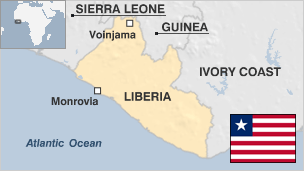
STATEMENT DELIVERED BY IBRAHIM AL-BAKRI NYEI AT A ONE-DAY SYMPOSIUM ORGANIZZED BY THE YOUTH UNITED FOR CHANGE IN THE TOWNSHIP OF NEW GEORGIAON MARCH 28, 2009
I was pleased and honored to have received a note of invitation from the Youth United for Change to present a paper on a very important and challenging topic that has a resounding relevance in contemporary political discourses and the reconstruction o9f our war-torn nation.
Upon receipt of the invitation, several thoughts began to pierce my mind. First, I was flattered by the invitation considering my limitations and the abundance of knowledgeable and resourceful men and women in Liberia including many prominent youth activities.
Second, I began to wonder as to why a specific topic considering democracy and youth must be a subject of the discourse, and particularly assigned to me.
Having undergone several thoughts and reflections in which my memories recalled the participation of young people in governance, and the terrible consequences that can be visited upon the young people when the society breaks into anarchy and the machineries of government cease to functionally impact their lives, I was quick to realize the essence of the blending. That was what I think liberated me from what I earlier saw as a mental incarceration.
However, it is of significant interest and a resounding prospect for progressive developments in Liberia to see young people in the midst of socio-economic challenges, mobilizing themselves into civil society groups to find alternative solutions to the complex political and socio-economic problems facing the country. Indeed this is a laudable venture which must be encouraged and promoted across the country.
When I received the invitation calling me to present on the topic “The importance of Democracy and youth Development”, I saw it as a broad topic that stretches beyond the horizon with academic and scholarship potentials to demand a global understanding. Again considering our immediate history and national demands as a post-conflict state in still in transition, I thought it necessary to narrow the topic to a particular setting using a case study.
I therefore seek your indulgence my distinguish audience and organizers to permit me to modify the topic as “The Importance of Democracy and Youth Development in Post-conflict Liberia”.
According to experts of international relations, from 1989-2003, the Liberian state ceased to exist as a functional sovereign authority with monopoly over the use of violence. The state deeply sank into terror when rebel forces or illegal citizen organizations under the guise of Liberation groups competed with the state on the use of violence. Liberia therefore became qualified to be listed in the category of ‘failed-states’.
It is important to briefly retrospect on the undemocratic nature of governance in Liberia that opened the precipice of grief, mass frustration and distrust, and finally the violence and the civil war.
The history of governance in Liberia is replete with a tradition of undemocratic practices and imperial leadership. For over 100 years an ethic minority of Americo –Liberian built an absolute and hegemonic control over all facets of the Liberian society, from the politics to the economy and to the social institutions
This kept the country polarized with fears because the vast majority of indigenous African ethnic groups were kept marginalized, disenfranchised, economically dispossessed, and were reduced to subservient levels.
The challenge to the autocracy was built by young Liberians who organized various pressure groups to demand change, reforms and equitable distributions of the nation’s wealth.
Finally, the Americo-Liberian hegemony was deposed by another group of young Liberians enlisted in the armed forces through a bloody coup. It was a sad day in history, because coup d’état in all its forms, is illegal, unconstitutional, barbaric, and a recipe for war and instability.
The history of activism, agitation, and the 1980 coup d’état tells that the youths have been actively involved with the nation’s body-politics, and have been the main engine of change in the country.
After years of governance failure, civil war and mass social dislocation, Liberia is today called a “shadow state”. A shadow state is a state that is fragile with high potential of descending into chaos. For Liberia to move to an ideal state status, with a dependent economy, venerated status in the international community, the need for democratic governance and empowerment of young people must be considered san quo non in our national development agenda.
Democracy must be the art and not and just word of the government and people. But what is democracy. Democracy is a concept that most African leaders have not understood. It is a concept still misunderstood and misused in a time when dictatorships and autocratic regimes have attempted to claim popular support by pinning democratic labels upon themselves. In their self-delusions of running democratic governments, we see massive under developments of the continent, pillage and plunder of resources, extreme poverty, and rigging of elections.
In the phrase of Abraham Lincoln, democracy is a government “of the people, by the people, and for the people”, but in a scholarly and theoretical definition, “democracy is a government by the people in which the supreme power is vested in the people and exercised directly by them or by their elected agents under a free electoral system”. Democracy goes beyond the periodic holding of elections. A viable democracy entails the unrestricted participation of the people in governance under a constitutional authority, equitable distribution of resources, and systems of transparency and accountability in governance. Liberia needs nothing less than the above to build its democratic credentials.
Democracy is therefore important in post conflict Liberia. It is only in a system of viable democracy that citizens freely work to reduce poverty and protect sustainable national development.
The young people that account for over sixty percent of the population of Liberia must be seen as the central focus in post conflict development initiative. The youths have participated in the country’s politics mainly during the years of war not as lead campaigners with conscious objectives but as agents or stooges fronting for the aggrandizement and interests of adults who had hidden economic and political agenda.
Empowering the young people must not in any way be reduced to a campaign of mobilizing political support this time around. It must be done with the clear objectives of meeting the national priorities of reconstruction and poverty reduction.
Youth development must entail the initiation of sustainable programs that will support both educational and economic empowerments. If the youths actively participate in the economy, it is most likely to have accelerated economic development, and a dramatic decline in crime, violence and instability in the country.
Youth development in post conflict Liberia is of relative importance to the building of a strong human security system. Security now no more depends on the formation of large armies with sophisticated weaponry, but the protection of individuals from violent comes, economic exploitations and social injustices. This is a new concept called Human security. This includes protecting people from hunger, disease, and natural disasters.
If the young people who are the reservoir of the productive energy of our society are economically and educationally empowered, those vice that threaten our human security will be drastically reduced.
Finally, my distinguished audience, I challenge you all to build a consciousness of national service and take on self initiative in the communities. See the nation as your own, the government as your making, work to promote the nation by respecting and supporting the government, demand your rights peacefully and be able to exercise your supreme power legally. Through this we can together build durable democracy, and provide development alternatives that will give the young people multiple options to better living standards.
In the Cause of Democracy and Social Justice, The Pen Shall Never Run Dry
Tuesday, April 7, 2009


Another Perspective on Liberia
By Heidi Baumgartner
Hunter College High School, New York
Leaving Roberts International Airport after a long flight from frigid New York City to Liberia, faint shadows of the landscape were all I could see of the new continent I had just landed on. It was a late hour of a humid February night when I arrived in West Africa with my teacher and one of his former students. For the next ten days I would be aiding them with humanitarian work, and exploring a place that was like nothing I had seen before. It was my first time in a third-world country and had no idea of what to expect in an area that only a few short years prior was a war zone.
An unexpected lack of running water and a broken generator awaited us at the house in Congo Town where we stayed that night. These conditions are commonplace to the majority of Liberians, but I admittedly was in a bit of a shock at having to grope my way through the darkness to the bed that the three of us had to share. Never having been deprived of running water, electricity and privacy, which as an American I had always considered essential resources that one could not live without, I was awakened to the fact that what I had always taken for granted could be considered a set of luxuries to others.
The closest previous contact I had with hardship was through my mother’s stories of growing up in impoverished Communist Poland after World War II. Her descriptions of the abject conditions she had to endure as a child were vivid in my mind as I thought about what I would find life to be like in this part of the world that was new to me, which was also still emerging from terrible civil conflict. But how similar could modern Liberia be to an Eastern European country fifty years ago?
My mother recollects much about the lasting effects of the war that ravaged the country. As has happened in Liberia, many buildings and roads in Poland were destroyed; centralized electricity and running water disappeared in many parts of the country. Water had to be carried from the bottom of the hill that my mother’s family lived on, up to the second floor of the building. The first floor was used as a schoolhouse, where seven large classes were fit into four rooms. Her father—my grandfather—was among the first group of college graduates in the country to receive a master’s degree after the war. He subsequently became a schoolteacher in an effort to contribute to the rebuilding of Poland. However, it was difficult. Several million Polish people had died in the war, the economy was destroyed, and the capital city was leveled to the ground in the aftermath of the Warsaw Uprising. There was no foreign aid and no U.N. assistance, leaving the ineffectual and corrupt Communist system imposed by the Soviet Union to cause far more harm than help. Soviet Communist propaganda was heard on the radio, newspapers were censored by the government, and political opponents were thrown into jail.
Under the Communist system, almost nothing was available in stores and there were few opportunities for employment, so my mother and her sister had to help their parents by picking mushrooms and berries and selling them in the market. Army trenches still scarred the land in Poland, and my mother remembers having to walk through them when she went to the forest. Fragments of grenades and land mines scattered the ground; reports about accidents caused by explosions of old undetonated mines were common. In the schoolhouse, one day a boy brought a grenade that he had found. To everyone’s horror, the teacher saw it was undetonated and called the police.
In Liberia I also saw remnants from the war, and problems obviating a system in need of improvement. The façades of government buildings were still visibly scorched, and sadly the people on the streets of Monrovia seemed far too accustomed to the many burning heaps of trash to do anything about them. Over the next week I experienced firsthand the necessity to bribe every police or customs officer to proceed without trouble. I drove on the potholed dirt highway from Monrovia to Ganta, breathing in the nauseating fumes from overfilled trucks that were sold to Liberia because they no longer passed emission requirements in other countries. I saw the omnipresent markets, with children desperately selling the few small items they had in front of them rather than going to school. Yet in the same way that Poland was able to recover from its problems, Liberia will be able to repair itself too.
Perhaps some lessons from Poland’s recovery can be applied to Liberia. I ask my mother what she thinks was the main factor that contributed to the recovery of Poland. The hard work of every single person, she says. Polish people took it unto themselves to make life better, not being able to rely on the government. Thus each and every person rebuilt his own house and planted a garden to grow food and save for the winter. Education was made a priority, as it was known that schooling was the key to advancement. The spectacular rebuilding of Warsaw became a source of national pride, with songs about progress becoming popular (such as the well-known song Budujemy nowy dom, or “We’re building a new house”) and schoolchildren learning about the hard work and strong values of the Polish people. And it was precisely these qualities of determination and self-help that allowed individuals better their lives, rebuild their homes and reestablish infrastructure. With time, Polish people regained independence from the oppressive Soviet rule and returned to a free market system.
And with time, Liberia will rise again. The aspirations, hard work, and strong morals of each individual can assure this success. What has been achieved since the war has been very significant, and the momentum of the progress will be sustained. Reconstruction will continue, and I hope that soon the streets of Monrovia will be cleaned. Maybe more people will take advantage of the relatively fertile soil of the region to grow their own gardens and lessen the burden of food costs on the family. I saw that Liberian students are motivated and well-disciplined, but those children who do not go to school need to be pushed into the classroom. Undaunted by the hindrances of ineffectual leadership, indifferent to the empty promises of foreign aid, and embracing the diversity of culture in Liberia to foster a sense of nationalism and unity, the Liberian people will sustain a lasting peace and prosperity.
About the Author
Heidi Baumgartner from Hunter College High School traveled to Liberia in February 2009 with her teacher Asumana Jabateh Randolph and his former student David Bauer, who is now studying at City University of New York. The group conducted workshops for science teachers about inexpensive laboratory technology that can be incorporated into the classroom. More information about their I-HELP Liberia Project can be found at http://www.ihelpliberia.com. The trip was also sponsored by LIMANY, the Liberian Mandingo Association of New York.
Hunter College High School, New York
Leaving Roberts International Airport after a long flight from frigid New York City to Liberia, faint shadows of the landscape were all I could see of the new continent I had just landed on. It was a late hour of a humid February night when I arrived in West Africa with my teacher and one of his former students. For the next ten days I would be aiding them with humanitarian work, and exploring a place that was like nothing I had seen before. It was my first time in a third-world country and had no idea of what to expect in an area that only a few short years prior was a war zone.
An unexpected lack of running water and a broken generator awaited us at the house in Congo Town where we stayed that night. These conditions are commonplace to the majority of Liberians, but I admittedly was in a bit of a shock at having to grope my way through the darkness to the bed that the three of us had to share. Never having been deprived of running water, electricity and privacy, which as an American I had always considered essential resources that one could not live without, I was awakened to the fact that what I had always taken for granted could be considered a set of luxuries to others.
The closest previous contact I had with hardship was through my mother’s stories of growing up in impoverished Communist Poland after World War II. Her descriptions of the abject conditions she had to endure as a child were vivid in my mind as I thought about what I would find life to be like in this part of the world that was new to me, which was also still emerging from terrible civil conflict. But how similar could modern Liberia be to an Eastern European country fifty years ago?
My mother recollects much about the lasting effects of the war that ravaged the country. As has happened in Liberia, many buildings and roads in Poland were destroyed; centralized electricity and running water disappeared in many parts of the country. Water had to be carried from the bottom of the hill that my mother’s family lived on, up to the second floor of the building. The first floor was used as a schoolhouse, where seven large classes were fit into four rooms. Her father—my grandfather—was among the first group of college graduates in the country to receive a master’s degree after the war. He subsequently became a schoolteacher in an effort to contribute to the rebuilding of Poland. However, it was difficult. Several million Polish people had died in the war, the economy was destroyed, and the capital city was leveled to the ground in the aftermath of the Warsaw Uprising. There was no foreign aid and no U.N. assistance, leaving the ineffectual and corrupt Communist system imposed by the Soviet Union to cause far more harm than help. Soviet Communist propaganda was heard on the radio, newspapers were censored by the government, and political opponents were thrown into jail.
Under the Communist system, almost nothing was available in stores and there were few opportunities for employment, so my mother and her sister had to help their parents by picking mushrooms and berries and selling them in the market. Army trenches still scarred the land in Poland, and my mother remembers having to walk through them when she went to the forest. Fragments of grenades and land mines scattered the ground; reports about accidents caused by explosions of old undetonated mines were common. In the schoolhouse, one day a boy brought a grenade that he had found. To everyone’s horror, the teacher saw it was undetonated and called the police.
In Liberia I also saw remnants from the war, and problems obviating a system in need of improvement. The façades of government buildings were still visibly scorched, and sadly the people on the streets of Monrovia seemed far too accustomed to the many burning heaps of trash to do anything about them. Over the next week I experienced firsthand the necessity to bribe every police or customs officer to proceed without trouble. I drove on the potholed dirt highway from Monrovia to Ganta, breathing in the nauseating fumes from overfilled trucks that were sold to Liberia because they no longer passed emission requirements in other countries. I saw the omnipresent markets, with children desperately selling the few small items they had in front of them rather than going to school. Yet in the same way that Poland was able to recover from its problems, Liberia will be able to repair itself too.
Perhaps some lessons from Poland’s recovery can be applied to Liberia. I ask my mother what she thinks was the main factor that contributed to the recovery of Poland. The hard work of every single person, she says. Polish people took it unto themselves to make life better, not being able to rely on the government. Thus each and every person rebuilt his own house and planted a garden to grow food and save for the winter. Education was made a priority, as it was known that schooling was the key to advancement. The spectacular rebuilding of Warsaw became a source of national pride, with songs about progress becoming popular (such as the well-known song Budujemy nowy dom, or “We’re building a new house”) and schoolchildren learning about the hard work and strong values of the Polish people. And it was precisely these qualities of determination and self-help that allowed individuals better their lives, rebuild their homes and reestablish infrastructure. With time, Polish people regained independence from the oppressive Soviet rule and returned to a free market system.
And with time, Liberia will rise again. The aspirations, hard work, and strong morals of each individual can assure this success. What has been achieved since the war has been very significant, and the momentum of the progress will be sustained. Reconstruction will continue, and I hope that soon the streets of Monrovia will be cleaned. Maybe more people will take advantage of the relatively fertile soil of the region to grow their own gardens and lessen the burden of food costs on the family. I saw that Liberian students are motivated and well-disciplined, but those children who do not go to school need to be pushed into the classroom. Undaunted by the hindrances of ineffectual leadership, indifferent to the empty promises of foreign aid, and embracing the diversity of culture in Liberia to foster a sense of nationalism and unity, the Liberian people will sustain a lasting peace and prosperity.
About the Author
Heidi Baumgartner from Hunter College High School traveled to Liberia in February 2009 with her teacher Asumana Jabateh Randolph and his former student David Bauer, who is now studying at City University of New York. The group conducted workshops for science teachers about inexpensive laboratory technology that can be incorporated into the classroom. More information about their I-HELP Liberia Project can be found at http://www.ihelpliberia.com. The trip was also sponsored by LIMANY, the Liberian Mandingo Association of New York.
Tuesday, March 10, 2009
CRITICAL ISSUES OF NATIONAL CONCERN X
THE LTA NEEDS INTERNAL ORDER
Ibrahim Al-bakri Nyei
pericle925@yahoo.com / www.ibrahimnyei.blogspot.com
The Liberia Telecommunication Authority was created by an Act of the Legislature to regulate telecommunications and frequency bands in the country. The LTA is part of the general public sector reform process aimed at ensuring efficiency in the delivery of services nation wide. Like many public commissions, members are appointed with a Chair to preside over its meetings and break ice when there are tied votes. Little did many know that the frequency zone is a major source of revenue in this country, but its effective regulation to maximize gains for the country was realized with the formation of the LTA, and the migration of moguls in the communication business into the country. In less than two years of its operations, its first chairman was hooked in a dubious deal with the West African Telecommunications which exposed its revenue generation capacity to many ordinary Liberians. The major problem observed was the balloon-infliction of the position of chairmanship which the first Chairman used in his attempt to dub his colleagues and the Liberian people. Little did he know that even a rubber balloon when improperly or over filled with air can explode and become irrelevant, particularly when the pressure exceeds its capacity. But this confusion and its resultant effect with the chairmanship issue of the LTA has not taught much lessons to those who are there now, as another inferno has begun to sink the regulating Authority into a crisis born out of an apparent lack of internal regulatory framework.
In all cases, there is no chairman of a public commission that is clothed with an authoritarian garment to unilaterally and sub-terraineously function without regular consultations with other members of the commission. But the case with the LTA has proven counterconsistent with conventional practices in the few months of its operations. The media's attention had been drawn to its activities and it seems that the Chairman of the Commission, Mr. Albert Bropleh had been caught hanging in a web of trilemas- failure to consult fellow members of the commission, failure to comply with auditors, and the self-crowning with an imperial leadership helmet. Bropleh on the other side of the divide had resurged with counterclaims. This and previous controversies at the LTA had magnetized the attention of pundits, and in the interest of furthering the national debate, and remaining constructive in engaging issues with the pen, this edition of the series had been preoccupied by the developments at the LTA and is therefore calling for immediate ceasefire, calm and order.
If our telecommunication systems will improve with consumers getting the maximum satisfactions from service providers and the service providers being regulated in a way that the chain is truly balanced - suppliers and consumers satisfied-this outcome will be based on a robust regulatory system. Regulating communication frequencies, bands, and all other telecommunication activities is much more like a saint presiding over a religious shrine whose deportment influences and direct the lives of his followers. The LTA therefore needs to be transparent and consistent with rules and regulations in order to be taken seriously and revered by its clients.
The internal rivalry at the LTA if not curtailed is capable of robbing it of its reverence in regulating our telecommunication systems, and we the consumers stand at a dangerous peril when the regulating agency is in internal feud. With prominent Liberians like Lamini Waritay, a long time public servant and redoubtable journalist this country can boast of, Commissioner Jappah-Samuka, Commissioner York, and others, the LTA can make a professional team to rely on. We expect the differences to be settled with majority votes as it is the case with public commissions that have commissioners with a ceremonious chairman whose power is only felt during elections. Differences in policies and ideological issues are never crashed over in the form and manner exhibited at the LTA. The problem identified now is that the nomenclature of 'Chairman' is being misconstrued thereby making Commissioner Bropleh to believe that he is an overhead boss, presiding over policy issues, meetings, and at the same time running the administration of the Liberia Telecommunication Authority.
Considering this complication of nomenclature and function which to some extent is building an imperial leadership that has met the conscious resistance of other Commissioners at the LTA, it is however prudent to recommend that the LTA hire the services of full time staffs under the supervision of a full time Executive Director, Executive Secretary, or Administrator, who shall be responsible for the financial, administrative and managerial operations of the LTA. With this at hand, the commissioners will mostly focus on regulatory policies and governance issues and the fear of dominance on the commission shall be extensively obliterated. As we can see with prominent commissions like the Governance Commission, the Truth and Reconciliation Commission and the newly created Liberia Anti-Corruption Commission, commissioners are preoccupied with policies and governance while the central administration is run by full time employees.
The feud at the LTA had also led to the leakage of several important financial documents detailing several transactions. On matters of such, only a well commissioned forensic audit can authenticate claims of misappropriation and theft of state resources. The LTA must therefore open its books to the General Auditing Commission for audit and should stop postponing or delaying scheduled audit if there is nothing under the sleeves to quarantine from public notice. We therefore rely on the viability and objectivity of the GAC to transform our rumors into facts or establish their current mixtures as truisms that need not be debated any further.
Finally, there is nothing more relevant in rescuing the LTA from drowning in a pool of corruption that will render it incompetent and incapable of regulating of frequency zones and generating revenues for our country than a system of genuine internal governance, cooperation and regular consultations among commissioners, an effective central administration and a transparent and accountable managerial framework. We believe that these will be important than to allow such relevant institution drown with the tarnishing of the good reputations of other commissioners who have outstanding records of services to this country and its people.
-In The Cause of Democracy and Social Justice, The Pen Shall Never Run Dry-
Ibrahim Al-bakri Nyei
pericle925@yahoo.com / www.ibrahimnyei.blogspot.com
The Liberia Telecommunication Authority was created by an Act of the Legislature to regulate telecommunications and frequency bands in the country. The LTA is part of the general public sector reform process aimed at ensuring efficiency in the delivery of services nation wide. Like many public commissions, members are appointed with a Chair to preside over its meetings and break ice when there are tied votes. Little did many know that the frequency zone is a major source of revenue in this country, but its effective regulation to maximize gains for the country was realized with the formation of the LTA, and the migration of moguls in the communication business into the country. In less than two years of its operations, its first chairman was hooked in a dubious deal with the West African Telecommunications which exposed its revenue generation capacity to many ordinary Liberians. The major problem observed was the balloon-infliction of the position of chairmanship which the first Chairman used in his attempt to dub his colleagues and the Liberian people. Little did he know that even a rubber balloon when improperly or over filled with air can explode and become irrelevant, particularly when the pressure exceeds its capacity. But this confusion and its resultant effect with the chairmanship issue of the LTA has not taught much lessons to those who are there now, as another inferno has begun to sink the regulating Authority into a crisis born out of an apparent lack of internal regulatory framework.
In all cases, there is no chairman of a public commission that is clothed with an authoritarian garment to unilaterally and sub-terraineously function without regular consultations with other members of the commission. But the case with the LTA has proven counterconsistent with conventional practices in the few months of its operations. The media's attention had been drawn to its activities and it seems that the Chairman of the Commission, Mr. Albert Bropleh had been caught hanging in a web of trilemas- failure to consult fellow members of the commission, failure to comply with auditors, and the self-crowning with an imperial leadership helmet. Bropleh on the other side of the divide had resurged with counterclaims. This and previous controversies at the LTA had magnetized the attention of pundits, and in the interest of furthering the national debate, and remaining constructive in engaging issues with the pen, this edition of the series had been preoccupied by the developments at the LTA and is therefore calling for immediate ceasefire, calm and order.
If our telecommunication systems will improve with consumers getting the maximum satisfactions from service providers and the service providers being regulated in a way that the chain is truly balanced - suppliers and consumers satisfied-this outcome will be based on a robust regulatory system. Regulating communication frequencies, bands, and all other telecommunication activities is much more like a saint presiding over a religious shrine whose deportment influences and direct the lives of his followers. The LTA therefore needs to be transparent and consistent with rules and regulations in order to be taken seriously and revered by its clients.
The internal rivalry at the LTA if not curtailed is capable of robbing it of its reverence in regulating our telecommunication systems, and we the consumers stand at a dangerous peril when the regulating agency is in internal feud. With prominent Liberians like Lamini Waritay, a long time public servant and redoubtable journalist this country can boast of, Commissioner Jappah-Samuka, Commissioner York, and others, the LTA can make a professional team to rely on. We expect the differences to be settled with majority votes as it is the case with public commissions that have commissioners with a ceremonious chairman whose power is only felt during elections. Differences in policies and ideological issues are never crashed over in the form and manner exhibited at the LTA. The problem identified now is that the nomenclature of 'Chairman' is being misconstrued thereby making Commissioner Bropleh to believe that he is an overhead boss, presiding over policy issues, meetings, and at the same time running the administration of the Liberia Telecommunication Authority.
Considering this complication of nomenclature and function which to some extent is building an imperial leadership that has met the conscious resistance of other Commissioners at the LTA, it is however prudent to recommend that the LTA hire the services of full time staffs under the supervision of a full time Executive Director, Executive Secretary, or Administrator, who shall be responsible for the financial, administrative and managerial operations of the LTA. With this at hand, the commissioners will mostly focus on regulatory policies and governance issues and the fear of dominance on the commission shall be extensively obliterated. As we can see with prominent commissions like the Governance Commission, the Truth and Reconciliation Commission and the newly created Liberia Anti-Corruption Commission, commissioners are preoccupied with policies and governance while the central administration is run by full time employees.
The feud at the LTA had also led to the leakage of several important financial documents detailing several transactions. On matters of such, only a well commissioned forensic audit can authenticate claims of misappropriation and theft of state resources. The LTA must therefore open its books to the General Auditing Commission for audit and should stop postponing or delaying scheduled audit if there is nothing under the sleeves to quarantine from public notice. We therefore rely on the viability and objectivity of the GAC to transform our rumors into facts or establish their current mixtures as truisms that need not be debated any further.
Finally, there is nothing more relevant in rescuing the LTA from drowning in a pool of corruption that will render it incompetent and incapable of regulating of frequency zones and generating revenues for our country than a system of genuine internal governance, cooperation and regular consultations among commissioners, an effective central administration and a transparent and accountable managerial framework. We believe that these will be important than to allow such relevant institution drown with the tarnishing of the good reputations of other commissioners who have outstanding records of services to this country and its people.
-In The Cause of Democracy and Social Justice, The Pen Shall Never Run Dry-
Friday, February 6, 2009
THE FUNDAMENTAL RIGHTS OF FREE SPEECH AND EXPRESSION IN THE CONSOLIDATION OF DEMOCRACY IN LIBERIA: THE ROLE OF THE MEDIA AND THE CIVIL SOCIETY
Ibrahim Al-bakri Nyei
Introduction
Liberia is a transitioning state struggling to heal wounds of a protracted civil conflict that resulted from a culture of marginalization, (attempts to alienate inalienable rights) suppression of inalienable rights, and opaque system in government transactions - underpinned by a system of bad governance. The people’s views were suppressed and crushed, thereby keeping them a distance from the administration of their country. This promoted imperial leadership, undermined democracy, and all values of transparency and accountability. The gross suppression of the views of the people, their rights to associate and express themselves freely, left them with no definitive role in the nation-building process, but to sit as passive observers. Unfortunately, while the people went through such political-dehumanization, the state was theoretically claiming to be run under a democratic system. But the overwhelming demands of the people have been popular participation and equality before the law. This surely can not take place in the absence of a propitious and enabling environment that will guarantee their rights to free expression and free speech.
In this post-conflict era democracy has been welcomed and its tenets promulgated in all corners of the country mainly by local and international civil society groups. Freedom of Expression and freedom of Speech are the pillows on which a durable democratic state stands. Practically, in the absence of a system that guarantees and promotes these rights, the people become separated from their state, vis-à-vis, their own destiny with fears and act of intimidations. Constructive and challenging competitions for leadership become non-existent, and policy decisions are made for a selected few.
The institutions of society and the state that guide and watch the activities of the state and the people to promote the tenets of democracy, the rule of law, and the inalienable rights of the citizens are the media and the civil society groups. These groups have pivotal roles in all aspects of the socio-economic and political developments of the state.
This paper will examine the essence of upholding the values of free speech and free expression in post-war Liberia not only as fundamental rights, but as sine quo non to fostering democracy and making it a culture and system of governance. It argues that if democracy is to be a system of governance in Liberia, the people must be free to speak and express themselves, they must have unlimited access to the media (both private and public media), participate in constructive dialogues and debates; and the people must also be conscientiously aware of the dangers associated with the abuse of those fundamentals rights.
The paper also asserts that the civil society and the media are the most appropriate vehicles through which the citizens express themselves, reach their government. Considering the critical aspects of the role of the civil society and the media in terms of values and objectivity, the paper concludes with a call to civil society and media groups to remain critical and independent in the performance of their roles as watchdogs.
The Rights to Free Speech and Expression
The rights to free speech and free expressions are inalienable rights given to mankind by his creator. The two are absolutely inextricable. Governments and civil society are created to protect those rights because it is those rights that set the foundations upon which democratic governments are legitimized and popularly supported. Attempts to have them suppressed or abrogated are potential causes for mass civil unrest, dishonesty, underdevelopment, and ultimately war. Several wars and unwanted revolutions have provided the absence of free speech, democracy and injustice as justifications. The Liberian Civil War, the fight Against Apartheid in South Africa, and the ongoing crisis in Zimbabwe are examples.
The building of democracy in Liberia will not just be dependent upon the holding of periodic elections for public officials. A genuine and functional democratic society is constructed by the participation of the people in a system of unhindered freedom to determine their own destinies singularly or in association with others through processes of dialogue and opportunities to provide alternatives for the operations of government and where necessary. In the 1986 Constitution of Liberia, Article 15 (a) declared the state’s commitment to its citizens in protecting their rights to free expression by providing that: ‘Every person shall have the right to freedom of expression, being fully responsible for the abuse thereof. This right shall not be curtailed, restricted or enjoined by government…’
The above provision of the 1986 Constitution draws a balance sheet which needs to be promulgated and properly interpreted for the people at all levels. That balance sheet is the point where the people’s rights as to be guaranteed by their government and their (people) responsibilities to those rights meet. A responsible government protects and strengthens the inalienable rights of the people, protects them from fears, relies on their views to make informed policy decisions, and maintains power by their general consent. On the other hand, a responsible citizenry gives loyalty to the state and supports its programs, and live under its laws. In a society where both sides honestly and transparently perform their shares of the responsibilities, democracy is strengthened and solidly consolidated, and the potentials for fears, corruption and injustices are considerably minimized.
In addition to the rights of free speech as part of free expression, the rights to freedom of religion and conscience, freedom of association and assembly, and the right to equal protection before the law are all complimentary in building and sustaining democracy in any civilized society. The suppression or attempt to abrogate any undermines the existence of all. These rights therefore, must in no way be limited to demands of constitutional provisions or statutes, but as natural gifts to mankind that are indispensable to the pursuit of happiness and liberty in society. Governments also must in no way legislate or decree in any form that will place restrictions on citizens from practicing those rights.
The state of democracy in Liberia today remains a function of extensive dialogues through symposia and conferences that ended the civil war, and called for elections which was freely held to inaugurate the present government. The democratic credentials of the present government, as have been declared by study groups, are ‘Good’ (World Bank, 2007). Liberia is a party to numerous international conventions and protocols that assert the basic fundamental rights discussed above. But the threat the country currently face in its transition to democracy is the looming illiteracy problem. As it is widely stated that democracy is for a conscious society, so is the requirement that consciousness goes with information through average literacy. The state must now work in programs to promote mass literacy which will not only build consciousness and awareness on fundamental rights, but will indeed promote growth and save succeeding generations from the scourge of bad governance and misrule that are extremely counterproductive to democracy.
The Media and Democracy
The role of the media is indisputable in generating and building a culture of democracy that extends beyond the political systems and becomes a way of life of the people as their consciousness increases. The media, as the name presents it, stands as a bridge that links the people to each other and their government. It is through the media that the government gets the thinking of the people and vis-à-vis the people get informed about the government and its activities, and also information from amongst them. The media as a channel of information also synthesizes and objectively presents to both the people and their government balanced reports to ensure that decisions are taken in the public interest.
By definitions, the media is the channel through which messages and information flows, and democracy is a system of government by the people in which the supreme power is vested in the people and exercised directly by them or by their elected agents under a free electoral system.
As stated above, freedom of speech and expressions are basic pillars of democracy. The common fact that the people can only express themselves or freely speak out their views through the media, makes it (media) an indispensable element of a democratic society. In the affirmative, no democracy exists without a vibrant media.
As the media’s role has been declared sacrosanct in the consolidation of democracy, its viability is essential in maintaining independence. The Liberian media community, like a typical African community, has struggled with tyrannical and oppressive regimes, and it still struggles to gain full independence from the ruling political establishment. Adding to the challenges posed by political influence-peddling in the media that undermines objectivity and credibility are the economic constraints and professional and technical inadequacies of practitioners and institutions in Liberia. Durable democracy in Liberia depends on an independent and vibrant media that will continuously provide credible reports, solicit views, and do critical analyses on principles of objectivity. The existence of such media community in a democratic state can transcend the role of message and information carrier in the eyes of the people to building trust and confidence among them and for their government. Those are the threads that hold the fibers of democracy together.
A state craving for democracy must not only have media institutions to use as channels for mere message carrying, but must ensure a propitious environment for the development and emergence of more institutions that will promote the tenets of democracy independent of government and political manipulations. The Liberian state must therefore ensure structural and functional viability and stability of media houses by enforcing laws of the media, promoting free speech and free expression, and legislating statutes where necessary to further strengthen the role of the media in the consolidation of democracy. It will be a resounding step forward if the current government can effectuate the passage of the three media laws drafted by the Liberia Media Law and Policy Reform Working Group: The Freedom of Information Act, the Act to Establish an Independent Broadcast Regulator for Liberia, and the Act to Transform the LBS into a Public Service Broadcast System.
Article 15 of the 1986 Constitution of Liberia supports the above requirements. In section (B) it outlines several rights to the citizens including ‘the right to hold opinions without interference and the right to knowledge’, the ‘right to free speech, academic freedom to receive and impart knowledge and information’, the right to libraries to make such knowledge available’, the ‘privacy of usage of the mail, telephone and the telegraph’ and the ‘right of citizens to remain silent’.
To have the above proclaimed rights fully exercised by the people, Section C states that ‘…there shall be no limitation on the public right to be informed about the government and its functionaries’.
The Role of the Civil Society
The civil society is the largest portion of the society representing all forces out of the government. Governments are functions of the civil society because it is from the civil society that all free governments are formed and operated. The civil society therefore has a pivotal role in ensuring that democracy is consolidated in Liberia. According to the Ministry of Planning and Economic Affairs there are over four hundred civil society organizations operating in the country. The goals and objectives of most of these groups are nearly the same, and sometimes they form coalitions to implement programs.
The history of effective contemporary civil society organizations in Liberia can be traced to the 1970s when pressure groups from around the country bounced on the national scene and began advocacies and agitations for multi-party democracy. These groups, the Movement for Justice in Africa, Progressive Alliance of Liberia represented people mainly from the destitute masses that were marginalized in political activities. The advocacy then could be done in no robust way in the absence of a democratic system that values and protects the rights of the people to express themselves by associating or socializing, and the right to speak out without intimidations.
Much of the works of mass public sensitization and awareness on governance and rule of law issues are done by the civil society. The media is more or less left as a one man army to inform and educate the people at the same time fearing reprisals for reports unfavorable to the political establishment. The civil society is now leading the campaign of mass awareness and civic education all directed at consolidating democracy as a way of life from the grassroots level. It is the civil society that leads the campaign against human rights violation, and the freedom of the press, and the freedom of the people to freely express themselves.
Civil Society Organizations (CSOs) must therefore build a firm reputation and stand vigilantly as the frontline agent in the advocacy for free speech and free expression. The need for effective internal governance and transparency in the operations of CSOs activities must be the moral ground on which CSOs should stand as campaigners against social malfeasances in society. In the absence of that the civil society by itself will drown into irrelevance, thereby fertilizing the ground for the sprouting of a modern dictatorship or totalitarian regime.
Civil society organizations in our context of free speech and expression must ensure that media institutions remain protected, and must continuously present the case that freedom of expression and access to official information are keys to sustainable human and economic development, democracy development, and the prevention of corruption, which in turn support conditions necessary for economic growth and good governance.
The Media and Civil Society as Partners
The partnership between the media and civil society organizations should be by practice, an ordained marriage of the proverbial ‘Roman Catholic’ style. In this partnership each compliments the work of the other and stands for the sake of the other in all instances. There is absolutely no room for divorce. The campaigns of civil society organizations can not go public in the absence of media coverage and at the same time the media can not afford to work in an environment that has no civil society independent of the government.
In contemporary societies, like Liberia, the media is an integral part of the civil society. And its role as a part of the whole civil society community is being seen through the works of independent media houses that have taken lines of ebullient advocacies for social justice and democracy in reportages that are people-sensitive. Since the return of normalcy in the country, several independent media institutions have emerged and hundreds of civil society organizations have also been formed by conscious-minded citizens. At the same time, some media practitioners have established civil society groups intended for the promotion of free speech, freedom of the press, and the empowerment of local journalists through training.
The results of the collaborations of the media and other civil society groups have been of significant impacts on both sides. The Press Union of Liberia and the Catholic Justice and Peace Commission (JPC) are in a partnership in which the JPC provides free legal services for journalists who during the expeditious execution of their duties are arrested or taken to court. At the same time, the three draft Laws of the Liberian Media that are now before the Legislature for enactments were drafted by a collaboration of government line agencies, several civil society groups, and the mass media, including the Press Union of Liberia, the Center for Media Studies and Peace Building, the Liberia Media Center, and the National Coalition of Civil Society Organizations in Liberia. The Liberia Coalition of Free Expression, another collaborating group comprising of media advocacy groups, other civil society groups and the PUL, is leading a campaign to ensure the speedy passage of the draft Laws.
Many civil society groups in the country are in specific agreements with media institutions for promotional and awareness programs aimed at civic education and the promotion of good governance and democracy. The Actions for Genuine Democratic Alternative (AGENDA) has a special program area intended to strengthen media institutions and civil society groups.
Conclusion
Building a culture of democracy in Liberia and establishing a system of democratic governance must be done simultaneously with the building and consolidating of a culture of press freedom and civil liberty. Democracy can not survive in an unfriendly media environment and an environment where the people’s fundamental rights are abused.
Consolidating democracy in Liberia with the media and civil society as active participants requires technical and professional capacity building of both the media and civil society actors. A weak civil society and biased media can pose challenge to the survivability of democracy. The media and the civil society must therefore be strong, unwavering and dedicated in the discharge of their duties as watchdogs and promoters of good governance. The people, too, the ultimate beneficiaries of a democratic system, must be empowered to participate through mass awareness and education. Article 6 of the Constitution of Liberia recognizes the people’s right to be educated as a requirement for national development:
The Republic shall, because of the vital role assigned to the individual citizen under this Constitution for the social, economic and political well-being of Liberia, provide equal access to educational opportunities and facilities for all citizens to the extent of available resources. Emphasis shall be placed on the mass education of the Liberian people and the elimination of illiteracy.
Introduction
Liberia is a transitioning state struggling to heal wounds of a protracted civil conflict that resulted from a culture of marginalization, (attempts to alienate inalienable rights) suppression of inalienable rights, and opaque system in government transactions - underpinned by a system of bad governance. The people’s views were suppressed and crushed, thereby keeping them a distance from the administration of their country. This promoted imperial leadership, undermined democracy, and all values of transparency and accountability. The gross suppression of the views of the people, their rights to associate and express themselves freely, left them with no definitive role in the nation-building process, but to sit as passive observers. Unfortunately, while the people went through such political-dehumanization, the state was theoretically claiming to be run under a democratic system. But the overwhelming demands of the people have been popular participation and equality before the law. This surely can not take place in the absence of a propitious and enabling environment that will guarantee their rights to free expression and free speech.
In this post-conflict era democracy has been welcomed and its tenets promulgated in all corners of the country mainly by local and international civil society groups. Freedom of Expression and freedom of Speech are the pillows on which a durable democratic state stands. Practically, in the absence of a system that guarantees and promotes these rights, the people become separated from their state, vis-à-vis, their own destiny with fears and act of intimidations. Constructive and challenging competitions for leadership become non-existent, and policy decisions are made for a selected few.
The institutions of society and the state that guide and watch the activities of the state and the people to promote the tenets of democracy, the rule of law, and the inalienable rights of the citizens are the media and the civil society groups. These groups have pivotal roles in all aspects of the socio-economic and political developments of the state.
This paper will examine the essence of upholding the values of free speech and free expression in post-war Liberia not only as fundamental rights, but as sine quo non to fostering democracy and making it a culture and system of governance. It argues that if democracy is to be a system of governance in Liberia, the people must be free to speak and express themselves, they must have unlimited access to the media (both private and public media), participate in constructive dialogues and debates; and the people must also be conscientiously aware of the dangers associated with the abuse of those fundamentals rights.
The paper also asserts that the civil society and the media are the most appropriate vehicles through which the citizens express themselves, reach their government. Considering the critical aspects of the role of the civil society and the media in terms of values and objectivity, the paper concludes with a call to civil society and media groups to remain critical and independent in the performance of their roles as watchdogs.
The Rights to Free Speech and Expression
The rights to free speech and free expressions are inalienable rights given to mankind by his creator. The two are absolutely inextricable. Governments and civil society are created to protect those rights because it is those rights that set the foundations upon which democratic governments are legitimized and popularly supported. Attempts to have them suppressed or abrogated are potential causes for mass civil unrest, dishonesty, underdevelopment, and ultimately war. Several wars and unwanted revolutions have provided the absence of free speech, democracy and injustice as justifications. The Liberian Civil War, the fight Against Apartheid in South Africa, and the ongoing crisis in Zimbabwe are examples.
The building of democracy in Liberia will not just be dependent upon the holding of periodic elections for public officials. A genuine and functional democratic society is constructed by the participation of the people in a system of unhindered freedom to determine their own destinies singularly or in association with others through processes of dialogue and opportunities to provide alternatives for the operations of government and where necessary. In the 1986 Constitution of Liberia, Article 15 (a) declared the state’s commitment to its citizens in protecting their rights to free expression by providing that: ‘Every person shall have the right to freedom of expression, being fully responsible for the abuse thereof. This right shall not be curtailed, restricted or enjoined by government…’
The above provision of the 1986 Constitution draws a balance sheet which needs to be promulgated and properly interpreted for the people at all levels. That balance sheet is the point where the people’s rights as to be guaranteed by their government and their (people) responsibilities to those rights meet. A responsible government protects and strengthens the inalienable rights of the people, protects them from fears, relies on their views to make informed policy decisions, and maintains power by their general consent. On the other hand, a responsible citizenry gives loyalty to the state and supports its programs, and live under its laws. In a society where both sides honestly and transparently perform their shares of the responsibilities, democracy is strengthened and solidly consolidated, and the potentials for fears, corruption and injustices are considerably minimized.
In addition to the rights of free speech as part of free expression, the rights to freedom of religion and conscience, freedom of association and assembly, and the right to equal protection before the law are all complimentary in building and sustaining democracy in any civilized society. The suppression or attempt to abrogate any undermines the existence of all. These rights therefore, must in no way be limited to demands of constitutional provisions or statutes, but as natural gifts to mankind that are indispensable to the pursuit of happiness and liberty in society. Governments also must in no way legislate or decree in any form that will place restrictions on citizens from practicing those rights.
The state of democracy in Liberia today remains a function of extensive dialogues through symposia and conferences that ended the civil war, and called for elections which was freely held to inaugurate the present government. The democratic credentials of the present government, as have been declared by study groups, are ‘Good’ (World Bank, 2007). Liberia is a party to numerous international conventions and protocols that assert the basic fundamental rights discussed above. But the threat the country currently face in its transition to democracy is the looming illiteracy problem. As it is widely stated that democracy is for a conscious society, so is the requirement that consciousness goes with information through average literacy. The state must now work in programs to promote mass literacy which will not only build consciousness and awareness on fundamental rights, but will indeed promote growth and save succeeding generations from the scourge of bad governance and misrule that are extremely counterproductive to democracy.
The Media and Democracy
The role of the media is indisputable in generating and building a culture of democracy that extends beyond the political systems and becomes a way of life of the people as their consciousness increases. The media, as the name presents it, stands as a bridge that links the people to each other and their government. It is through the media that the government gets the thinking of the people and vis-à-vis the people get informed about the government and its activities, and also information from amongst them. The media as a channel of information also synthesizes and objectively presents to both the people and their government balanced reports to ensure that decisions are taken in the public interest.
By definitions, the media is the channel through which messages and information flows, and democracy is a system of government by the people in which the supreme power is vested in the people and exercised directly by them or by their elected agents under a free electoral system.
As stated above, freedom of speech and expressions are basic pillars of democracy. The common fact that the people can only express themselves or freely speak out their views through the media, makes it (media) an indispensable element of a democratic society. In the affirmative, no democracy exists without a vibrant media.
As the media’s role has been declared sacrosanct in the consolidation of democracy, its viability is essential in maintaining independence. The Liberian media community, like a typical African community, has struggled with tyrannical and oppressive regimes, and it still struggles to gain full independence from the ruling political establishment. Adding to the challenges posed by political influence-peddling in the media that undermines objectivity and credibility are the economic constraints and professional and technical inadequacies of practitioners and institutions in Liberia. Durable democracy in Liberia depends on an independent and vibrant media that will continuously provide credible reports, solicit views, and do critical analyses on principles of objectivity. The existence of such media community in a democratic state can transcend the role of message and information carrier in the eyes of the people to building trust and confidence among them and for their government. Those are the threads that hold the fibers of democracy together.
A state craving for democracy must not only have media institutions to use as channels for mere message carrying, but must ensure a propitious environment for the development and emergence of more institutions that will promote the tenets of democracy independent of government and political manipulations. The Liberian state must therefore ensure structural and functional viability and stability of media houses by enforcing laws of the media, promoting free speech and free expression, and legislating statutes where necessary to further strengthen the role of the media in the consolidation of democracy. It will be a resounding step forward if the current government can effectuate the passage of the three media laws drafted by the Liberia Media Law and Policy Reform Working Group: The Freedom of Information Act, the Act to Establish an Independent Broadcast Regulator for Liberia, and the Act to Transform the LBS into a Public Service Broadcast System.
Article 15 of the 1986 Constitution of Liberia supports the above requirements. In section (B) it outlines several rights to the citizens including ‘the right to hold opinions without interference and the right to knowledge’, the ‘right to free speech, academic freedom to receive and impart knowledge and information’, the right to libraries to make such knowledge available’, the ‘privacy of usage of the mail, telephone and the telegraph’ and the ‘right of citizens to remain silent’.
To have the above proclaimed rights fully exercised by the people, Section C states that ‘…there shall be no limitation on the public right to be informed about the government and its functionaries’.
The Role of the Civil Society
The civil society is the largest portion of the society representing all forces out of the government. Governments are functions of the civil society because it is from the civil society that all free governments are formed and operated. The civil society therefore has a pivotal role in ensuring that democracy is consolidated in Liberia. According to the Ministry of Planning and Economic Affairs there are over four hundred civil society organizations operating in the country. The goals and objectives of most of these groups are nearly the same, and sometimes they form coalitions to implement programs.
The history of effective contemporary civil society organizations in Liberia can be traced to the 1970s when pressure groups from around the country bounced on the national scene and began advocacies and agitations for multi-party democracy. These groups, the Movement for Justice in Africa, Progressive Alliance of Liberia represented people mainly from the destitute masses that were marginalized in political activities. The advocacy then could be done in no robust way in the absence of a democratic system that values and protects the rights of the people to express themselves by associating or socializing, and the right to speak out without intimidations.
Much of the works of mass public sensitization and awareness on governance and rule of law issues are done by the civil society. The media is more or less left as a one man army to inform and educate the people at the same time fearing reprisals for reports unfavorable to the political establishment. The civil society is now leading the campaign of mass awareness and civic education all directed at consolidating democracy as a way of life from the grassroots level. It is the civil society that leads the campaign against human rights violation, and the freedom of the press, and the freedom of the people to freely express themselves.
Civil Society Organizations (CSOs) must therefore build a firm reputation and stand vigilantly as the frontline agent in the advocacy for free speech and free expression. The need for effective internal governance and transparency in the operations of CSOs activities must be the moral ground on which CSOs should stand as campaigners against social malfeasances in society. In the absence of that the civil society by itself will drown into irrelevance, thereby fertilizing the ground for the sprouting of a modern dictatorship or totalitarian regime.
Civil society organizations in our context of free speech and expression must ensure that media institutions remain protected, and must continuously present the case that freedom of expression and access to official information are keys to sustainable human and economic development, democracy development, and the prevention of corruption, which in turn support conditions necessary for economic growth and good governance.
The Media and Civil Society as Partners
The partnership between the media and civil society organizations should be by practice, an ordained marriage of the proverbial ‘Roman Catholic’ style. In this partnership each compliments the work of the other and stands for the sake of the other in all instances. There is absolutely no room for divorce. The campaigns of civil society organizations can not go public in the absence of media coverage and at the same time the media can not afford to work in an environment that has no civil society independent of the government.
In contemporary societies, like Liberia, the media is an integral part of the civil society. And its role as a part of the whole civil society community is being seen through the works of independent media houses that have taken lines of ebullient advocacies for social justice and democracy in reportages that are people-sensitive. Since the return of normalcy in the country, several independent media institutions have emerged and hundreds of civil society organizations have also been formed by conscious-minded citizens. At the same time, some media practitioners have established civil society groups intended for the promotion of free speech, freedom of the press, and the empowerment of local journalists through training.
The results of the collaborations of the media and other civil society groups have been of significant impacts on both sides. The Press Union of Liberia and the Catholic Justice and Peace Commission (JPC) are in a partnership in which the JPC provides free legal services for journalists who during the expeditious execution of their duties are arrested or taken to court. At the same time, the three draft Laws of the Liberian Media that are now before the Legislature for enactments were drafted by a collaboration of government line agencies, several civil society groups, and the mass media, including the Press Union of Liberia, the Center for Media Studies and Peace Building, the Liberia Media Center, and the National Coalition of Civil Society Organizations in Liberia. The Liberia Coalition of Free Expression, another collaborating group comprising of media advocacy groups, other civil society groups and the PUL, is leading a campaign to ensure the speedy passage of the draft Laws.
Many civil society groups in the country are in specific agreements with media institutions for promotional and awareness programs aimed at civic education and the promotion of good governance and democracy. The Actions for Genuine Democratic Alternative (AGENDA) has a special program area intended to strengthen media institutions and civil society groups.
Conclusion
Building a culture of democracy in Liberia and establishing a system of democratic governance must be done simultaneously with the building and consolidating of a culture of press freedom and civil liberty. Democracy can not survive in an unfriendly media environment and an environment where the people’s fundamental rights are abused.
Consolidating democracy in Liberia with the media and civil society as active participants requires technical and professional capacity building of both the media and civil society actors. A weak civil society and biased media can pose challenge to the survivability of democracy. The media and the civil society must therefore be strong, unwavering and dedicated in the discharge of their duties as watchdogs and promoters of good governance. The people, too, the ultimate beneficiaries of a democratic system, must be empowered to participate through mass awareness and education. Article 6 of the Constitution of Liberia recognizes the people’s right to be educated as a requirement for national development:
The Republic shall, because of the vital role assigned to the individual citizen under this Constitution for the social, economic and political well-being of Liberia, provide equal access to educational opportunities and facilities for all citizens to the extent of available resources. Emphasis shall be placed on the mass education of the Liberian people and the elimination of illiteracy.
Wednesday, January 14, 2009
CRITICAL ISSUES OF NATIONAL CONCERN IX
ON THE PRESIDENT'S APPEARANCE AT THE TRC
Ibrahim Al-bakri Nyei
It was in the interest of national reconciliation and the promotion of an environment of genuine coexistence that the Truth and Reconciliation Commission (TRC) was established as part of resolutions at the Comprehensive Peace Agreement in Accra in 2003. Since the commencement of its activities in the country, we have witnessed the appearance of victims, perpetrators as well as witnesses or individuals who have experiences or involvement with certain events during the conflict. In that direction, we have heard the testimonies of key actors, including the leaders of the NPFL, INPFL, ULIMO-K, ULIMO-J, MODEL, LURD, LPC, and other smaller groups that were duped as ‘defend forces’ for tribal or geographical settings. Individuals associated with the People’s redemption Council and the mass citizen-driven revolutionary groups of PAL and MOJA have also appeared and vivid accounts of their experiences during the internecine political decadence our country went though were delivered publicly. It is also of interest to state that children, civil society actors, women advocates, and media practitioners and historians delivered presentation on their own experiences. This indicates the relevance of the reconciliation process, and the resolved commitment of the people of Liberia to reconcile history and set a stage through structural and institutional change to avoid recurrence of conflict. Even those that were directly affected (those whose families were broken apart, homes and properties destroyed, loved ones killed) have embraced the process and are mustering the courage in true spirit of nationalism appearing before the Commission.
At this critical and terminal point of public hearings in the work of the Commission, the attention of this series has been drawn to a very simple issue – the appearance of President Ellen Johnson Sirleaf - that have turned to be controversial due to misinterpretation, misinformation, sycophancy, and the traditional Liberian style of favor-buying from the power-that- be. This edition of the series intends not to further deepen the controversies of the debate, but to emphasize the need for the President to appear, and not ignoring her right to an alternative appearance as provided by the TRC ACT.
Since the debate concerning the public appearance of President Ellen Johnson Sirleaf surfaced in the intellectual gymnasium, many commentators have argued that the President should not appear in public, some have campaigned for her public appearance like main perpetrators have done, but others, like the Attorney General of Liberia, have argued against any form of appearance by the President. The legal premise of those who are against public appearance and non-appearance have been based on Article 61 of the 1986 Constitution: “The President shall be immune from any suits, actions or proceedings, judicial or otherwise, and from arrest, detention or other actions on the account of any act done by him while President of Liberia pursuant to any provision of this Constitution or any other laws of the Republic. The President shall not however, be immune from prosecution upon removal from office for the commission of any criminal act done while President”.
At the same time, this argument has been buttressed by what they call ‘protecting the reverence of the office of the presidency’. As for the Attorney General, he had warned that the President should not appear on the basis of his assumption that some commissioners ‘could seek to also use the opportunity to embarrass or humiliate the presidency and this most noble office’. But this is a sheer sycophancy and a direct attempt to undermine the credibility of the Commissioners and their efforts in reconciling this country. The office of the presidency has no ounce of reverence to lose by appearing before the TRC to willingly make presentation on experiences, and answering questions from Commissioners which may primarily be drawn from testimonies of previous witnesses concerning the role of President Sirleaf in the civil crisis. Giving the office of the Presidency the noblest reverence, it remains prudent that as a person her position should not bereft her of her humanity and personality. That is, her position as a president should not restrict her from doing what she has openly expressed willingness to do in the national interest (not violating the constitution), and should also not deny her the opportunity to clear doubts of her involvement in the civil crisis as there are numerous claims on this subject.
The misinterpretation of Article 61 by those pseudo-constitutionalists is the belief or assumption that the TRC is a court, or proceedings at the TRC are forms of prosecution. An invitation to appear before a truth commission to give accounts of experiences is in no way an indictment, a suit nor an arrest. And statements at a truth commission, like the Liberian TRC, cannot be used in any court of law against the person making them (TRC ACT-Article VII, Section 30). The Commission’s sole mandate, according to its Act of 2005, is to promote national peace, security, unity and reconciliation. It is pursuant to that mandate that hearings are held to document the historical occurrences and the experiences of key players of the civil crisis, victims, witnesses, experts and individuals of interest to the process.
Another erratic and blatant bias on the part of the pseudo-constitutionalist is their deliberate refusal to interpret Article 97 of the 1986 Constitution which protects members of the People’s Redemption Council from answering questions at any proceedings regarding their roles in the change of government in 1980, and all other actions taken by the Council thereafter. Interestingly members of the PRC have appeared and their appearances in the eyes of those pseudo-constitutionalists have not contradicted any constitutional provision since they have kept silence on it. If history were to accidentally make President Sirleaf a member of the PRC, the basis of their argument would have been on Article 97 (but glory be to God she survived that historical accident).
President Sirleaf had promised to lead by example, and initiatives in her regime are manifestations of the fulfillment of that promise. She has taken bold steps to kickoff many national projects intentionally to encourage her fellow Liberians to follow. This was demonstrated when she took the HIV/AIDS and other Tests. Her mini agriculture project in her back yard and many other initiatives are resounding examples of leadership by example. In like manner, had President Sirleaf being the first to testify before the TRC, considering results yielded from initiatives she had launched, could make one to believe that the TRC would have had more witnesses than it currently have. And those threatening to boycott the process, particularly ministers in government, would have thought twice.
Her appearance before the Commission, no matter what is never late as she will be treated like any other witness as a prominent Liberian during the war years and not as the President of Liberia. Some witnesses have alleged that she directly participated in the. One witness claimed that he saw her in military outfits in rebel control areas; another witnessed linked her to the 1985 abortive coup. The veracities of those claims are yet to be established. There is also a statement attributed to her concerning the dismantling of the Executive Mansion during the heat of the war. The TRC public hearing is a ‘one-stop shop’ opportunity for every Liberian including President Sirleaf to perforate the rumor-balloon of their involvement with the civil crisis.
There are alternatives to appearing before the TRC. A witness could chose to appear in Camera by an application for proceedings to be held in camera by victims, perpetrators or witnesses and such application shall be considered and passed upon as the commission deems fit (TRC ACT – Art. VII Sec. 26, ii). President Sirleaf like any other Liberian has rights to all available alternatives.
But considering Liberia as a rumor- based society, where rumors, rather than facts spread quickly, we see it prudent and expedient that President Sirleaf muster the courage to appear before the TRC in public. This will not only promote her leadership by example campaign, but will help to clarify the doubts that many Liberians have concerning her involvement with war in this country. At the same time her failure to appear publicly will indirectly gown the claims of the previous witnesses as fact. Finally, this is a call to President Sirleaf, that for the sake of the national good, for the interest of those that admire her and willing to know about her involvement with the crisis, and for the clarifications of public doubts, and for the defense of her humanity she must disregard all ill-advices and make a public appearance at the TRC. If possible this must be broadcast live on all radio and television stations for many Liberians to have the opportunity to obtain first hand information.
It is a Liberian parable that says ‘the kojologbo (bitter medicine) is too bitter, but you must close your eyes to drink it with courage, and you will be healed”.
-In the Cause of Democracy and Social Justice, the Pen Shall Never Run Dry-
Ibrahim Al-bakri Nyei
It was in the interest of national reconciliation and the promotion of an environment of genuine coexistence that the Truth and Reconciliation Commission (TRC) was established as part of resolutions at the Comprehensive Peace Agreement in Accra in 2003. Since the commencement of its activities in the country, we have witnessed the appearance of victims, perpetrators as well as witnesses or individuals who have experiences or involvement with certain events during the conflict. In that direction, we have heard the testimonies of key actors, including the leaders of the NPFL, INPFL, ULIMO-K, ULIMO-J, MODEL, LURD, LPC, and other smaller groups that were duped as ‘defend forces’ for tribal or geographical settings. Individuals associated with the People’s redemption Council and the mass citizen-driven revolutionary groups of PAL and MOJA have also appeared and vivid accounts of their experiences during the internecine political decadence our country went though were delivered publicly. It is also of interest to state that children, civil society actors, women advocates, and media practitioners and historians delivered presentation on their own experiences. This indicates the relevance of the reconciliation process, and the resolved commitment of the people of Liberia to reconcile history and set a stage through structural and institutional change to avoid recurrence of conflict. Even those that were directly affected (those whose families were broken apart, homes and properties destroyed, loved ones killed) have embraced the process and are mustering the courage in true spirit of nationalism appearing before the Commission.
At this critical and terminal point of public hearings in the work of the Commission, the attention of this series has been drawn to a very simple issue – the appearance of President Ellen Johnson Sirleaf - that have turned to be controversial due to misinterpretation, misinformation, sycophancy, and the traditional Liberian style of favor-buying from the power-that- be. This edition of the series intends not to further deepen the controversies of the debate, but to emphasize the need for the President to appear, and not ignoring her right to an alternative appearance as provided by the TRC ACT.
Since the debate concerning the public appearance of President Ellen Johnson Sirleaf surfaced in the intellectual gymnasium, many commentators have argued that the President should not appear in public, some have campaigned for her public appearance like main perpetrators have done, but others, like the Attorney General of Liberia, have argued against any form of appearance by the President. The legal premise of those who are against public appearance and non-appearance have been based on Article 61 of the 1986 Constitution: “The President shall be immune from any suits, actions or proceedings, judicial or otherwise, and from arrest, detention or other actions on the account of any act done by him while President of Liberia pursuant to any provision of this Constitution or any other laws of the Republic. The President shall not however, be immune from prosecution upon removal from office for the commission of any criminal act done while President”.
At the same time, this argument has been buttressed by what they call ‘protecting the reverence of the office of the presidency’. As for the Attorney General, he had warned that the President should not appear on the basis of his assumption that some commissioners ‘could seek to also use the opportunity to embarrass or humiliate the presidency and this most noble office’. But this is a sheer sycophancy and a direct attempt to undermine the credibility of the Commissioners and their efforts in reconciling this country. The office of the presidency has no ounce of reverence to lose by appearing before the TRC to willingly make presentation on experiences, and answering questions from Commissioners which may primarily be drawn from testimonies of previous witnesses concerning the role of President Sirleaf in the civil crisis. Giving the office of the Presidency the noblest reverence, it remains prudent that as a person her position should not bereft her of her humanity and personality. That is, her position as a president should not restrict her from doing what she has openly expressed willingness to do in the national interest (not violating the constitution), and should also not deny her the opportunity to clear doubts of her involvement in the civil crisis as there are numerous claims on this subject.
The misinterpretation of Article 61 by those pseudo-constitutionalists is the belief or assumption that the TRC is a court, or proceedings at the TRC are forms of prosecution. An invitation to appear before a truth commission to give accounts of experiences is in no way an indictment, a suit nor an arrest. And statements at a truth commission, like the Liberian TRC, cannot be used in any court of law against the person making them (TRC ACT-Article VII, Section 30). The Commission’s sole mandate, according to its Act of 2005, is to promote national peace, security, unity and reconciliation. It is pursuant to that mandate that hearings are held to document the historical occurrences and the experiences of key players of the civil crisis, victims, witnesses, experts and individuals of interest to the process.
Another erratic and blatant bias on the part of the pseudo-constitutionalist is their deliberate refusal to interpret Article 97 of the 1986 Constitution which protects members of the People’s Redemption Council from answering questions at any proceedings regarding their roles in the change of government in 1980, and all other actions taken by the Council thereafter. Interestingly members of the PRC have appeared and their appearances in the eyes of those pseudo-constitutionalists have not contradicted any constitutional provision since they have kept silence on it. If history were to accidentally make President Sirleaf a member of the PRC, the basis of their argument would have been on Article 97 (but glory be to God she survived that historical accident).
President Sirleaf had promised to lead by example, and initiatives in her regime are manifestations of the fulfillment of that promise. She has taken bold steps to kickoff many national projects intentionally to encourage her fellow Liberians to follow. This was demonstrated when she took the HIV/AIDS and other Tests. Her mini agriculture project in her back yard and many other initiatives are resounding examples of leadership by example. In like manner, had President Sirleaf being the first to testify before the TRC, considering results yielded from initiatives she had launched, could make one to believe that the TRC would have had more witnesses than it currently have. And those threatening to boycott the process, particularly ministers in government, would have thought twice.
Her appearance before the Commission, no matter what is never late as she will be treated like any other witness as a prominent Liberian during the war years and not as the President of Liberia. Some witnesses have alleged that she directly participated in the. One witness claimed that he saw her in military outfits in rebel control areas; another witnessed linked her to the 1985 abortive coup. The veracities of those claims are yet to be established. There is also a statement attributed to her concerning the dismantling of the Executive Mansion during the heat of the war. The TRC public hearing is a ‘one-stop shop’ opportunity for every Liberian including President Sirleaf to perforate the rumor-balloon of their involvement with the civil crisis.
There are alternatives to appearing before the TRC. A witness could chose to appear in Camera by an application for proceedings to be held in camera by victims, perpetrators or witnesses and such application shall be considered and passed upon as the commission deems fit (TRC ACT – Art. VII Sec. 26, ii). President Sirleaf like any other Liberian has rights to all available alternatives.
But considering Liberia as a rumor- based society, where rumors, rather than facts spread quickly, we see it prudent and expedient that President Sirleaf muster the courage to appear before the TRC in public. This will not only promote her leadership by example campaign, but will help to clarify the doubts that many Liberians have concerning her involvement with war in this country. At the same time her failure to appear publicly will indirectly gown the claims of the previous witnesses as fact. Finally, this is a call to President Sirleaf, that for the sake of the national good, for the interest of those that admire her and willing to know about her involvement with the crisis, and for the clarifications of public doubts, and for the defense of her humanity she must disregard all ill-advices and make a public appearance at the TRC. If possible this must be broadcast live on all radio and television stations for many Liberians to have the opportunity to obtain first hand information.
It is a Liberian parable that says ‘the kojologbo (bitter medicine) is too bitter, but you must close your eyes to drink it with courage, and you will be healed”.
-In the Cause of Democracy and Social Justice, the Pen Shall Never Run Dry-
Wednesday, December 31, 2008
CRITICAL ISSUES OF NATIONAL CONCERN (VIII)
Year End Message to My Fellow Countrymen, Comrades, Well-Wishers and Audience
My Dear Countrymen and great comrades in the fight for social justice and democracy, I salute you all at this great time from the hilltop of progressivism where we have all over the years been posted critically thinking and utilizing the might of the pen to repel the forces of injustice, corruption, imperial leadership and the menace of poverty.
The year 2008 has gone and shall never return to meet us where it met us when we, mostly in our youths celebrated with lullabies and sent up praises to our Creator asking for longevity. At this time, our concern must not focus on request for longevity in life. What we must pray for considering the political climate and situation, which conventionally is at a disadvantage, is good governance, the product of which shall provide opportunities for longevity.
The year 2008 was a great challenge to lead campaigners for democracy and social justice in Africa. In our country, we saw the locust of corruption, due to the lack of security for public integrity, consuming the fabrics of good governance thereby depriving the masses of our people from better social services and ideal living standards. The scourges of rape and armed robbery went uncontrollably and still remain threats to the survivability of our people.
Mass killings and kidnappings, and abuse of little children through human trafficking were reported around the country. Natural disasters and unfortunate ones caused by men also left some of our people in homelessness and mournful agony. About nineteen of our countrymen died at the hands of others over a farmland dispute in Margibi County, which led to the arrest of a Senator and some others accused as partners-in-crime. Sadly, about ten of our compatriot also died during a football match between our dear Lone Star and visiting Gambia. Hundreds of our people were left as victims of flood around Monrovia, Nimba County, Grand Cape Mount County, and other parts of the country.
There were also several steps taken by our government to address some of those things threatening the existence of our people. Our government launched a road rehabilitation project which saw the paving of major streets in the country. Several construction works were undertaken in local communities to give our people roads to access markets with farm produce, schools to educate children, and health centers were opened in some communities. A strategy to reduce poverty, called LIFT LIBERIA, the common name for the Poverty Reduction Strategy, was launched as a means of reducing poverty in the lives of our people. An Emergency Response Unit of the Liberia National Police was inaugurated to fight robbery and other crimes in the country effectively.
An anti-graft unit called the Liberia Anti-Corruption Commission was launched to enforce the campaign against corruption in the country. But the make-up of the commission is still a controversial issue with the civil society community describing it as a ‘bogus process, which fell short of consultations’.
The Truth and Reconciliation Commission commenced its public hearings early in the year. Witnesses around the country, including individuals suspected of being perpetrators appeared and gave testimonies of their roles and experiences during the civil war. The testimonies left many of our countrymen in uncertainties and extreme frustrations due to the controversial accounts and deliberate distortions of the facts by those actors. At the same time the advocacy for the establishment of a war crime court continues with vigilance in the country.
During the year, several personalities visited our country which signaled to the world the return of genuine peace in Liberia. The President of the United States, George W. Bush, The Secretary General of the United Nations, Ban Ki Moon, including several other world larders and investors came and left. And a landmark event worth mentioning here was the election of Barack Obama as the First Afro-American to become President of the United States of America.
On the continent of Africa, several unfortunate situations left us with great challenges as we strive to democratize the continent. Electoral violence and protests left several of our people dead in Kenya and caused the East African state to lose nearly one billion dollar. Several properties were destroyed as the state nearly loses its authority. A new government was formed against the Constitution of the Country.
As the year ends, Zimbabwe remains a threat to us all where the political crisis has been transformed into a deadly humanitarian crisis that is killing our people. Hunger and pandemics have spread among the rural people while the political leaders have been stifled in a deadlock thereby leaving our people in conditions suffused with hopelessness. The state of Zimbabwe has completely loss its authority and has proven to be unable to protect our people from violence and at the same time can not provide for the people basic social services in health, nutrition, education, and security.
Our people in the Democratic Republic of Congo are being terrified and are dying of the scourge of war for which decades ago the United Nations was founded to prevent. In neighboring Guinea, the long time military cum civilian ruler, Lansana Conteh died, and a bloodless coup took place. The army has seized power and has unfortunately suspended the constitution, trade union activities, and political activities. This action by the army indicates that the rights of our people there will be suppressed and bad governance and dictatorship will continue there. That is a serious threat to us all and the entire subregion that is still recuperating from the internecine crises and political decadence that went around from Liberia to Sierra Leone and then to Ivory Coast.
At this critical point my dear compatriots, it is no imagination that I can tell you that the struggle for democracy and social justice in Africa will one day succeed. For us in Liberia, as we have committed ourselves to the fight against injustices, tyranny and bad governance using the pen and the intellectual mind, we must endure the fight. As we enter into a new year, let us all be hopeful and set a goal for every country. Our concentration in Liberia should be the Elimination of Corruption. Eliminating corruption should not be limited to government. We must enter our schools and oppose bribery; we must obey the laws of our country. For those of us who are in the markets, we must stop skyrocketing prices and sell according to standard prices. Extortion for services out of normal systems must be spoken against in our hospitals, banks, and public services and even the larger private sector.
Continentally, we must all join hands to campaign for the liberation of the great people of Zimbabwe, who by accident of history are the unfortunate victims of a failed state rambling in what the Legendary Nelson Mandela referred to as ‘a tragic failure of leadership’.
This is why we must utilize all available energies and option to counter every act in our country that may have the propensity of creating an imperial leadership. While we must be loyal citizens to our country, and we must all be defenders of its sovereignty, let us with consciousness avoid sycophancy and challenge dictatorship from all angles. Our common focus, if we are to reduce poverty, stop corruption and injustices must be the institutionalization of a system of good governance, because men in all spheres of the globe according to the Athenian Philosopher Socrates, desire nothing more in common than the wish for ‘good governance’.
Let the campaign continue with vigor and endurance in the New Year (2009). We must remain carriers of messages of peace, democracy and social justice every where we go. Peace in a neighboring country is peace in Liberia, and a threat to peace anywhere around the world, is threat to peace in Liberia. There must be no time in our lives when violence should become an option. Leaving the pen for violence is an indication that the intellectual reservoir has run dried, and unfortunately a violence campaign never succeed till the end, all in such struggle are mere cowards and losers. For our people to live in harmony and improved living conditions, the struggle for change, democracy, and social justice must remain bloodless.
I salute you, and wish you all the Blessing of our Creator in the Coming Year.
-In the Cause of Democracy and Social Justice, the Pen Shall Never Run Dry-
My Dear Countrymen and great comrades in the fight for social justice and democracy, I salute you all at this great time from the hilltop of progressivism where we have all over the years been posted critically thinking and utilizing the might of the pen to repel the forces of injustice, corruption, imperial leadership and the menace of poverty.
The year 2008 has gone and shall never return to meet us where it met us when we, mostly in our youths celebrated with lullabies and sent up praises to our Creator asking for longevity. At this time, our concern must not focus on request for longevity in life. What we must pray for considering the political climate and situation, which conventionally is at a disadvantage, is good governance, the product of which shall provide opportunities for longevity.
The year 2008 was a great challenge to lead campaigners for democracy and social justice in Africa. In our country, we saw the locust of corruption, due to the lack of security for public integrity, consuming the fabrics of good governance thereby depriving the masses of our people from better social services and ideal living standards. The scourges of rape and armed robbery went uncontrollably and still remain threats to the survivability of our people.
Mass killings and kidnappings, and abuse of little children through human trafficking were reported around the country. Natural disasters and unfortunate ones caused by men also left some of our people in homelessness and mournful agony. About nineteen of our countrymen died at the hands of others over a farmland dispute in Margibi County, which led to the arrest of a Senator and some others accused as partners-in-crime. Sadly, about ten of our compatriot also died during a football match between our dear Lone Star and visiting Gambia. Hundreds of our people were left as victims of flood around Monrovia, Nimba County, Grand Cape Mount County, and other parts of the country.
There were also several steps taken by our government to address some of those things threatening the existence of our people. Our government launched a road rehabilitation project which saw the paving of major streets in the country. Several construction works were undertaken in local communities to give our people roads to access markets with farm produce, schools to educate children, and health centers were opened in some communities. A strategy to reduce poverty, called LIFT LIBERIA, the common name for the Poverty Reduction Strategy, was launched as a means of reducing poverty in the lives of our people. An Emergency Response Unit of the Liberia National Police was inaugurated to fight robbery and other crimes in the country effectively.
An anti-graft unit called the Liberia Anti-Corruption Commission was launched to enforce the campaign against corruption in the country. But the make-up of the commission is still a controversial issue with the civil society community describing it as a ‘bogus process, which fell short of consultations’.
The Truth and Reconciliation Commission commenced its public hearings early in the year. Witnesses around the country, including individuals suspected of being perpetrators appeared and gave testimonies of their roles and experiences during the civil war. The testimonies left many of our countrymen in uncertainties and extreme frustrations due to the controversial accounts and deliberate distortions of the facts by those actors. At the same time the advocacy for the establishment of a war crime court continues with vigilance in the country.
During the year, several personalities visited our country which signaled to the world the return of genuine peace in Liberia. The President of the United States, George W. Bush, The Secretary General of the United Nations, Ban Ki Moon, including several other world larders and investors came and left. And a landmark event worth mentioning here was the election of Barack Obama as the First Afro-American to become President of the United States of America.
On the continent of Africa, several unfortunate situations left us with great challenges as we strive to democratize the continent. Electoral violence and protests left several of our people dead in Kenya and caused the East African state to lose nearly one billion dollar. Several properties were destroyed as the state nearly loses its authority. A new government was formed against the Constitution of the Country.
As the year ends, Zimbabwe remains a threat to us all where the political crisis has been transformed into a deadly humanitarian crisis that is killing our people. Hunger and pandemics have spread among the rural people while the political leaders have been stifled in a deadlock thereby leaving our people in conditions suffused with hopelessness. The state of Zimbabwe has completely loss its authority and has proven to be unable to protect our people from violence and at the same time can not provide for the people basic social services in health, nutrition, education, and security.
Our people in the Democratic Republic of Congo are being terrified and are dying of the scourge of war for which decades ago the United Nations was founded to prevent. In neighboring Guinea, the long time military cum civilian ruler, Lansana Conteh died, and a bloodless coup took place. The army has seized power and has unfortunately suspended the constitution, trade union activities, and political activities. This action by the army indicates that the rights of our people there will be suppressed and bad governance and dictatorship will continue there. That is a serious threat to us all and the entire subregion that is still recuperating from the internecine crises and political decadence that went around from Liberia to Sierra Leone and then to Ivory Coast.
At this critical point my dear compatriots, it is no imagination that I can tell you that the struggle for democracy and social justice in Africa will one day succeed. For us in Liberia, as we have committed ourselves to the fight against injustices, tyranny and bad governance using the pen and the intellectual mind, we must endure the fight. As we enter into a new year, let us all be hopeful and set a goal for every country. Our concentration in Liberia should be the Elimination of Corruption. Eliminating corruption should not be limited to government. We must enter our schools and oppose bribery; we must obey the laws of our country. For those of us who are in the markets, we must stop skyrocketing prices and sell according to standard prices. Extortion for services out of normal systems must be spoken against in our hospitals, banks, and public services and even the larger private sector.
Continentally, we must all join hands to campaign for the liberation of the great people of Zimbabwe, who by accident of history are the unfortunate victims of a failed state rambling in what the Legendary Nelson Mandela referred to as ‘a tragic failure of leadership’.
This is why we must utilize all available energies and option to counter every act in our country that may have the propensity of creating an imperial leadership. While we must be loyal citizens to our country, and we must all be defenders of its sovereignty, let us with consciousness avoid sycophancy and challenge dictatorship from all angles. Our common focus, if we are to reduce poverty, stop corruption and injustices must be the institutionalization of a system of good governance, because men in all spheres of the globe according to the Athenian Philosopher Socrates, desire nothing more in common than the wish for ‘good governance’.
Let the campaign continue with vigor and endurance in the New Year (2009). We must remain carriers of messages of peace, democracy and social justice every where we go. Peace in a neighboring country is peace in Liberia, and a threat to peace anywhere around the world, is threat to peace in Liberia. There must be no time in our lives when violence should become an option. Leaving the pen for violence is an indication that the intellectual reservoir has run dried, and unfortunately a violence campaign never succeed till the end, all in such struggle are mere cowards and losers. For our people to live in harmony and improved living conditions, the struggle for change, democracy, and social justice must remain bloodless.
I salute you, and wish you all the Blessing of our Creator in the Coming Year.
-In the Cause of Democracy and Social Justice, the Pen Shall Never Run Dry-
Tuesday, December 23, 2008
CRITICAL ISSUES OF NATIONAL CONCERN (VII)
Emphasizing the Reality of Bropleh’s Alternative to Rapists
Ibrahim Al-bakri Nyei
One would wonder why this controversial issue has claimed the attention of the pen, and has become a subject of discussion under this series. As it was stated in the maiden edition of this series, that our discovery of the fact that what we are writing are influencing national policy decisions, so everything that has to do with a contentious national issue will have to be a matter of dialoguing here for possible solutions. That has, and will always be our intent. That is also why the slogan of the series goes like this: In the Cause of Democracy and Social Justice the Pen Shall Never Run Dry.
There are three major reasons why we will have to attempt to emphasize the reality of Dr. Bropleh’s clear and audacious alternative to the spineless and vicious men in our society who are inhumanely assaulting teenagers as low as six years and nine years to ease their sexual emotions. We have to divorce this issue from all hypocrisies and sycophancies. As a social thinker I believe strongly that what threatened society and the survivability of a particular generation must be countered and eliminated with all available options. Whether Bropleh thinks the same way, so be it. The three reasons we will discussed to emphasize the reality of the alternative are: The issue of rape, the issue of prostitution, and the controversies surrounding the personality of Bropleh.
The first reason here is the prevalence of rape in our country today. It is indeed appalling that rape and armed robbery are the two crimes that usually top police charge sheet. Sadly, little girls in their teens and under ten years are the unfortunate victims of this scourge. There are several cases that when we reminisced of for the sake of humanity we weep in empathy. That an innocent kid will loss her life or her future just in few minutes to the pleasure of a man who has no esteem for himself is a question that we all must ponder over. Two years ago nine-year old Janjay died of rape. Earlier this year, a little girl identified as Tenezee was raped to death in New Kru Town. Several of these cases are occurring uncontrollably. Children are either dying or being damaged completely. Imagine that a six-year old had her womb removed after being raped.
With all attempts made, including the Act that makes rape unbaillabe, with all the harsh punishments against convicts, the crime continues unabatedly. These are occurring in a country where there are prostitutes available for anything one can afford. Therefore, it is prudent and realistic enough for anyone to call the attention of rapists to the services of prostitutes as a means of saving little children from their (rapists) wrath. For anyone to think the other way and condemn this as an option is to be hypocritical and to give a blind-folded eye to the reality of prostitution, and at the same time not doing anything about it.
Prostitution is now an open business in Liberia, and this is not an issue to brag on any longer. In 2005 Save The Children-UK released a report indicating that 90 percent of a sample of school going girls in Monrovia were surviving on prostitution. Regrettably the Gender Ministry and the NTGL did not do any counter investigation to help reduce this immorality in Liberia, but later condemned the report. This is a wrong way of addressing our social problems in this country. We need to face the facts about those problems and find solutions or alternatives to them.
Finally, I must bring out an important issue here to conclude this conversation. Bropleh’s personality and assertions have most often sprouted controversies in this country. This is not strange to me. Every revolutionary who attempts to bring momentary changes to the prevailing order will have to face the condemnations of those benefiting from the wastage of that order. It is evident that many things we accept and do in this country do not reflect the reality of the day and also can not be accommodated in the new realm of globalization. But it will only take a virtuous and courageous man to denounce those things. And as such, he must be prepared to suffer attacks from conformists. In recognition of the fact that Liberia is a pluralistic society, Bropleh, a Methodist prelate, called for the recognition of Islamic Holidays or the elimination of Christian holidays from our national activities. He was misunderstood not because he was not clear, but because people wanted to use the situation against him to score relevance, and for many other reasons. And unfortunately, he received all the condemnations available to the wisdom of his critics. He had come across similar situations in his attempt to attitudinally revolutionize this society that is morally decrepit. Today, he has seen a situation that is very troubling - involving the future of little and innocent Liberian girls against the quenching of the sexual thirst of individuals who have no esteem for their manhood - destroying little and innocent kids. For him he believes that since all attempts are not yielding the required result of curbing rape - he had proposed to rapist to make use of prostitutes that are available. But as usual this is the society that he is struggling with, he is the subject of all humiliations and personality mortification by people including women groups that can not curb rape and prostitution by themselves. Anyway, this where he has launched his revolution, so help us God.
I give him my support and I care not who misunderstand the reality of these revolutions that are coming event by event. Where the fact is practical and visible, we shall not deter to throw in our energy.
It was the American civil rights writer, Ralph Waldo Emerson that said, ‘….To be great is to be misunderstood’. … ‘Jesus was misunderstood, Socrates was misunderstood, Pythagoras was misunderstood, and so many who came to change were misunderstood.’
And I am not surprised if Bropleh is misunderstood.
-In the Cause of Democracy and Social Justice, the Pen Shall Never Run Dry-
Ibrahim Al-bakri Nyei
One would wonder why this controversial issue has claimed the attention of the pen, and has become a subject of discussion under this series. As it was stated in the maiden edition of this series, that our discovery of the fact that what we are writing are influencing national policy decisions, so everything that has to do with a contentious national issue will have to be a matter of dialoguing here for possible solutions. That has, and will always be our intent. That is also why the slogan of the series goes like this: In the Cause of Democracy and Social Justice the Pen Shall Never Run Dry.
There are three major reasons why we will have to attempt to emphasize the reality of Dr. Bropleh’s clear and audacious alternative to the spineless and vicious men in our society who are inhumanely assaulting teenagers as low as six years and nine years to ease their sexual emotions. We have to divorce this issue from all hypocrisies and sycophancies. As a social thinker I believe strongly that what threatened society and the survivability of a particular generation must be countered and eliminated with all available options. Whether Bropleh thinks the same way, so be it. The three reasons we will discussed to emphasize the reality of the alternative are: The issue of rape, the issue of prostitution, and the controversies surrounding the personality of Bropleh.
The first reason here is the prevalence of rape in our country today. It is indeed appalling that rape and armed robbery are the two crimes that usually top police charge sheet. Sadly, little girls in their teens and under ten years are the unfortunate victims of this scourge. There are several cases that when we reminisced of for the sake of humanity we weep in empathy. That an innocent kid will loss her life or her future just in few minutes to the pleasure of a man who has no esteem for himself is a question that we all must ponder over. Two years ago nine-year old Janjay died of rape. Earlier this year, a little girl identified as Tenezee was raped to death in New Kru Town. Several of these cases are occurring uncontrollably. Children are either dying or being damaged completely. Imagine that a six-year old had her womb removed after being raped.
With all attempts made, including the Act that makes rape unbaillabe, with all the harsh punishments against convicts, the crime continues unabatedly. These are occurring in a country where there are prostitutes available for anything one can afford. Therefore, it is prudent and realistic enough for anyone to call the attention of rapists to the services of prostitutes as a means of saving little children from their (rapists) wrath. For anyone to think the other way and condemn this as an option is to be hypocritical and to give a blind-folded eye to the reality of prostitution, and at the same time not doing anything about it.
Prostitution is now an open business in Liberia, and this is not an issue to brag on any longer. In 2005 Save The Children-UK released a report indicating that 90 percent of a sample of school going girls in Monrovia were surviving on prostitution. Regrettably the Gender Ministry and the NTGL did not do any counter investigation to help reduce this immorality in Liberia, but later condemned the report. This is a wrong way of addressing our social problems in this country. We need to face the facts about those problems and find solutions or alternatives to them.
Finally, I must bring out an important issue here to conclude this conversation. Bropleh’s personality and assertions have most often sprouted controversies in this country. This is not strange to me. Every revolutionary who attempts to bring momentary changes to the prevailing order will have to face the condemnations of those benefiting from the wastage of that order. It is evident that many things we accept and do in this country do not reflect the reality of the day and also can not be accommodated in the new realm of globalization. But it will only take a virtuous and courageous man to denounce those things. And as such, he must be prepared to suffer attacks from conformists. In recognition of the fact that Liberia is a pluralistic society, Bropleh, a Methodist prelate, called for the recognition of Islamic Holidays or the elimination of Christian holidays from our national activities. He was misunderstood not because he was not clear, but because people wanted to use the situation against him to score relevance, and for many other reasons. And unfortunately, he received all the condemnations available to the wisdom of his critics. He had come across similar situations in his attempt to attitudinally revolutionize this society that is morally decrepit. Today, he has seen a situation that is very troubling - involving the future of little and innocent Liberian girls against the quenching of the sexual thirst of individuals who have no esteem for their manhood - destroying little and innocent kids. For him he believes that since all attempts are not yielding the required result of curbing rape - he had proposed to rapist to make use of prostitutes that are available. But as usual this is the society that he is struggling with, he is the subject of all humiliations and personality mortification by people including women groups that can not curb rape and prostitution by themselves. Anyway, this where he has launched his revolution, so help us God.
I give him my support and I care not who misunderstand the reality of these revolutions that are coming event by event. Where the fact is practical and visible, we shall not deter to throw in our energy.
It was the American civil rights writer, Ralph Waldo Emerson that said, ‘….To be great is to be misunderstood’. … ‘Jesus was misunderstood, Socrates was misunderstood, Pythagoras was misunderstood, and so many who came to change were misunderstood.’
And I am not surprised if Bropleh is misunderstood.
-In the Cause of Democracy and Social Justice, the Pen Shall Never Run Dry-
Monday, December 15, 2008
CRITICAL ISSUES OF NATIONAL CONCERN (VI)
Who wins the Corruption War?
Ibrahim Al-bakri Nyei
President Ellen Johnson-Sirleaf in her inaugural address declared corruption as publc enemy number one, indicating that a fierce battle would be launched against corruption. But President Sirleaf did not indicate where the battle front or the buffer zone will be. Moreover the word corruption has become a political cliché to either destroy opponents or to score political victory. Both are evidence in the ongoing war.
Since then the government had continuously decried the presence and prevalence of corruption in the country, portraying a forceful resurgence of the public enemy. But when one thinks about who or what really represent the public enemy on the front, it creates a pseudomystic thinking to either assume or dismiss that those who are decrying the public enemy are the ones representing the forces of the enemy. Thus the enemy becomes invisible, and practically invincible.
And now it seems that the public enemy number one has worn bullet proof to survive, there seems to be serious inadequacy on the part of the battle front commander who declared the war open. The inadequacies are not the absence of logistics, equipments, and resources. The inadequacies are manifested in the deep-seated cronyism style of leadership and the lack of political and administrative will in the Frontline Commander to move vigilantly. Moreover, the war has been influenced by peddling, bigotry, and a system of ‘cover-up’ for those who are in or near the ‘kitchen cabinet’
The government of Liberia is armed with all necessary weaponry and units to ensure victory. The infantry battalion at the GAC is doing all to dig out the hidden public enemy in government agencies. But it seems that forces representing the government in the illusive, yet publicized war are not appreciative of each other. Some public occurrences in recent time can actually tell where the public enemy is being hosted. The Deputy Auditor General was brutally attacked at the Ministry of Public Works, while officials indicted by audit reports are sponsoring bogus ‘pro-democracy’ groups to undermine the credibility of the GAC. Reports of influence peddling are lingering in the spheres of government operations in terms of contracts, concessions, and political appointments. The worst of these reports are the ones occurring in the camp of the commander-in- chief, and the u-turn in decision concerning the Western Cluster deal which was widely believed to be characterized by ‘palm greasing’.
The judiciary is swimming in serious pool of malfeasances where justice is now on bonanza for sale, and the Supreme Court is nearly turning to a partisan syndicate, where majority votes, influenced by lobbyists - not reasons, precedence, and statutes - are determining verdicts.
The Liberia Anti-Corruption Commission was intended to reinforce the battle, but its rejection by the civil society has dumped it into a pool of the incredible syndicates. This had left the people with no hope in the war, as the public enemy gluttonously consumes their resources with no accounts.
After crying wolves for nearly three years, the president announced a policy on corruption which still falls short of effective political will to prosecute and restitute stolen assets. Yet she claimed that the battle will be won. Intellectually, as they are now fighting the war using public speeches and gimmicks, they may win applause from their cheering squads for their oratorical skills. Fantastically, the government claims that the widespread talk about corruption in the country is an indication that the fight is succeeding, but that is a sheer farce. The noise is publicly made because the people are deeply frustrated and tired of corruption because they are still feeling its impacts in the presence of intellectual grandiloquence and opulent pleasantries.
The battle line has been absorbed in extreme hypocrisy thereby putting the true owners of the nation’s resources, in whose interests the war is purportedly launched, in sheer disillusionments.
But at the end of the six-year term, it will be no surprise to see the masses of the people weeping for losing the corruption war, because it is not fought in their interest. The war has taken a trend that had left pundits to believe that it is intended for those who are innocent and have no real affiliations with the ‘untouchables’. Audit reports from the statutory audit institution, the General Auditing Commission, have been reduced to legislative debate where anything can happen and anyone can lobby to go free, while audit reports from quasi panels are used as the basis in the fight against corruption. But let them know that whatever the case, we are aware that the prosecution based on the ECOWAS Panel Report is in no way a fight against corruption in this government. What we know is that those accuse of corruption in this government are either changed from one Ministry or Agency to another, or forwarded to the Justice Ministry for investigations- the reports of which are never made public or heard of anymore .
Finally, let’s make no satire of this situation; the Liberian people will definitely lose the corruption war. At the end of the six-year term, those that have been destitute will still be the same or deteriorate beyond conventional poverty classification, while the central clique, the group that earns nothing except in government, will grow their bellies and secure big accounts out of the country; paying huge mortgages on properties in the U. S and Europe while Liberia remains undeveloped; paying tuitions in schools and Universities in Europe and the U.S thereby giving them no reason to improve educational facilities in the country. Shamelessly, the same group seeks medical treatments abroad, benefitting from the products of the farsighted leadership given by others while resources given to them to manage are squandered. The much talked about Poverty Reduction Strategy, a fine intellectual paper, is nothing but an illusion, because even those that are preaching it around are aware that it cannot be achieved in three years, and resources to be used for its implementation are transferred to private pockets. But the sycophancy and hypocrisy has to go on, to pave the way for continuity in the spree of ‘gobachopism’. Who wins the war is left with anyone to determine, but the loser is clear.
But I say this to my dear people: The days of weeping shall one day be over, and a leadership that will fight corruption in the true interest of Liberia will one day come. And so, ‘endure the times and weep no more, for your days are ahead’.
In the Cause of Democracy and Social Justice, The Pen Shall Never Run Dry
Ibrahim Al-bakri Nyei
President Ellen Johnson-Sirleaf in her inaugural address declared corruption as publc enemy number one, indicating that a fierce battle would be launched against corruption. But President Sirleaf did not indicate where the battle front or the buffer zone will be. Moreover the word corruption has become a political cliché to either destroy opponents or to score political victory. Both are evidence in the ongoing war.
Since then the government had continuously decried the presence and prevalence of corruption in the country, portraying a forceful resurgence of the public enemy. But when one thinks about who or what really represent the public enemy on the front, it creates a pseudomystic thinking to either assume or dismiss that those who are decrying the public enemy are the ones representing the forces of the enemy. Thus the enemy becomes invisible, and practically invincible.
And now it seems that the public enemy number one has worn bullet proof to survive, there seems to be serious inadequacy on the part of the battle front commander who declared the war open. The inadequacies are not the absence of logistics, equipments, and resources. The inadequacies are manifested in the deep-seated cronyism style of leadership and the lack of political and administrative will in the Frontline Commander to move vigilantly. Moreover, the war has been influenced by peddling, bigotry, and a system of ‘cover-up’ for those who are in or near the ‘kitchen cabinet’
The government of Liberia is armed with all necessary weaponry and units to ensure victory. The infantry battalion at the GAC is doing all to dig out the hidden public enemy in government agencies. But it seems that forces representing the government in the illusive, yet publicized war are not appreciative of each other. Some public occurrences in recent time can actually tell where the public enemy is being hosted. The Deputy Auditor General was brutally attacked at the Ministry of Public Works, while officials indicted by audit reports are sponsoring bogus ‘pro-democracy’ groups to undermine the credibility of the GAC. Reports of influence peddling are lingering in the spheres of government operations in terms of contracts, concessions, and political appointments. The worst of these reports are the ones occurring in the camp of the commander-in- chief, and the u-turn in decision concerning the Western Cluster deal which was widely believed to be characterized by ‘palm greasing’.
The judiciary is swimming in serious pool of malfeasances where justice is now on bonanza for sale, and the Supreme Court is nearly turning to a partisan syndicate, where majority votes, influenced by lobbyists - not reasons, precedence, and statutes - are determining verdicts.
The Liberia Anti-Corruption Commission was intended to reinforce the battle, but its rejection by the civil society has dumped it into a pool of the incredible syndicates. This had left the people with no hope in the war, as the public enemy gluttonously consumes their resources with no accounts.
After crying wolves for nearly three years, the president announced a policy on corruption which still falls short of effective political will to prosecute and restitute stolen assets. Yet she claimed that the battle will be won. Intellectually, as they are now fighting the war using public speeches and gimmicks, they may win applause from their cheering squads for their oratorical skills. Fantastically, the government claims that the widespread talk about corruption in the country is an indication that the fight is succeeding, but that is a sheer farce. The noise is publicly made because the people are deeply frustrated and tired of corruption because they are still feeling its impacts in the presence of intellectual grandiloquence and opulent pleasantries.
The battle line has been absorbed in extreme hypocrisy thereby putting the true owners of the nation’s resources, in whose interests the war is purportedly launched, in sheer disillusionments.
But at the end of the six-year term, it will be no surprise to see the masses of the people weeping for losing the corruption war, because it is not fought in their interest. The war has taken a trend that had left pundits to believe that it is intended for those who are innocent and have no real affiliations with the ‘untouchables’. Audit reports from the statutory audit institution, the General Auditing Commission, have been reduced to legislative debate where anything can happen and anyone can lobby to go free, while audit reports from quasi panels are used as the basis in the fight against corruption. But let them know that whatever the case, we are aware that the prosecution based on the ECOWAS Panel Report is in no way a fight against corruption in this government. What we know is that those accuse of corruption in this government are either changed from one Ministry or Agency to another, or forwarded to the Justice Ministry for investigations- the reports of which are never made public or heard of anymore .
Finally, let’s make no satire of this situation; the Liberian people will definitely lose the corruption war. At the end of the six-year term, those that have been destitute will still be the same or deteriorate beyond conventional poverty classification, while the central clique, the group that earns nothing except in government, will grow their bellies and secure big accounts out of the country; paying huge mortgages on properties in the U. S and Europe while Liberia remains undeveloped; paying tuitions in schools and Universities in Europe and the U.S thereby giving them no reason to improve educational facilities in the country. Shamelessly, the same group seeks medical treatments abroad, benefitting from the products of the farsighted leadership given by others while resources given to them to manage are squandered. The much talked about Poverty Reduction Strategy, a fine intellectual paper, is nothing but an illusion, because even those that are preaching it around are aware that it cannot be achieved in three years, and resources to be used for its implementation are transferred to private pockets. But the sycophancy and hypocrisy has to go on, to pave the way for continuity in the spree of ‘gobachopism’. Who wins the war is left with anyone to determine, but the loser is clear.
But I say this to my dear people: The days of weeping shall one day be over, and a leadership that will fight corruption in the true interest of Liberia will one day come. And so, ‘endure the times and weep no more, for your days are ahead’.
In the Cause of Democracy and Social Justice, The Pen Shall Never Run Dry
Monday, November 24, 2008
CRITICAL ISSUE OF NATIONAL CONCERN (V)
THE CONDITION OF DISABLED LIBERIANS: MY ENCOUNTER WITH THE BLINDS
Ibrahim Al-bakri Nyei
While roaming the streets of Monrovia one encounters many things, sometimes strange, mysterious and sometimes very interesting events that seem to be unimaginable. For those with hearts and minds for humanity come across sorrows while others may just move about. During those chores, it sometimes becomes a fortune to meet an old friend or a good friend and, to see entertainers –most of them in search of a bread to take home.
My observation has roughly concluded that three out of every twenty Liberians that roam the streets of Monrovia during the week must have some form of disability, or inability- blindness, physically impaired, mentally impaired and technically incapacitated (lacking in productive skills) - but LISGIS can prove me otherwise. These are really the people that most often come out with no specific routine or schedule for the day but with high hopes of taking bread to feed a family and keep life going.
This, in some ways, is indicative of the depth to which poverty have sunk into the lives of the people that it is becoming deep-rooted and finally accepted as part of life. Interestingly, it is prevailing in the midst of multilateral donor funding and acclaimed professional government with a much publicized poverty reduction agenda coupled with huge revenue intake. This unfavorable, yet prevailing state of affairs had involuntarily reduced thousands of our people to sheer mendicancy at the expense of the dignity of their humanity and personal integrity. Anyway, let’s get to the critical issue.
On a hot Saturday afternoon I encountered four blind Liberians who had come on what they normally term as field outreach – singing in street corners. The four blinds were engaged in a hot feud over the spot at the Carey and Lynch Streets intersection. One had claimed that the spot is his position and he gets his daily bread from there. The other, a lady in a counterclaim, averred that she had met no one there; therefore she is entitled to be there. The other two were peacemakers. One of the blinds being so farsighted suggested that a deal be agreed upon: One person use the location for three days in the week, and the other for the remaining three days excluding Sunday. The blind man who claimed ownership of the spot refused to accept the deal on grounds that the lady has always obstructed his normal ‘eating spot’.
I could not withstand witnessing what the people were going through. They attracted a huge number of people that stood witnessing them, some steering in laughter while some expressing sympathetic ululations. Even within the audience witnessing the blinds, there were some Liberians who still complain about the presence of unfavorable economic conditions that are making life unbearable.
But why will everyone complain in the country. The survivability of the physically, mentally and visually disabled and the technically unable who move around the streets depends on those that are both physically and technically able, and if the latter group complains of hardship, by extension, the disabled only survive at the general mercy of God.
Yes everyone must survive at the general mercy of God, but the segment of our society surviving on welfare needs special attention from the society – the state, religious groups, philanthropic organizations, and the family. These groups must work to ensure the upholding of the dignity of those people by providing better livelihoods for them that their survivability can not be dependent upon transitory incomes obtained from begging in street corners.
The empowering of those people economically through the provision of skills that will make them independent will not only take them from the street as beggars, but it will also reduce the state’s expenditure on welfare for the disabled. By extension that will in some way reduce burdens and stress on those that are able in a way that saving will increase in the economy.
Finally, it will also be important that relevant line ministries and welfare groups focus attention to the mentally impaired. The number of mentally impaired persons (mad men and women) is increasing steadily in the city of Monrovia and the country at large. Some of these people begin their madness with minor psychosocial problems that can be solved. But the absence of care through counseling and encouragement gradually leads them to a terrible situation of madness. This group of people needs to be catered to at a special center for mental rehabilitation where they will be properly monitored and protected from returning to the streets where they are abused, beaten, raped, and sometimes kidnapped.
-In the Cause of Democracy and Social Justice the Pen Shall Never Run Dry-
Ibrahim Al-bakri Nyei
While roaming the streets of Monrovia one encounters many things, sometimes strange, mysterious and sometimes very interesting events that seem to be unimaginable. For those with hearts and minds for humanity come across sorrows while others may just move about. During those chores, it sometimes becomes a fortune to meet an old friend or a good friend and, to see entertainers –most of them in search of a bread to take home.
My observation has roughly concluded that three out of every twenty Liberians that roam the streets of Monrovia during the week must have some form of disability, or inability- blindness, physically impaired, mentally impaired and technically incapacitated (lacking in productive skills) - but LISGIS can prove me otherwise. These are really the people that most often come out with no specific routine or schedule for the day but with high hopes of taking bread to feed a family and keep life going.
This, in some ways, is indicative of the depth to which poverty have sunk into the lives of the people that it is becoming deep-rooted and finally accepted as part of life. Interestingly, it is prevailing in the midst of multilateral donor funding and acclaimed professional government with a much publicized poverty reduction agenda coupled with huge revenue intake. This unfavorable, yet prevailing state of affairs had involuntarily reduced thousands of our people to sheer mendicancy at the expense of the dignity of their humanity and personal integrity. Anyway, let’s get to the critical issue.
On a hot Saturday afternoon I encountered four blind Liberians who had come on what they normally term as field outreach – singing in street corners. The four blinds were engaged in a hot feud over the spot at the Carey and Lynch Streets intersection. One had claimed that the spot is his position and he gets his daily bread from there. The other, a lady in a counterclaim, averred that she had met no one there; therefore she is entitled to be there. The other two were peacemakers. One of the blinds being so farsighted suggested that a deal be agreed upon: One person use the location for three days in the week, and the other for the remaining three days excluding Sunday. The blind man who claimed ownership of the spot refused to accept the deal on grounds that the lady has always obstructed his normal ‘eating spot’.
I could not withstand witnessing what the people were going through. They attracted a huge number of people that stood witnessing them, some steering in laughter while some expressing sympathetic ululations. Even within the audience witnessing the blinds, there were some Liberians who still complain about the presence of unfavorable economic conditions that are making life unbearable.
But why will everyone complain in the country. The survivability of the physically, mentally and visually disabled and the technically unable who move around the streets depends on those that are both physically and technically able, and if the latter group complains of hardship, by extension, the disabled only survive at the general mercy of God.
Yes everyone must survive at the general mercy of God, but the segment of our society surviving on welfare needs special attention from the society – the state, religious groups, philanthropic organizations, and the family. These groups must work to ensure the upholding of the dignity of those people by providing better livelihoods for them that their survivability can not be dependent upon transitory incomes obtained from begging in street corners.
The empowering of those people economically through the provision of skills that will make them independent will not only take them from the street as beggars, but it will also reduce the state’s expenditure on welfare for the disabled. By extension that will in some way reduce burdens and stress on those that are able in a way that saving will increase in the economy.
Finally, it will also be important that relevant line ministries and welfare groups focus attention to the mentally impaired. The number of mentally impaired persons (mad men and women) is increasing steadily in the city of Monrovia and the country at large. Some of these people begin their madness with minor psychosocial problems that can be solved. But the absence of care through counseling and encouragement gradually leads them to a terrible situation of madness. This group of people needs to be catered to at a special center for mental rehabilitation where they will be properly monitored and protected from returning to the streets where they are abused, beaten, raped, and sometimes kidnapped.
-In the Cause of Democracy and Social Justice the Pen Shall Never Run Dry-
Friday, November 21, 2008
THE CHALLENGES OF ACHIEVING GENUINE RECONCILIATION IN LIBERIA
Ibrahim Al-bakri Nyei
Introduction
Reconciliation as an institution and function of the transitional justice system is done with contrition and forgiveness based on the conviction of the parties involved. There have been numerous discourses to explore possibilities of genuine reconciliation in the absence of justice. Justice comes in two forms, restorative and retributive. Restorative justice calls for the reconciling of the forces involved in a conflict to restore and build broken relations without punitive actions against perpetrators. On the other hand, retributive justice prosecutes and punishes guilty perpetrators for war crimes and crimes against humanity.
In all cases, transitional justice examines the two – restorative, through truth commissions, and retributive through tribunals or courts. In the transitional justice process none is a substitute for the other, and individuals searching for the truth, or prosecuting perpetrators are to have no connections with the conflicts and its associated problems. A tribunal can succeed a truth commission or any of them can be duly implemented. Other countries like Sierra Leone and Rwanda have experienced some forms of the two. While South Africa, Ghana, and some states in the United States resolved their internal conflicts with only truth commissions.
The post-conflict situation in Liberia is challenged by numerous occurrences and expectations. The effort to establish the actual causes of the Liberian Civil War is on-going through the Truth and Reconciliation Commission established under the Comprehensive Peace Agreement that finalized the brutal aspects of the Civil War. The process as a whole is transitional and needs to be handled carefully in the absence of biases and prejudices. This paper is an attempt to critically examine the ability and will of the commission to effectively propel the shattered and traumatized people of Liberia towards the achievement of genuine reconciliation in the midst of blunders, glaring deficiencies, oversights, contradictions, claims, counterclaims, rebuttals and propositions and limited human, material and financial capacity. The argument therefore does not attempt to dismiss the strides made by the commission in executing its mandate.
Historical Distortions and Empirical Contradictions
History as the account of events of the past built on political and socio-economic occurrences can not be evaded in reality. What history suffers is distortion and biases from academicians who deliberately write to satisfy clique or individual interests. However the case with Liberia, it is empirical that the written history of Liberia is replete with errors and deliberate distortions. Written Liberian history texts taught in schools have no details on the contributions of many sectors to the growth of the state, some are humiliating to the tribal communities, and many with glorifications for the settlers. Today, eyebrows, and questions are being raised about the reality of the existence or actual occurrences of some incidents in Liberian history, the Matilda Newport and Canon situation is one of such.
Every event of today must have some connections with precedence from the past. The present can not therefore be decided without references and linkages with the past just as the future can not be determined in the absence of acquaintances with the past and the present.
This issue of deliberately prejudicing and slicing the contextual issues of our history does not only pose a challenge to our reconciliation process, but also retains a declassified mentality of the Liberian psyche for a significant part of our population. Our reconciliation process is therefore highly challenged to clarify the contradictions.
One of the mandates of the TRC is to ‘conduct a critical review of Liberia’s historical past, with the view to establishing and giving recognition to historical truths in order to address falsehoods and misconceptions of the past relating to the nation’s socio-economic and political development’ [Article IV (d) TRC ACT]. With varying and controversial accounts of our history, one wonders critically as to whose writing may be considered the falsity and whose writing the truth by the TRC.
The Commission, according to its Act is to investigate occurrences between the period January 1979 to October 14, 2003. We will have to be told by common logic whether an incident that occurred on January 1, 1979 have no unbalance force that precipitated its occurrence from December 31, 1978 backward. The causes of events can not be evaded in a reconciliation or prosecution process, and a problem can not be addressed without using its causes as a prime variable. These are necessary to further expound in the discourse and sharpen the contradictions in our reconciliation process because the Act did not mandate the Commission to go into events preceding 1979. The Commission will only thread into such incidents based on an application by any person or group of persons.
Critically, the Twin Battles, the issue of the Fernando Po Crises, the Matilda Newport Situation (whether True of False), the 1951 and 1955 incidents, the numerous raids of natives by the LFF and many more incidents are not within the stipulated mandate of the Commission, except by the interest of a group or an individual who may by inquisitiveness request the Commission to do so.
Questions of Neutrality and Independence
If we are all to be at the Great Judgment Day, those to prosecute or ask us questions are those who never live with us on earth. There hands are cleans of all worldly deeds, whether good or evil. They therefore morally fit to mount the podium, enjoy the requisite independence, and characteristic neutrality to ask anyone a question and declare you fit for either heaven or hell.
Transitional justice or conventional judicial systems require independence of juries, panelists, judges, and commissioners, etc. This independence is required to render unbiased and impartial decisions that will set a peaceful trajectory for progress and avoid, by the conscience of the participants –perpetrators, victims as well as witness- a relapse into chaos. Does our institution of reconciliation, the Truth and Reconciliation Commission possess the characteristics of independence, impartiality, neutrality with reference to our civil war, and our political evolution as a nation-state in connection with varying ideologies? This question is puzzling and raised another critical one of the possibility of x-raying every Liberian to find the most neutral to lead the reconciliation drive. Is there any of us, so unique and without stains from the causes and consequences of the conflict? Let the search begin. So help us God!
Since the process began many questions of such have emerge from key actors as well as victims. Some members of the Commission, however the case, were connected to either the cause or the consequences of the civil conflict. Some are from the political institution which many of the witnesses have condemned for being responsible for our national woes. Will they now resign and put out public defense for their party. At the same time, some are from various activist organizations, and student groups that agitated in the country thereby necessitating the change that led to the war. What can they also say of their roles? One may wonder whether they will build their defense in their report, or possibly, there may be a compromising report to satisfy the apparently opposing forces on the Commission.
Claims and Counterclaims
We are seeking to have genuine reconciliation. This desire, if fervent and ardent to our quest for peace and development must be guided by principles of truth and judgment of morality. In this effort, we must speak nothing but the whole truth since indeed we have decided to speak of our roles and reconcile our socio-political and economic disparities that will lead to the possible consolidation of peace among us as a nation and people.
It is the importance of the truth to the process of reconciliation that all witnesses are required to take oath before explaining their roles. But if the witnesses are fiendish enough and have no reverence for the process, their testimonies become clothed with lies, errors and contradictions, thereby making a buffoonery of the process.
The hearings of our Truth and Reconciliation Commission since its inception in January 2008 have been characterized by claims and counterclaims which expose the possibilities of falsities and distortions in the testimonies of witnesses. With these ensuing, it ponders our consciousness to think with exegeses about the prospects of achieving genuine reconciliation when the truth or the whole are allegedly not been told.
In fact, the first testimony that was made before the Commission on the first day of public hearing still remains an issue of serious controversy. The accused perpetrator has mustered all courage to challenge the testimony against him on the basis of its inaccuracy as he alleged. That testimony also lifted the floor mat and dragged the public attention to a claim that it was done under a conspiratorial supervision of one of the Commissioners.
In recent occurrences, the pages of newspapers and headlines of major news have been focused on the thematic hearings of the Commission, but regrettably, rebuttals and counterclaims and street discussions are challenging those testimonies continuously, and are simultaneously posing more encumbering challenges to the overall process of genuine reconciliation, since the parties involved in the cross-claiming scenarios are not submissive to accepting what have been said under oath vis-à-vis there is no barometer to test the testimonies and determine the lies form the truths, or no means of avoiding witnesses from lying under oath.
General Expectation versus Capacity
The general expectation of the people of Liberia is to live in perpetual peace and economic prosperity. Toward this end, the people are committed to whatsoever initiative that can reconcile the past, build the peace and improve both the governance and the economy. This is generally demonstrated by the people’s support to major activities in the country – the Elections, the Reconciliation process, etc.
At present, the vicinity of the Centennial Pavilion that has been over the years an abandoned and quiet area is fully active and paying host to Liberians from all orientations who assemble daily based on their inherent interests to follow the reconciliation process of their country. At the bottom of their heart is to have PEACE and DEVELOPMENT, though many persons suggest different ways of reaching that ultimate desire. For some a War Crime Tribunal is the best way to solve the problems of our civil crisis and bring perpetrators to justice. But others believe that reconciliation through the TRC should remain the only channel of addressing national anguish and tragedy. Yet, there are some who believe that ‘sleeping dog should lie’, so that ‘we can not dig out old wounds’.
However, the road to achieving genuine reconciliation to meet the general expectation of the people need to be matched with the capacity of the state, its institutions of governance and the Truth and Reconciliation Commission. The capacity of the Commission- human, material and financial needs significant support and effective monitoring till the end. The Commission at one time went comatose as a result of limited funding to the extent that statement-takers launched series of strikes.
People are recommending, in regards to the alleged connections of some members of the Commission to the conflict which undermines their neutrality, that foreigners be hired to write the report and actual history of the country based on the data gathered by the Commission. With the ongoing expectations of the public, the need to empower the commission in finance, human and material resources needs not be overemphasized. In the absence of such capacity building to ensure efficiency in its work, the people’s expectation will be cataclysmically defeated and the reconciliation process will remain illusive.
Conclusion
The process of attaining genuine reconciliation in a post-conflict nation is as delicate as the process of making and keeping the peace. Our quest to have a nation reconciled with its people in harmony and economic prosperity must be treated with much delicacy and reverence for basic principle of transitional justice.
The truth and Reconciliation Commission, the transitional justice institution championing our reconciliation agenda, is threatened by many challenges that may erupt controversies after the process have concluded. These challenges are manifested in the structure, mandate and targets of the commission as have been made public during its period of
Hearings. The process has witnessed accusations from major actors on the independence and neutrality of Commissioners, on the credibility of witness and so forth.
The people are now in their consciousness, diagnosing the possibilities of achieving genuine reconciliation amidst the deliberate distortion of historical facts and claims of falsities and witch-hunting, and limitations or inadequacies on the part of the Commission itself.
However, the Liberian people are committed to seeing their nation peaceful in booming with economic opportunities, and a spirit of trust and confidence in the system of governance. This resolve of the people to reconcile and build peace have been manifested to their courage and support given to all national initiatives.
Introduction
Reconciliation as an institution and function of the transitional justice system is done with contrition and forgiveness based on the conviction of the parties involved. There have been numerous discourses to explore possibilities of genuine reconciliation in the absence of justice. Justice comes in two forms, restorative and retributive. Restorative justice calls for the reconciling of the forces involved in a conflict to restore and build broken relations without punitive actions against perpetrators. On the other hand, retributive justice prosecutes and punishes guilty perpetrators for war crimes and crimes against humanity.
In all cases, transitional justice examines the two – restorative, through truth commissions, and retributive through tribunals or courts. In the transitional justice process none is a substitute for the other, and individuals searching for the truth, or prosecuting perpetrators are to have no connections with the conflicts and its associated problems. A tribunal can succeed a truth commission or any of them can be duly implemented. Other countries like Sierra Leone and Rwanda have experienced some forms of the two. While South Africa, Ghana, and some states in the United States resolved their internal conflicts with only truth commissions.
The post-conflict situation in Liberia is challenged by numerous occurrences and expectations. The effort to establish the actual causes of the Liberian Civil War is on-going through the Truth and Reconciliation Commission established under the Comprehensive Peace Agreement that finalized the brutal aspects of the Civil War. The process as a whole is transitional and needs to be handled carefully in the absence of biases and prejudices. This paper is an attempt to critically examine the ability and will of the commission to effectively propel the shattered and traumatized people of Liberia towards the achievement of genuine reconciliation in the midst of blunders, glaring deficiencies, oversights, contradictions, claims, counterclaims, rebuttals and propositions and limited human, material and financial capacity. The argument therefore does not attempt to dismiss the strides made by the commission in executing its mandate.
Historical Distortions and Empirical Contradictions
History as the account of events of the past built on political and socio-economic occurrences can not be evaded in reality. What history suffers is distortion and biases from academicians who deliberately write to satisfy clique or individual interests. However the case with Liberia, it is empirical that the written history of Liberia is replete with errors and deliberate distortions. Written Liberian history texts taught in schools have no details on the contributions of many sectors to the growth of the state, some are humiliating to the tribal communities, and many with glorifications for the settlers. Today, eyebrows, and questions are being raised about the reality of the existence or actual occurrences of some incidents in Liberian history, the Matilda Newport and Canon situation is one of such.
Every event of today must have some connections with precedence from the past. The present can not therefore be decided without references and linkages with the past just as the future can not be determined in the absence of acquaintances with the past and the present.
This issue of deliberately prejudicing and slicing the contextual issues of our history does not only pose a challenge to our reconciliation process, but also retains a declassified mentality of the Liberian psyche for a significant part of our population. Our reconciliation process is therefore highly challenged to clarify the contradictions.
One of the mandates of the TRC is to ‘conduct a critical review of Liberia’s historical past, with the view to establishing and giving recognition to historical truths in order to address falsehoods and misconceptions of the past relating to the nation’s socio-economic and political development’ [Article IV (d) TRC ACT]. With varying and controversial accounts of our history, one wonders critically as to whose writing may be considered the falsity and whose writing the truth by the TRC.
The Commission, according to its Act is to investigate occurrences between the period January 1979 to October 14, 2003. We will have to be told by common logic whether an incident that occurred on January 1, 1979 have no unbalance force that precipitated its occurrence from December 31, 1978 backward. The causes of events can not be evaded in a reconciliation or prosecution process, and a problem can not be addressed without using its causes as a prime variable. These are necessary to further expound in the discourse and sharpen the contradictions in our reconciliation process because the Act did not mandate the Commission to go into events preceding 1979. The Commission will only thread into such incidents based on an application by any person or group of persons.
Critically, the Twin Battles, the issue of the Fernando Po Crises, the Matilda Newport Situation (whether True of False), the 1951 and 1955 incidents, the numerous raids of natives by the LFF and many more incidents are not within the stipulated mandate of the Commission, except by the interest of a group or an individual who may by inquisitiveness request the Commission to do so.
Questions of Neutrality and Independence
If we are all to be at the Great Judgment Day, those to prosecute or ask us questions are those who never live with us on earth. There hands are cleans of all worldly deeds, whether good or evil. They therefore morally fit to mount the podium, enjoy the requisite independence, and characteristic neutrality to ask anyone a question and declare you fit for either heaven or hell.
Transitional justice or conventional judicial systems require independence of juries, panelists, judges, and commissioners, etc. This independence is required to render unbiased and impartial decisions that will set a peaceful trajectory for progress and avoid, by the conscience of the participants –perpetrators, victims as well as witness- a relapse into chaos. Does our institution of reconciliation, the Truth and Reconciliation Commission possess the characteristics of independence, impartiality, neutrality with reference to our civil war, and our political evolution as a nation-state in connection with varying ideologies? This question is puzzling and raised another critical one of the possibility of x-raying every Liberian to find the most neutral to lead the reconciliation drive. Is there any of us, so unique and without stains from the causes and consequences of the conflict? Let the search begin. So help us God!
Since the process began many questions of such have emerge from key actors as well as victims. Some members of the Commission, however the case, were connected to either the cause or the consequences of the civil conflict. Some are from the political institution which many of the witnesses have condemned for being responsible for our national woes. Will they now resign and put out public defense for their party. At the same time, some are from various activist organizations, and student groups that agitated in the country thereby necessitating the change that led to the war. What can they also say of their roles? One may wonder whether they will build their defense in their report, or possibly, there may be a compromising report to satisfy the apparently opposing forces on the Commission.
Claims and Counterclaims
We are seeking to have genuine reconciliation. This desire, if fervent and ardent to our quest for peace and development must be guided by principles of truth and judgment of morality. In this effort, we must speak nothing but the whole truth since indeed we have decided to speak of our roles and reconcile our socio-political and economic disparities that will lead to the possible consolidation of peace among us as a nation and people.
It is the importance of the truth to the process of reconciliation that all witnesses are required to take oath before explaining their roles. But if the witnesses are fiendish enough and have no reverence for the process, their testimonies become clothed with lies, errors and contradictions, thereby making a buffoonery of the process.
The hearings of our Truth and Reconciliation Commission since its inception in January 2008 have been characterized by claims and counterclaims which expose the possibilities of falsities and distortions in the testimonies of witnesses. With these ensuing, it ponders our consciousness to think with exegeses about the prospects of achieving genuine reconciliation when the truth or the whole are allegedly not been told.
In fact, the first testimony that was made before the Commission on the first day of public hearing still remains an issue of serious controversy. The accused perpetrator has mustered all courage to challenge the testimony against him on the basis of its inaccuracy as he alleged. That testimony also lifted the floor mat and dragged the public attention to a claim that it was done under a conspiratorial supervision of one of the Commissioners.
In recent occurrences, the pages of newspapers and headlines of major news have been focused on the thematic hearings of the Commission, but regrettably, rebuttals and counterclaims and street discussions are challenging those testimonies continuously, and are simultaneously posing more encumbering challenges to the overall process of genuine reconciliation, since the parties involved in the cross-claiming scenarios are not submissive to accepting what have been said under oath vis-à-vis there is no barometer to test the testimonies and determine the lies form the truths, or no means of avoiding witnesses from lying under oath.
General Expectation versus Capacity
The general expectation of the people of Liberia is to live in perpetual peace and economic prosperity. Toward this end, the people are committed to whatsoever initiative that can reconcile the past, build the peace and improve both the governance and the economy. This is generally demonstrated by the people’s support to major activities in the country – the Elections, the Reconciliation process, etc.
At present, the vicinity of the Centennial Pavilion that has been over the years an abandoned and quiet area is fully active and paying host to Liberians from all orientations who assemble daily based on their inherent interests to follow the reconciliation process of their country. At the bottom of their heart is to have PEACE and DEVELOPMENT, though many persons suggest different ways of reaching that ultimate desire. For some a War Crime Tribunal is the best way to solve the problems of our civil crisis and bring perpetrators to justice. But others believe that reconciliation through the TRC should remain the only channel of addressing national anguish and tragedy. Yet, there are some who believe that ‘sleeping dog should lie’, so that ‘we can not dig out old wounds’.
However, the road to achieving genuine reconciliation to meet the general expectation of the people need to be matched with the capacity of the state, its institutions of governance and the Truth and Reconciliation Commission. The capacity of the Commission- human, material and financial needs significant support and effective monitoring till the end. The Commission at one time went comatose as a result of limited funding to the extent that statement-takers launched series of strikes.
People are recommending, in regards to the alleged connections of some members of the Commission to the conflict which undermines their neutrality, that foreigners be hired to write the report and actual history of the country based on the data gathered by the Commission. With the ongoing expectations of the public, the need to empower the commission in finance, human and material resources needs not be overemphasized. In the absence of such capacity building to ensure efficiency in its work, the people’s expectation will be cataclysmically defeated and the reconciliation process will remain illusive.
Conclusion
The process of attaining genuine reconciliation in a post-conflict nation is as delicate as the process of making and keeping the peace. Our quest to have a nation reconciled with its people in harmony and economic prosperity must be treated with much delicacy and reverence for basic principle of transitional justice.
The truth and Reconciliation Commission, the transitional justice institution championing our reconciliation agenda, is threatened by many challenges that may erupt controversies after the process have concluded. These challenges are manifested in the structure, mandate and targets of the commission as have been made public during its period of
Hearings. The process has witnessed accusations from major actors on the independence and neutrality of Commissioners, on the credibility of witness and so forth.
The people are now in their consciousness, diagnosing the possibilities of achieving genuine reconciliation amidst the deliberate distortion of historical facts and claims of falsities and witch-hunting, and limitations or inadequacies on the part of the Commission itself.
However, the Liberian people are committed to seeing their nation peaceful in booming with economic opportunities, and a spirit of trust and confidence in the system of governance. This resolve of the people to reconcile and build peace have been manifested to their courage and support given to all national initiatives.
Subscribe to:
Posts (Atom)


